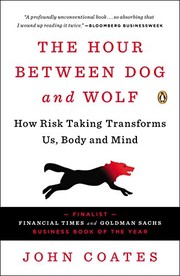
The Hour Between Dog and Wolf
How testosterone feeds traders' winning streaks and appetite for risk.
A former trader turned neuroscientist on hormones and risk-taking
Summary
Coates traded derivatives at Goldman Sachs and Deutsche Bank before returning to Cambridge to study neuroscience and endocrinology, and this book presents his research on the physiology of financial risk-taking.
His central finding comes from studies he conducted on a London trading floor, measuring traders' hormone levels against their performance. He reports that testosterone rose on days when traders made money and that raised morning testosterone predicted higher profit that day, which he attributes to the winner effect observed in animals, where winning raises testosterone and increases the propensity to take risk and win again. His argument is that this produces a feedback loop in which a sustained run of gains raises risk appetite physiologically, which is what turns a bull market into a bubble. In the reverse condition, sustained losses raise cortisol, which he reports rose sharply with market volatility, and which produces risk aversion, selective attention to threat and eventually the physiological symptoms of chronic stress.
His wider argument is that the mind-body separation assumed in economics and finance is wrong, that judgement is a physiological process, and that risk-taking is regulated by systems that evolved for physical challenge and are being applied to financial ones.
The sample sizes in the trading floor studies are small and the field of behavioural endocrinology has produced mixed replication results. The general argument that physiological state affects risk-taking is well supported; the specific hormonal mechanisms should be treated as provisional.
Key takeaways 7
- Testosterone rose on days traders made money, and raised morning testosterone predicted higher profit that day.
- A sustained run of gains raises risk appetite physiologically, which produces a feedback loop that can turn a rising market into a bubble.
- Sustained losses and market volatility raise cortisol, which produces risk aversion and selective attention to threat.
- Persistently high cortisol produces physiological symptoms and impairs judgement in ways the person experiencing it cannot perceive.
- Judgement is a physiological process rather than a purely cognitive one, which means the trader's bodily state is part of the decision.
- Risk-taking is regulated by systems that evolved for physical challenge and are being applied to financial situations they did not evolve for.
- The trading floor sample sizes are small and behavioural endocrinology replication has been mixed, so the specific mechanisms are provisional.
Who should read it
Traders, risk managers and allocators interested in the physiological basis of risk appetite, with the specific hormonal findings treated as provisional.
Who recommended it 2 · 1 direct
“John Coates, The Hour Between Dog and Wolf: Risk Taking, Gut Feelings, and the Biology of Boom and Bust (New York: The Penguin Press, 2012)”
Similar books 6
Chosen by shared topics, the entries that hold them, and the people who recommended both.
Twenty short essays on why behaviour matters more than knowledge with money.
“Example: Morgan Housel has sold 1M+ copies of "The Psychology of Money" with them (though he probably didn't need much help 😝 - if you haven't read this book yet, it's a MUST)” — Ana Fabrega
Source: Fab Fridays 96: Book Deal! - by Ana Lorena - Fab Fridays
Recommended by: Ana Fabrega, Andrew Wilkinson, Derek Sivers and 11 others
The neuroscience and psychology of investment decisions.
“Jason Zweig, Your Money and Your Brain: How the New Science of Neuroeconomics Can Help Make You Rich (New York: Simon & Schuster, 2007), 57-61” — Michael Mauboussin
Source: New Business Boom and Bust: How Capitalism Experiments, page 9
Recommended by: Michael Mauboussin, Mohnish Pabrai
The foundational papers of behavioural finance, collected.
A second collection of behavioural finance papers, more theoretical than the first.
Behavioural finance for practitioners: mental shortcuts, framing and market errors.
Data showing that low-expectation stocks beat popular ones over the long run.
“all these people really were helpful in forming and getting me involved in investing” — Joel Greenblatt
Source: Masters in Business transcript: Joel Greenblatt (2018)
Recommended by: Joel Greenblatt, Michael Mauboussin and 2 others