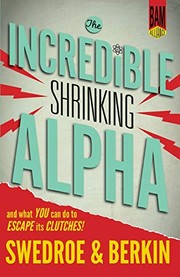
The Incredible Shrinking Alpha
Why the alpha left for active managers keeps shrinking, and where it went.
How much alpha turned out to be factor exposure sold expensively.
Summary
Larry Swedroe and Andrew Berkin argue that the pool of alpha available to active managers has shrunk continuously and will continue to, and they identify the reasons.
Their first mechanism is that academic research converts alpha into beta. When a source of excess return is identified and published, it becomes a factor that can be captured through a systematic low-cost product, and the manager who was earning it can no longer charge for it. Size, value, momentum, profitability and low volatility all followed this path. What remains as alpha shrinks each time.
The second mechanism is the paradox of skill, taken from Michael Mauboussin: as the average skill of participants rises and the dispersion of skill narrows, outcomes depend increasingly on luck. The unskilled participants who supplied the returns have left, replaced by professionals, so the remaining competition is among people of similar ability. The third is the growth of capital chasing any identified opportunity, which compresses the return. The fourth is that institutional investors have become better at identifying and firing underperforming managers, which has removed the persistent sources of easy profit.
Their conclusion is that investors should hold low-cost factor exposures rather than seeking managers. The book is short, well evidenced and consistent with the academic literature. Its authors work for a firm selling factor-based products, which readers should weigh, though the argument is standard in the field.
Key takeaways 7
- Academic identification of a return source converts it from alpha into a factor that can be bought cheaply.
- The pool of available alpha shrinks each time a source of excess return is published and productised.
- As the average skill of participants rises and its dispersion narrows, outcomes depend increasingly on luck.
- Unskilled participants who supplied the returns to skilled ones have largely left the market, leaving professionals competing with each other.
- Capital flows into any identified opportunity quickly enough to compress its return before most investors can capture it.
- Institutional investors identify and fire underperforming managers faster than they did, which removes persistent easy profits.
- The authors conclude that investors should buy factor exposures cheaply rather than paying for managers to assemble them.
Who should read it
Investors and allocators deciding between active management and systematic factor exposure who want the case that the alpha pool is structurally shrinking.
About Larry Swedroe
Head of financial and economic research, Buckingham Wealth Partners / Buckingham Strategic Wealth
Unusually prolific and reliable translator of academic factor research for practitioners, but his standing is largely inside the evidence-based advisory niche.
Similar books 6
Chosen by shared topics, the entries that hold them, and the people who recommended both.
Which return factors from academic research meet the bar for an investor's money.
The quantitative method for building active portfolios against a benchmark.
“Richard C. Grinold and Ronald N. Kahn, Active Portfolio Management: A Quantitative Approach for Producing Superior Returns and Controlling Risk, Second Edition (New York: McGraw-Hill, 2000), 480” — Michael Mauboussin
Source: The Coffee Can Approach: Why Doing Less Can Leave You with More, page 9
Recommended by: Michael Mauboussin
The evidence for passive investing over active management.
Factor investing for asset owners: factors as the nutrients inside assets.
“In his 2014 text Asset Management, for example, Columbia Professor Andrew Ang opens his chapter on mutual funds with this pungent summary.” — John C. Bogle
Source: The Road Less Traveled, page 13
Recommended by: John C. Bogle, Michael Mauboussin and 1 other
Markets pay skilled active managers; a survey of the strategies they run.
“Now another outstanding Nordic researcher (and AQR partner), Lasse Heje Pedersen, presents me with the same dilemma: His new book, Efficiently Inefficient (Princeton University Press), is fantastic — almost too good at laying out how successful professional asset managers think and act.” — Clifford Asness
Source: Efficient Inefficiency: The Oxymoron That Explains the Investing World
Recommended by: Clifford Asness, Michael Mauboussin
Portfolio sorts and cross-sectional regressions: how to test what predicts returns.