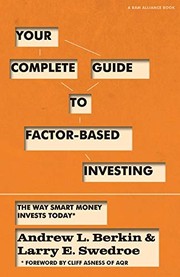
Your Complete Guide to Factor-Based Investing
Which return factors from academic research meet the bar for an investor's money.
Sets evidence bars a factor must clear before you allocate to it.
Summary
Larry Swedroe and Andrew Berkin examine the factors that academic research has identified as sources of return, and apply a set of criteria to determine which of them an investor should actually use.
Their criteria are the book's organising contribution. A factor should be persistent, meaning it appears across long periods and across economic regimes. It should be pervasive, meaning it appears across countries, across asset classes where applicable, and across sectors. It should survive changes in how it is defined and measured, so that the result does not depend on one specific construction. It should be intuitive, meaning there is a risk-based or behaviour-based explanation for why it exists and should continue. And it should be investable, meaning it survives transaction costs at realistic scale.
Applying these, they endorse market beta, size, value, momentum, profitability and quality, term and carry, while rejecting or qualifying many others from the several hundred that have been published. For each endorsed factor they present the evidence, the explanations offered, the implementation considerations and the periods of underperformance an investor must survive. They are direct that every factor has produced long stretches of poor relative performance, and that this is why the premia persist. The book is clear, well evidenced and honest about what it does not know. Its authors work at a firm selling factor-based products, which readers should weigh, though the criteria are stricter than commercial interest would suggest.
Key takeaways 7
- A usable factor must be persistent across periods, pervasive across markets, insensitive to definition, intuitively explicable and investable after costs.
- Applying these criteria eliminates most of the several hundred factors that have been published in the academic literature.
- Every endorsed factor has produced long stretches of underperformance, which is why the premia have not been arbitraged away.
- A factor without a risk-based or behavioural explanation is likely to be a data mining artefact regardless of its historical record.
- Implementation costs eliminate several factors whose paper returns look attractive, particularly those requiring high turnover.
- Combining factors with low correlation to each other reduces the length of the underperformance periods an investor must survive.
- The authors work at a firm selling factor products, though the criteria they apply are stricter than commercial interest would suggest.
Who should read it
Investors building systematic portfolios who need a filter for distinguishing genuine return factors from published statistical artefacts.
About Larry Swedroe
Head of financial and economic research, Buckingham Wealth Partners / Buckingham Strategic Wealth
Unusually prolific and reliable translator of academic factor research for practitioners, but his standing is largely inside the evidence-based advisory niche.
Similar books 6
Chosen by shared topics, the entries that hold them, and the people who recommended both.
Why the alpha left for active managers keeps shrinking, and where it went.
The quantitative method for building active portfolios against a benchmark.
“Richard C. Grinold and Ronald N. Kahn, Active Portfolio Management: A Quantitative Approach for Producing Superior Returns and Controlling Risk, Second Edition (New York: McGraw-Hill, 2000), 480” — Michael Mauboussin
Source: The Coffee Can Approach: Why Doing Less Can Leave You with More, page 9
Recommended by: Michael Mauboussin
The evidence for passive investing over active management.
Factor investing for asset owners: factors as the nutrients inside assets.
“In his 2014 text Asset Management, for example, Columbia Professor Andrew Ang opens his chapter on mutual funds with this pungent summary.” — John C. Bogle
Source: The Road Less Traveled, page 13
Recommended by: John C. Bogle, Michael Mauboussin and 1 other
Markets pay skilled active managers; a survey of the strategies they run.
“Now another outstanding Nordic researcher (and AQR partner), Lasse Heje Pedersen, presents me with the same dilemma: His new book, Efficiently Inefficient (Princeton University Press), is fantastic — almost too good at laying out how successful professional asset managers think and act.” — Clifford Asness
Source: Efficient Inefficiency: The Oxymoron That Explains the Investing World
Recommended by: Clifford Asness, Michael Mauboussin
Portfolio sorts and cross-sectional regressions: how to test what predicts returns.