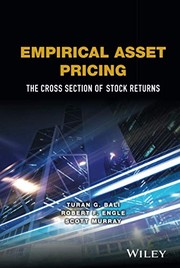
Empirical Asset Pricing
Portfolio sorts and cross-sectional regressions: how to test what predicts returns.
The cross-sectional testing methods behind every factor claim.
Summary
Bali, Engle and Murray wrote this as a methods textbook for empirical asset pricing, teaching the techniques used to test whether a variable predicts stock returns.
The two central methods are portfolio sorts and cross-sectional regression. Portfolio sorts group stocks by a variable, form portfolios, and compare returns across them, with the difference between the extreme portfolios being the test statistic. The authors work through univariate sorts, bivariate sorts that control for a second variable, and the choice between equal and value weighting, which frequently changes the result because small stocks drive many documented effects. Fama-MacBeth regression estimates the relationship cross-sectionally in each period and then averages the coefficients over time, which handles the correlation structure that pooled regression does not.
The book applies these methods to the main documented effects: beta and its failure to predict returns, size, value, momentum, reversal, illiquidity, idiosyncratic volatility and skewness. For each it presents the full empirical procedure with the actual data, so the reader sees the results rather than being told them.
The methodological warnings are the most valuable content. The authors are explicit about the choices that affect results: the sample period, whether financial firms and small stocks are included, the weighting scheme, the treatment of delisting returns, the standard error adjustments required for correlated residuals, and the fact that hundreds of published factors are tested on the same data, which guarantees that many findings are selection artefacts.
The book is technical and requires econometrics. It teaches how to do the work rather than arguing about what the results mean, which makes it useful for anyone who needs to evaluate factor research rather than take it on faith.
Key takeaways 7
- Portfolio sorts and Fama-MacBeth regressions are the two standard methods for testing whether a variable predicts returns.
- Equal weighting and value weighting frequently give different answers, because small stocks drive many documented effects.
- Fama-MacBeth estimation handles the correlation structure across stocks that pooled regression does not.
- Beta does not predict returns in the cross-section, which contradicts the capital asset pricing model directly.
- Sample period, inclusion rules, weighting and delisting return treatment all change results, so published findings depend on choices that are rarely stated.
- Hundreds of factors have been tested on the same data, which guarantees that a substantial share of published findings are selection artefacts.
- Standard errors must be adjusted for correlated residuals, or significance is overstated.
Who should read it
Quantitative researchers and investors who need to run or to evaluate factor research rather than accept published findings.
Similar books 6
Chosen by shared topics, the entries that hold them, and the people who recommended both.
Markets pay skilled active managers; a survey of the strategies they run.
“Now another outstanding Nordic researcher (and AQR partner), Lasse Heje Pedersen, presents me with the same dilemma: His new book, Efficiently Inefficient (Princeton University Press), is fantastic — almost too good at laying out how successful professional asset managers think and act.” — Clifford Asness
Source: Efficient Inefficiency: The Oxymoron That Explains the Investing World
Recommended by: Clifford Asness, Michael Mauboussin
Research papers showing that stock prices do not follow a random walk.
“Andrew W. Lo and A. Craig MacKinlay, A Non-Random Walk Down Wall Street (Princeton, NJ: Princeton University Press, 1999), 4-5” — Michael Mauboussin
Source: Capital Ideas Revisited - Part 2: Thoughts on Beating a Mostly-Efficient Stock Market, page 9
Recommended by: Michael Mauboussin
The statistical tools of empirical finance and the questions they test.
“Campbell, John Y., Andrew W. Lo, and A. Craig MacKinley, The Econometrics of Financial Markets (Princeton, NJ: Princeton University Press, 1996)” — Michael Mauboussin
Source: Capital Ideas Revisited: The Prime Directive, Sharks, and The Wisdom of Crowds, page 16
Recommended by: Michael Mauboussin, William J. Bernstein
How physicists and mathematicians brought their models into finance.
“But such oversimplification can—and did—create a flawed conclusion.3 2 I am indebted to James Owen Wetherall, physicist, philosopher, and mathematician at the University of California for telling Bachelier’s story in his book, “The Physics of Wall Street, A Brief History of Predicting the Unpredictable” (Houghton Mifflin Harcourt, 2015).” — John C. Bogle
Source: David and Goliath: Who Wins the Quantitative Battle?, page 8
Recommended by: John C. Bogle, Eric Weinstein
Decades of US stock data testing which selection rules have beaten the market.
“Strongly Recommended. Great data.” — Mohnish Pabrai
Source: Mohnish's Bookshelf — Books on Investing & Capital Allocation, entry 336
Recommended by: Mohnish Pabrai, Patrick O'Shaughnessy and 2 others
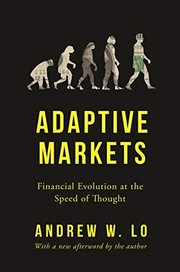
The adaptive markets hypothesis, joining efficient markets and behavioural finance.
“Lo, Andrew W., Adaptive Markets: Financial Evolution at the Speed of Thought (Princeton, NJ: Princeton University Press, 2017)” — Michael Mauboussin
Source: Who Is On the Other Side? You Need Good BAIT to Land a Winner, page 40
Recommended by: Michael Mauboussin