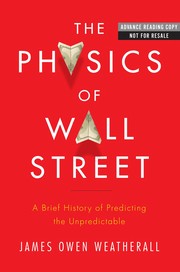
The Physics of Wall Street: A Brief History of Predicting the Unpredictable
How physicists and mathematicians brought their models into finance.
How physicists and mathematicians came to run money; useful context for Simons.
Summary
Weatherall, a philosopher of physics, traces the movement of physical and mathematical ideas into finance through a series of biographical chapters. He starts with Louis Bachelier's 1900 thesis modelling prices as random walks, then covers Maury Osborne applying statistical mechanics to log returns, Benoit Mandelbrot arguing that price changes follow fat-tailed distributions rather than normal ones, Ed Thorp moving from blackjack to convertible arbitrage, Fischer Black and the option pricing formula, Doyne Farmer and Norman Packard's Prediction Company, and Didier Sornette's work on log-periodic precursors to crashes.
The argument the book makes is a defence. Weatherall holds that mathematical models did not cause the 2008 crisis, and that the failures came from using models outside their stated assumptions, from institutional incentives, and from ignoring what the modellers themselves said about limits. He points out that Mandelbrot and Black both wrote explicitly about when their models would fail. His constructive proposal is that economics needs the physicist habit of treating a model as an approximation valid in a specified regime, and he ends by calling for a large coordinated research effort.
The history is accurate and readable and the biographical detail is good, particularly on Bachelier's neglect and on Thorp.
The defence of the modellers is contested. Critics including Mandelbrot's own followers and Nassim Taleb argue that the problem is not misuse but that Gaussian-based risk models are structurally wrong for financial data, and that the profession's continued reliance on value at risk demonstrates it. The book also gives little space to the political economy of why banks preferred models that understated risk.
Key takeaways 7
- Bachelier described the random walk model of prices in 1900, five years before Einstein's treatment of Brownian motion, and was ignored for half a century.
- Price changes have fat tails, so extreme moves occur far more often than a normal distribution predicts.
- Mandelbrot published this finding in the early 1960s and the industry adopted Gaussian models anyway.
- Ed Thorp used option pricing and delta hedging in practice before Black and Scholes published the formula.
- Black and Scholes stated the conditions under which their model fails, and practitioners ignored those conditions.
- The 2008 failures came from applying models outside their domain of validity rather than from the mathematics itself.
- Economics would improve by adopting the physicist's discipline of specifying the regime in which a model is expected to hold.
Who should read it
Investors and technologists who want the intellectual history of quantitative finance and a clear statement of what the models assume.
Who recommended it 2 · 1 direct
“But such oversimplification can—and did—create a flawed conclusion.3 2 I am indebted to James Owen Wetherall, physicist, philosopher, and mathematician at the University of California for telling Bachelier’s story in his book, “The Physics of Wall Street, A Brief History of Predicting the Unpredictable” (Houghton Mifflin Harcourt, 2015).”
Similar books 6
Chosen by shared topics, the entries that hold them, and the people who recommended both.

Research papers showing that stock prices do not follow a random walk.
“Andrew W. Lo and A. Craig MacKinlay, A Non-Random Walk Down Wall Street (Princeton, NJ: Princeton University Press, 1999), 4-5” — Michael Mauboussin
Source: Capital Ideas Revisited - Part 2: Thoughts on Beating a Mostly-Efficient Stock Market, page 9
Recommended by: Michael Mauboussin
Portfolio sorts and cross-sectional regressions: how to test what predicts returns.
The statistical tools of empirical finance and the questions they test.
“Campbell, John Y., Andrew W. Lo, and A. Craig MacKinley, The Econometrics of Financial Markets (Princeton, NJ: Princeton University Press, 1996)” — Michael Mauboussin
Source: Capital Ideas Revisited: The Prime Directive, Sharks, and The Wisdom of Crowds, page 16
Recommended by: Michael Mauboussin, William J. Bernstein
The Kelly criterion for sizing bets, from Bell Labs to casinos and hedge funds.
“For a less technical discussion, see William Poundstone, Fortune’s Formula: The Untold Story of the Scientific Betting System that Beat the Casinos and Wall Street (New York: Hill and Wang, 2005), 197-201” — Michael Mauboussin
Source: Thoughts on Dividends and Buybacks: Clearing Up Some Common Misconceptions, page 10
Recommended by: Michael Mauboussin, Mohnish Pabrai

How Markowitz, Sharpe, Fama, Black and Scholes built the theory of modern finance.
“But it was in his Capital Ideas, published in 1992, that I first learned of Louis Bachelier’s 1900 dissertation, The Theory of Speculation.” — John C. Bogle
Source: Success In Investment Management: What Can We Learn From Indexing?, page 1
Recommended by: John C. Bogle, Michael Mauboussin

How economics copied the maths of 19th-century physics, and what that cost it.
“Mirowski, Philip, More Heat than Light: Economics as Social Physics, Physics as Nature’s Economics (Cambridge: Cambridge University Press, 1989)” — Michael Mauboussin
Source: Size Matters: The Kelly Criterion and the Importance of Money Management, page 12
Recommended by: Michael Mauboussin, Eric Weinstein