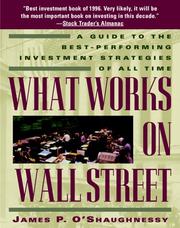
What Works on Wall Street
Decades of US stock data testing which selection rules have beaten the market.
The long-run backtests that put numbers on the size and value effects.
Summary
O'Shaughnessy tests investment strategies systematically against long-run United States equity data, running each selection criterion as a rules-based portfolio over decades and reporting the results with drawdowns and consistency measures alongside returns.
The method is the contribution. Rather than arguing for a strategy, he specifies each one precisely, applies it mechanically to the full data set, and reports how it performed including the worst periods. This allows direct comparison between value measures, growth measures, momentum, size effects and combinations.
His principal findings across editions include that low price to sales was among the most effective single value measures; that price to earnings and price to book also worked but less consistently; that high dividend yield worked for large companies; that pure growth measures without a value constraint performed poorly; that momentum measured over three to twelve months added return and combined well with value; that combining several value factors into a composite outperformed any single one; that small companies produced higher returns partly through illiquidity that cannot be captured at scale; and that the strategies underperform for periods of several years, which is what prevents most investors from using them.
His general argument is that discipline in applying any reasonable strategy beats discretion, because human judgment introduces the behavioural errors that the strategy exists to avoid. The backtests carry the standard problems including survivorship in the underlying data, transaction costs, taxes and the capacity limits of small-company strategies. Value and small-company factors have performed poorly across an extended recent period. The methodology of testing strategies with full disclosure of drawdowns remains the book's most valuable feature.
Key takeaways 8
- Investment strategies can be specified precisely and tested mechanically across decades, which permits direct comparison rather than argument.
- Composite value measures combining several factors outperformed any single value measure consistently.
- Low price to sales was among the most effective single value criteria across the full data period.
- Growth measures applied without any valuation constraint performed poorly, since paying any price for growth removes the return.
- Momentum measured over three to twelve months added return and combined well with value measures.
- Small company returns partly reflect illiquidity that cannot be captured at scale, which limits the practical application.
- Every effective strategy underperformed for periods of several years, which is what prevents investors from holding it.
- Discipline in applying a reasonable strategy beats discretion, because judgment introduces the errors the strategy exists to prevent.
Who should read it
Quantitative and systematic investors who want strategies tested with full disclosure of drawdowns rather than argued for.
About James P. O'Shaughnessy
Founder of O'Shaughnessy Asset Management and of O'Shaughnessy Ventures; hosts the Infinite Loops podcast.
What Works on Wall Street tested valuation, growth, momentum and quality factors against decades of Compustat data and published the return series for each, which set the expectation that a strategy is argued from out-of-sample evidence rather than from reasoning alone. The composite value and shareholder-yield screens it describes became standard practice in quantitative equity.
Who recommended it 4 · 3 direct
“Strongly Recommended. Great data.”
“O'Shaughnessy published What Works on Wall Street, which rapidly became an investment bestseller and classic.”
Similar books 6
Chosen by shared topics, the entries that hold them, and the people who recommended both.
Portfolio sorts and cross-sectional regressions: how to test what predicts returns.
How individual investors can use what they know to find stocks before professionals.
“In November 1992, after juggling with all sorts of investing approaches, I read “One Up on Wall Street” by Peter Lynch.” — Francois Rochon
Source: Giverny Capital Annual Letter to Partners 2011, page 6
Recommended by: David Rolfe, Francisco Garcia Parames and 10 others
What stocks that rose a hundredfold had in common, and how to find them.
Recommended by: Mohnish Pabrai
Factor investing for asset owners: factors as the nutrients inside assets.
“In his 2014 text Asset Management, for example, Columbia Professor Andrew Ang opens his chapter on mutual funds with this pungent summary.” — John C. Bogle
Source: The Road Less Traveled, page 13
Recommended by: John C. Bogle, Michael Mauboussin and 1 other
Why large growth stocks would lag for twenty years, and what to hold instead.
Recommended by: Mohnish Pabrai
Data and stock ratings for the 600 small-cap companies of the S&P SmallCap 600 index.
Recommended by: Mohnish Pabrai