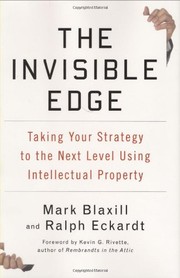
The Invisible Edge
How to make intellectual property a source of competitive advantage.
IP as competitive strategy rather than legal housekeeping.
Summary
Mark Blaxill and Ralph Eckardt, both consultants in intellectual property strategy, argue that competitive advantage in the modern economy rests on intellectual property and that most executives treat it as a legal matter rather than as a strategic one.
Their historical material traces intellectual property conflicts across industries, including the sewing machine patent war and the resulting patent pool, the Wright brothers' litigation and its effect on American aviation, the semiconductor cross-licensing arrangements, and the pharmaceutical industry's dependence on patent exclusivity. They use these to argue that the outcome of industrial competition has repeatedly been determined by who held and enforced rights rather than by who built better products.
The strategic prescriptions concern treating the portfolio as an asset to be managed: mapping what the company owns against what it needs, identifying gaps before competitors do, deciding deliberately between exclusion and licensing, and building rights around a competitor's position. They also argue for aggressive enforcement and for treating litigation as a business decision rather than a legal one. The book appeared in 2009, and the subsequent changes in American patent law, including the America Invents Act, the Alice decision on software patentability and the eBay decision limiting injunctions, have substantially weakened the enforcement leverage the authors assume. Bessen and Meurer's empirical work also challenges the general claim that patents create value outside specific industries.
Key takeaways 7
- Competitive outcomes in several major industries were determined by who held and enforced intellectual property rather than by product quality.
- Executives treat intellectual property as a legal matter, which means the portfolio is managed for defence rather than for advantage.
- Mapping what a company owns against what it needs reveals gaps that competitors can exploit before the company notices them.
- The decision between excluding competitors and licensing to them is a strategic choice with different economics, not a default.
- Building rights around a competitor's core position limits the practical value of that position.
- Later changes in American patent law weakened the enforcement leverage the authors assume throughout.
- Empirical work by Bessen and Meurer finds that patent litigation costs exceed patent profits outside specific industries.
Who should read it
Executives with significant intellectual property who want the strategic case for managing it actively, read against the later legal changes and empirical challenges.
Similar books 6
Chosen by shared topics, the entries that hold them, and the people who recommended both.

Treat patents as financial and strategic assets, not legal defences.
Why social tools should be the backbone of a business model, not just its media.
Recommended by: Kathryn Minshew

Forecasts of how information technology and biotechnology will change business.
Recommended by: Mohnish Pabrai
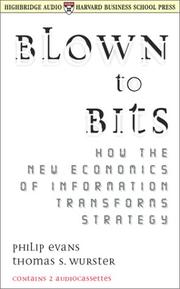
How the new economics of information ends the trade-off between richness and reach.
“Evans, Philip, and Thomas S. Wurster, Blown to Bits: How the New Economics of Information Transforms Strategy (Boston: Harvard Business School Press, 1999)” — Michael Mauboussin
Source: Measuring the Moat: Assessing the Magnitude and Sustainability of Value Creation, page 48
Recommended by: Michael Mauboussin, Mohnish Pabrai
How technology can run businesses better and change the nature of business.
Recommended by: Mohnish Pabrai

Mathematical models of when renting cloud computing beats owning capacity.