The Kelly Capital Growth Investment Criterion
The key papers on the Kelly criterion for sizing bets, for and against.
Edited volume of collected papers.
Summary
MacLean, Thorp and Ziemba edited a collection of the key papers on the Kelly criterion, from Kelly's original 1956 information theory paper through Breiman, Latane, Samuelson's objections, Thorp's applications to blackjack and to markets, and later work on fractional Kelly and on practical implementation.
The criterion itself specifies the fraction of capital to bet in order to maximise the long-run growth rate of wealth. Its properties are strong: it asymptotically maximises the rate of capital growth, it minimises the expected time to reach a given wealth level, and no other strategy can outperform it over sufficiently long horizons. It also never risks total loss, since the prescribed bet is always a fraction of capital.
The objections are equally substantive and the volume includes them. Samuelson argued repeatedly and forcefully that maximising expected logarithmic utility is a particular utility choice and not a normative requirement, and that an investor with different preferences should not use it. The practical objection is that Kelly betting produces very large drawdowns which few investors or their clients can tolerate, and that the criterion is extremely sensitive to estimation error in the probabilities, which in markets are never known. This is why practitioners use fractional Kelly, typically half or less.
The collection is technical and assumes probability and utility theory. It is the reference source rather than an introduction. Readers wanting a practical treatment should start with Poundstone's Fortune's Formula or Thorp's own memoir.
Key takeaways 7
- The Kelly criterion specifies the bet size that maximises the long-run growth rate of capital, and no other strategy outperforms it over sufficiently long horizons.
- Kelly betting never risks total loss because the prescribed stake is always a fraction of current capital, which makes ruin impossible in principle.
- The criterion is extremely sensitive to estimation error in the probabilities, and in markets those probabilities are never known.
- Overbetting relative to Kelly reduces the growth rate and increases risk simultaneously, which makes errors in one direction far worse than the other.
- Kelly betting produces drawdowns most investors and their clients cannot tolerate, which is why practitioners use a fraction of the full Kelly stake.
- Maximising expected logarithmic utility is a specific preference assumption rather than a normative requirement, which is Samuelson's objection and it stands.
- Bet size should scale with the size of the edge relative to the odds, which means a small edge at long odds justifies only a very small stake.
Who should read it
Quantitative investors and traders who want the primary sources on growth-optimal bet sizing and the substantive objections to it.
About Edward O. Thorp
Mathematician; founder, Princeton/Newport Partners 1969-1988 and Ridgeline Partners 1994-2002
Turned the Kelly criterion and warrant-pricing math into the first quantitative hedge fund, and his books are primary sources for both card counting and convertible arbitrage.
Who recommended it 2 · 1 direct
“Leonard C. MacLean, Edward O. Thorp, and William T. Ziemba, eds., The Kelly Capital Growth Investment Criterion: Theory and Practice (Hackensack, NJ: World Scientific, 2011), 823”
Similar books 6
Chosen by shared topics, the entries that hold them, and the people who recommended both.
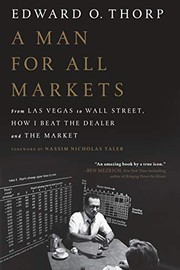
From beating blackjack with maths to pricing warrants and running a hedge fund.
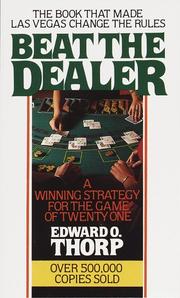
The first proven way to beat blackjack, by counting the cards left in the deck.
“Many years ago, Ed Thorp, an MIT professor of mathematics, literally “wrote the book” on blackjack. It’s called “Beat the Dealer.” — Howard Marks
Source: A Case in Point, page 1
Recommended by: Howard Marks, Michael Mauboussin
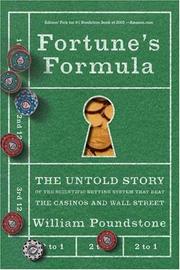
The Kelly criterion for sizing bets, from Bell Labs to casinos and hedge funds.
“For a less technical discussion, see William Poundstone, Fortune’s Formula: The Untold Story of the Scientific Betting System that Beat the Casinos and Wall Street (New York: Hill and Wang, 2005), 197-201” — Michael Mauboussin
Source: Thoughts on Dividends and Buybacks: Clearing Up Some Common Misconceptions, page 10
Recommended by: Michael Mauboussin, Mohnish Pabrai
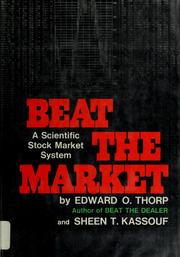
A method to price warrants and convertibles and hedge them against the stock.
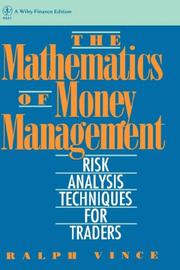
Optimal f and the mathematics of sizing positions and bets.
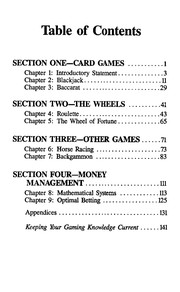
The mathematics of baccarat, backgammon, blackjack and other games of chance.
“In his book, The Mathematics of Gambling, Thorp explains the Kelly system’s attractive features:12 1.” — Michael Mauboussin
Source: Size Matters: The Kelly Criterion and the Importance of Money Management, page 4
Recommended by: Michael Mauboussin