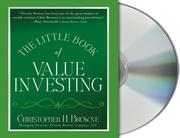
The Little Book of Value Investing
Tweedy Browne's distilled version of the Graham method.
Summary
Christopher Browne ran Tweedy Browne, the firm that had been Benjamin Graham's broker and later became a value manager with a long record. This short book states the value approach for a general reader.
The method is Graham's, updated. Browne argues for buying stocks trading below intrinsic value estimated conservatively, with a preference for low price to book, low price to earnings and high dividend yield, and for holding a diversified portfolio rather than concentrating. He is explicit that the approach is uncomfortable by construction, since the stocks that meet the criteria are ones with visible problems and recent bad news, and that the discomfort is what produces the return. He covers international value investing, which Tweedy Browne pioneered, arguing the same criteria work in every market they have tested. He also covers the firm's research on insider buying and on company share repurchases as confirming signals.
Browne includes Tweedy Browne's own study, What Has Worked in Investing, which assembled the empirical evidence for value criteria across markets and periods. That evidence is the book's foundation and is stronger than the anecdotal argument.
The book is short and readable, and it is a reasonable entry point. It says nothing that Graham did not say and does not engage with the challenges to value investing from intangible-heavy business models, from accounting that treats value-creating investment as expense, or from the long underperformance of price-to-book screens since publication. Readers should take the criteria as a starting point rather than as a complete method.
Key takeaways 7
- Buying securities below a conservatively estimated intrinsic value produces excess returns, and the evidence for this holds across markets and periods.
- The stocks that meet value criteria are uncomfortable to own because they carry visible bad news, and that discomfort is the source of the return.
- Diversification across a reasonable number of cheap securities works better for most investors than concentration, because any individual estimate can be wrong.
- Value criteria that work in the United States also work in international markets, and Tweedy Browne's international results support this.
- Insider purchases and corporate share repurchases at low prices are confirming signals that the people with the most information agree with the valuation.
- An investor must be willing to hold a position for years, because the market's recognition of value has no schedule.
- Selling should be governed by the security reaching its estimated value, not by price movement or by the passage of time.
Who should read it
Individual investors who want a short, credible statement of classic value criteria from a practitioner with a long record.
About Christopher Browne
Managing Director and General Partner, Tweedy, Browne Company (1969-2009)
Ran the firm that broked Benjamin Graham's own trades; his one book distils that lineage, and the Tweedy Browne research he oversaw is cited more widely than the book itself.
Who recommended it 2 · 2 direct
“Forget Wall Street. It's a promotion machine. Forget almost all books on investing. They won't help you. But this book will. Chris Browne makes sense.”
Similar books 6
Chosen by shared topics, the entries that hold them, and the people who recommended both.
Treat stocks as parts of businesses and buy only with a margin of safety.
“I have been accused of telling all my secrets. I have written a number of books, and I reveal them all in these books.” — Benjamin Graham
Source: Graham on revealing everything he knows in his books
Recommended by: Benjamin Graham, Christopher Bloomstran and 27 others
Updates Graham and Dodd's valuation method for modern financial statements
Recommended by: Mohnish Pabrai
A fund manager of sixty years on investing, business and a long life.
Recommended by: Mohnish Pabrai
Stock prices follow a random walk, so a low-cost index fund beats stock picking.
Recommended by: Nat Eliason, Mohnish Pabrai
Recommended by: Mohnish Pabrai
Recommended by: Mohnish Pabrai
Where it sits in the reference 2
Topics