
Updates

  1. Person pages list letters, writing, profiles and links as sortable tables with filters, and show each person's companies as links; Fund letters show each letter's description in its own column.
  2. Experts show a checked job title and a short description of each person; 30 more people have photographs.
  3. Every company, fund, university and publication the experts work for has a page listing the people there.
  4. Fund letters show each letter's thesis and filter by it; 225 person pages list the essays, columns and newsletter issues the person wrote.
  5. Person pages list every essay and newsletter issue a person wrote, and their own books as a table in List view.
  6. Recommends shows the five largest kinds of book and the rest under More; browse pictures load sooner.
  7. Podcasts and talks link the original episode, filter by Audio and video or Press, and list each publisher once.
  8. Pages are wider, Recommends has List and Grid, and a filter clicked again turns off.
  9. Book cards sit in a ruled grid with Open Library and Goodreads links and each book's one-line note.
  10. Funds is now Investors; each investor's styles are buttons that filter the table.
  11. Podcasts and talks on a person's page filter by year and publisher and show as a list or a grid of pictures.
  12. Quotes show only people's own words: 472 summaries written by list sites are gone.
  13. Country pages open from Browse again, and every link on the shelf lands on a page.
  14. Subject and person pages show their sections as tabs, and each book appears once on a person's page.
  15. Book cards show the quote, who said it and the source; grids show five cards to a row.
  16. On a phone, a menu holds the sections, search, Updates, Feedback and dark mode.
  17. Feedback takes a screenshot of the page with no browser prompt, opens a screenshot full size when you click it, and clears itself once sent.
  18. Book cards are centred, search names the topic each book sits in, and any text cut short shows whole on hover.
  19. Search groups its results by kind: people, companies, geographies, subjects, topics, books, funds, fund letters and papers.
  20. The Books table lists who recommended each book by name, and the browser tab names the section you are in.
  21. Feedback can take a screenshot of the page, or one you paste or choose, and opens in the corner beside Updates.
  22. Each rail button reopens its section where you left it, and Browse, Table and People show on every book and subject page.
  23. Filters grey out choices that hold nothing instead of hiding them, and Books › People filters by authors or recommenders.
  24. Feedback takes a subject line and up to three screenshots.
  25. Biographies are grouped by the person they are about: 41 new pages, from Abraham Lincoln to Lee Kuan Yew.
  26. Sport splits into 23 sports, and Religion into one topic per faith.
  27. Book lists show as cards: the cover, one recommendation quote and every recommender by name.
  28. Seventeen subjects that had two or three pages under different names now have one page each.
  29. Every page lists its Experts as authors and recommenders, with a link to them on the Experts tab.
  30. Economics, Financial history, Financial panics and Accounting are subjects of their own, with one page per financial crisis.
  31. Book, person and subject pages open inside the app, so the tabs stay in view.
  32. 996 more book covers, and photographs or logos for 227 more people and companies.
  33. Books › Browse shows every subject as cards, and the rail holds Fund letters, Papers, Experts, Books and Funds.
  34. Every topic over 150 books splits into narrower topics, each with a page of its own.

Send feedback

What is it?
Screenshots, up to 3 (optional)
or paste one with Ctrl+V

We use your email only to reply to you.

The Macroeconomics of Populism in Latin Amer

The Macroeconomics of Populism in Latin America

Rudiger Dornbusch, Sebastian Edwards
1991
T2 402 pages · about 6h 42m to read Open Librarygoodreads

The four-phase populist cycle; still the best predictive framework for the region.

Summary

Rudiger Dornbusch and Sebastian Edwards edited this volume, and their own introductory essay defining macroeconomic populism has been more influential than any of the case studies.

Their definition is specific and not about political style. Macroeconomic populism is an approach that emphasises growth and income redistribution while deemphasising the risks of inflation, deficit finance, external constraints and the reaction of economic agents to aggressive non-market policies. They set out a four-phase cycle. In the first, the programme works: output and real wages rise, and the initial results appear to vindicate the critics of orthodox policy. In the second, bottlenecks appear, inventories are exhausted, imports rise and the current account deteriorates while price controls suppress the signals. In the third, shortages, inflation acceleration and capital flight force devaluation and fiscal correction; real wages collapse. In the fourth, a new orthodox government stabilises, typically under International Monetary Fund supervision, and real wages end below where they began.

The case studies apply this to Chile under Allende, Peru under Garcia, Argentina under multiple governments, Brazil, Mexico and Nicaragua. The framework has been criticised for lumping distinct political programmes together, for treating the outcomes as inevitable rather than as consequences of specific choices, and for its use to discredit redistribution generally. It has also been applied successfully to subsequent episodes including Venezuela. The introductory essay is the essential reading.

Key takeaways 7

  1. Macroeconomic populism emphasises growth and redistribution while dismissing inflation, deficits and external constraints as secondary.
  2. The programme's first phase works, which is what makes the approach politically attractive and analytically dangerous.
  3. Bottlenecks and current account deterioration appear in the second phase while price controls suppress the signals that would reveal them.
  4. The third phase brings shortages, capital flight, forced devaluation and a collapse in real wages.
  5. Workers end the cycle with real wages below where they started, which is the outcome the programme was designed to prevent.
  6. The authors argue that the cycle recurs because each generation of policymakers treats the previous failure as a special case.
  7. Critics argue the framework lumps distinct political programmes together and treats specific policy choices as inevitable.

Who should read it

Investors in emerging markets who want the analytical template for recognising a policy programme that will end in currency and inflation crisis.

Similar books 6

Chosen by shared topics, the entries that hold them, and the people who recommended both.
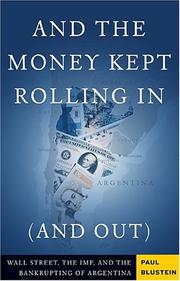
Paul Blustein · 2005

How Argentina and the IMF headed toward the 2001 default and devaluation.

Michael Mussa · 2002

The IMF's own former chief economist on the Fund's failures in Argentina.

Domingo Cavallo, Sonia Cavallo Runde · 2017

Insider: the economy minister who built convertibility defending the record.

Joseph Collins, John Lear · 1995

The critical case; distributional costs behind the headline growth numbers.

Javier Martínez, Alvaro Díaz · 1996

How the productive structure and business class were remade after 1973.

Sebastian Edwards · 1995

Latin America's reforms from the 1980s debt crisis to the mid-1990s, assessed.

Where it sits in the reference 2

Geographies
Economics

Topics

EconomicsPolitics and Government