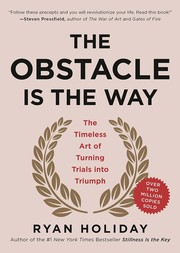
The Obstacle Is the Way
Stoic lessons on turning obstacles into a path, through perception, action and will.
Summary
Holiday builds a book around a line from Marcus Aurelius, that what stands in the way becomes the way, and organises it into three parts corresponding to the Stoic division of perception, action and will. Perception covers how a person interprets a situation, action covers what they do about it, and will covers what they endure when nothing can be done.
The perception section argues for controlling the emotional response before assessing the facts, for recognising that the label placed on an event determines the response to it, and for practising objectivity by describing situations without evaluative language. The action section argues for persistence, for starting with what is immediately in front of you, for iteration over planning, and for using an opponent's strength against them where direct confrontation would fail. The will section covers acceptance of what cannot be changed, preparation for setbacks through negative visualisation, and the argument that a person can always choose to persist.
The historical cases include John D Rockefeller during the 1857 panic, Ulysses Grant, Amelia Earhart, Rubin Carter, Thomas Edison and Theodore Roosevelt, each used briefly to illustrate a principle.
The book contains no research and the cases are simplified to fit. Holiday moves quickly and repeats himself across his books. The argument that obstacles are opportunities can encourage a reading in which genuine harm is reframed as benefit, and Holiday does not distinguish carefully between situations where the framing helps and situations where it obscures a real problem. As a compressed and readable statement of applied Stoicism for a working audience, it does its job.
Key takeaways 8
- The interpretation placed on an event, rather than the event itself, determines what response is available.
- Emotional reaction should be controlled before assessment begins, because the reaction determines what facts a person is able to see.
- Objectivity can be practised by describing a situation without evaluative language, which removes the amplification that emotion adds.
- Action should begin with whatever is immediately in front of you rather than with a complete plan for the whole problem.
- Persistence through repeated failure is the mechanism that produces results, and most people stop while the process is still working.
- Where direct confrontation would fail, the obstacle's own force can be used, which requires giving up the intention to overcome it head-on.
- Preparing in advance for setbacks removes their power to disrupt, because the response has already been decided.
- Some situations cannot be changed and the only available choice is the manner of enduring them, which the Stoics treat as sufficient.
Who should read it
Operators facing a specific setback who want a compressed and readable application of Stoic practice rather than the primary texts.
About Ryan Holiday
Author and media strategist; former director of marketing at American Apparel and owner of the Painted Porch bookshop in Texas.
The Obstacle Is the Way and Ego Is the Enemy convert Stoic practice - separating what is controllable from what is not, treating recognition as a threat to judgment - into working habits for people running companies, which is why the books circulate so widely among founders. Trust Me, I'm Lying and Growth Hacker Marketing document how online media incentives can be manipulated, written by someone who did it professionally.
Who recommended it 7 · 3 direct
“A succinct adrenaline-generating call to clear thinking and rational action. Many historical examples. Incredibly inspiring.”
Similar books 6
Chosen by shared topics, the entries that hold them, and the people who recommended both.
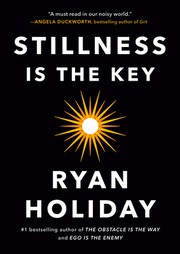
How stillness helps leaders and artists control temper and avoid distraction.
“If even one chapter in each section strikes a chord with you, I encourage you to grab a copy of Stillness Is The Key.” — Brad Feld
Source: Book: Stillness Is The Key — Feld Thoughts
Recommended by: Brad Feld, Cal Newport, Derek Sivers and 1 other
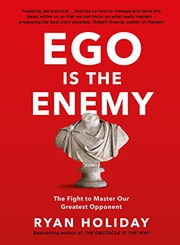
How ego harms a person in aspiration, success and failure, and how to check it.
“Forget yourself and focus on the work. Be humble and persistent. Value discipline and results, not passion and confidence. Be lesser, do more. This message is crucial, but the opposite of almost every other book. I wish everyone would read this. I need to re-read it each year. It's that important. It's easy to read this and say “oh yeah I've got my ego under control”, but the problem is deeper than that.” — Derek Sivers
Source: Derek Sivers book notes (primary, rated list) · Rating: 9/10
Recommended by: Andrew Wilkinson, David Cancel, Derek Sivers and 5 others
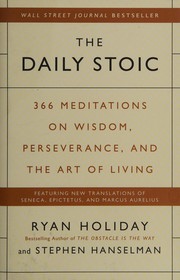
Stoic wisdom for living a better life, not for the classroom.
“As I was reading The Daily Stoic I found many ideas that spoke to me. I’ve known Ryan from a distance for a while. We ended up at a dinner together at either SXSW or CES a number of years together and I remember an interesting and engaged conversation.” — Brad Feld
Recommended by: Brad Feld, Derek Sivers, Alex Lieberman and 1 other
A short New Thought essay on how a person's thinking shapes their life.
Recommended by: Nat Eliason, Tim Ferriss, Tony Robbins
Short pieces of advice on living, goals, generosity, careers, family and money.
“Tiny sentences with deep wisdom unelaborated. Up to you to extract, reflect, and apply.” — Derek Sivers
Source: Derek Sivers book notes (primary, rated list) · Rating: 6/10
Recommended by: Andrew Wilkinson, Derek Sivers and 1 other
Life in Nazi concentration camps, and logotherapy: finding meaning to survive.
“What's more certain to me is that we all need a why, as Viktor Frankl told us in Man's Search for Meaning.” — David Heinemeier Hansson
Source: Universal Basic Dead End
Recommended by: David Heinemeier Hansson, David Perell and 29 others