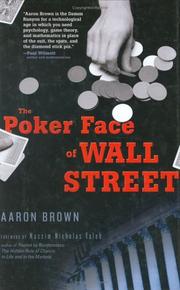
The Poker Face of Wall Street
Why poker and financial markets are the same game of risk, from a risk manager.
Summary
Brown, a risk manager who has worked at Morgan Stanley, Citigroup and AQR and who played poker semi-professionally, argues that poker and financial markets are the same activity studied under different names. Both allocate risk among people with different information, different tolerance for loss and different reads of each other.
The historical sections make a specific claim: that gambling and finance in America grew together rather than separately. Brown traces card play among frontier traders, the role of betting in early commodity and securities markets, the overlap between bucket shops and gambling houses, and the personnel who moved between the two. He argues that the legal distinction between a wager and a financial contract has always been drawn for political reasons rather than economic ones.
The practical sections concern risk-taking behaviour. Brown discusses bankroll management, the difference between edge and variance, why good players fold most hands, why the money in poker comes from opponents' errors rather than from cards, and how these map onto trading. He is direct that most people who think they are investing are gambling badly, and that most people who think they are gambling are taking better-analysed risks than the investors.
The book is idiosyncratic and digressive, mixing memoir, history and technical material without a clear structure, which some readers find frustrating. The poker material predates the online poker boom and the solver era, which changed how the game is played and analysed. The historical claims are interesting but lightly sourced compared with academic financial history.
Key takeaways 7
- Poker and trading are the same activity, because both distribute risk among participants with different information and different loss tolerance.
- American financial markets and gambling institutions developed together, and the legal separation between them was drawn politically.
- Profits in poker come from opponents' mistakes, and the same is true of active trading.
- Bankroll management determines survival more than skill does, because a good player who bets too large still goes broke.
- Folding most hands is the correct strategy, and the trading equivalent is holding cash most of the time.
- Most retail investing involves less analysis of odds than competent gambling does.
- Risk takers need to distinguish between edge, which is small and durable, and variance, which is large and temporary.
Who should read it
Traders and risk takers who want an argument about the psychology and structure of betting, and readers interested in the shared history of gambling and finance.
Who recommended it 1 · 1 direct
“To quote Aaron Brown—a legendary Morgan Stanley derivatives trader and poker expert—from his extraordinary book”
Similar books 6
Chosen by shared topics, the entries that hold them, and the people who recommended both.
The Kelly criterion for sizing bets, from Bell Labs to casinos and hedge funds.
“For a less technical discussion, see William Poundstone, Fortune’s Formula: The Untold Story of the Scientific Betting System that Beat the Casinos and Wall Street (New York: Hill and Wang, 2005), 197-201” — Michael Mauboussin
Source: Thoughts on Dividends and Buybacks: Clearing Up Some Common Misconceptions, page 10
Recommended by: Michael Mauboussin, Mohnish Pabrai
Low-risk, high-uncertainty bets and cloning good ideas, after Buffett and Munger.
“It is, without a doubt, my most recommended book on investing” — Andrew Wilkinson
Source: @awilkinson on X, 22 May 2024
Recommended by: Andrew Wilkinson, Guy Spier and 1 other
From beating blackjack with maths to pricing warrants and running a hedge fund.
Essays on investing philosophy, psychology, competition and science.
“My colleague Michael Mauboussin applied some of Gould’s analysis to investing in Chapter 6 of his book More Than You Know.” — Bill Miller
Source: 2006 Q4 Market Commentary
Recommended by: Bill Miller and 1 other
The key papers on the Kelly criterion for sizing bets, for and against.
“Leonard C. MacLean, Edward O. Thorp, and William T. Ziemba, eds., The Kelly Capital Growth Investment Criterion: Theory and Practice (Hackensack, NJ: World Scientific, 2011), 823” — Michael Mauboussin
Source: Probabilities and Payoffs: The Practicalities and Psychology of Expected Value
Recommended by: Michael Mauboussin, Nassim Nicholas Taleb
How people learned to measure risk, from early probability to portfolio theory.
“(Risk is the subject of Peter Bernstein’s wonderful new book, Against the Gods: The Remarkable Story of Risk.)” — Bill Miller
Source: 1996 Q3 Market Commentary
Recommended by: Bill Miller, Charles de Vaulx, Howard Marks and 9 others
Where it sits in the reference 2
Topics 2
As an Amazon Associate I earn from qualifying purchases.