Updates

  1. Person pages list letters, writing, profiles and links as sortable tables with filters, and show each person's companies as links; Fund letters show each letter's description in its own column.
  2. Experts show a checked job title and a short description of each person; 30 more people have photographs.
  3. Every company, fund, university and publication the experts work for has a page listing the people there.
  4. Fund letters show each letter's thesis and filter by it; 225 person pages list the essays, columns and newsletter issues the person wrote.
  5. Person pages list every essay and newsletter issue a person wrote, and their own books as a table in List view.
  6. Recommends shows the five largest kinds of book and the rest under More; browse pictures load sooner.
  7. Podcasts and talks link the original episode, filter by Audio and video or Press, and list each publisher once.
  8. Pages are wider, Recommends has List and Grid, and a filter clicked again turns off.
  9. Book cards sit in a ruled grid with Open Library and Goodreads links and each book's one-line note.
  10. Funds is now Investors; each investor's styles are buttons that filter the table.
  11. Podcasts and talks on a person's page filter by year and publisher and show as a list or a grid of pictures.
  12. Quotes show only people's own words: 472 summaries written by list sites are gone.
  13. Country pages open from Browse again, and every link on the shelf lands on a page.
  14. Subject and person pages show their sections as tabs, and each book appears once on a person's page.
  15. Book cards show the quote, who said it and the source; grids show five cards to a row.
  16. On a phone, a menu holds the sections, search, Updates, Feedback and dark mode.
  17. Feedback takes a screenshot of the page with no browser prompt, opens a screenshot full size when you click it, and clears itself once sent.
  18. Book cards are centred, search names the topic each book sits in, and any text cut short shows whole on hover.
  19. Search groups its results by kind: people, companies, geographies, subjects, topics, books, funds, fund letters and papers.
  20. The Books table lists who recommended each book by name, and the browser tab names the section you are in.
  21. Feedback can take a screenshot of the page, or one you paste or choose, and opens in the corner beside Updates.
  22. Each rail button reopens its section where you left it, and Browse, Table and People show on every book and subject page.
  23. Filters grey out choices that hold nothing instead of hiding them, and Books › People filters by authors or recommenders.
  24. Feedback takes a subject line and up to three screenshots.
  25. Biographies are grouped by the person they are about: 41 new pages, from Abraham Lincoln to Lee Kuan Yew.
  26. Sport splits into 23 sports, and Religion into one topic per faith.
  27. Book lists show as cards: the cover, one recommendation quote and every recommender by name.
  28. Seventeen subjects that had two or three pages under different names now have one page each.
  29. Every page lists its Experts as authors and recommenders, with a link to them on the Experts tab.
  30. Economics, Financial history, Financial panics and Accounting are subjects of their own, with one page per financial crisis.
  31. Book, person and subject pages open inside the app, so the tabs stay in view.
  32. 996 more book covers, and photographs or logos for 227 more people and companies.
  33. Books › Browse shows every subject as cards, and the rail holds Fund letters, Papers, Experts, Books and Funds.
  34. Every topic over 150 books splits into narrower topics, each with a page of its own.

Send feedback

What is it?
Screenshots, up to 3 (optional)
or paste one with Ctrl+V

We use your email only to reply to you.

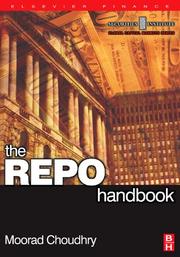
The REPO Handbook

The REPO Handbook

Moorad Choudhry
2002
T3 479 pages · about 7h 59m to read Open Librarygoodreads

Practitioner reference for the repo market that funds bill portfolios.

Summary

Moorad Choudhry, a practitioner and academic in fixed income, wrote this reference on the repurchase agreement market, which is the mechanism through which securities positions are financed and through which short-term secured lending occurs.

The content covers the instrument's mechanics: the classic repo, the sell and buy-back, the legal documentation under the Global Master Repurchase Agreement, margin and haircuts, and the treatment of coupon payments and substitution. It covers the market's participants and purposes, including dealers financing inventory, investors lending cash against collateral, and traders borrowing specific securities to deliver against short positions, which produces the distinction between general collateral repo, where any acceptable security will do and the rate reflects cash market conditions, and special repo, where a specific security is in demand and the rate falls, sometimes to zero or below.

Further chapters cover repo trading strategies, the relationship between repo rates and the bond basis, government bond futures and cheapest to deliver calculation, securities lending as a related activity, tri-party arrangements, credit risk and its management, and the accounting and regulatory treatment. The book covers both sterling and international markets. Editions matter substantially, since central clearing, the post-2008 regulatory changes to bank balance sheets, and the transformation of central bank operating frameworks have all altered the market. The instrument mechanics are unchanged.

Key takeaways 7

  1. A repurchase agreement is economically a secured loan and legally a sale with an agreed repurchase, and the legal form determines what happens in a default.
  2. General collateral repo rates reflect cash market conditions while special rates reflect demand for a specific security.
  3. A security going special indicates concentrated short interest and lets its holder finance the position at below-market rates.
  4. Haircuts determine the leverage available against a given security and are the mechanism through which funding conditions tighten.
  5. Repo financing is what allows dealers to hold securities inventory, so dealer capacity depends on repo availability rather than on capital.
  6. Tri-party arrangements let a custodian manage collateral allocation, which reduces operational cost and concentrates operational risk.
  7. The bond basis between cash and futures is determined by repo rates, which makes repo the link between the two markets.

Who should read it

Fixed income practitioners and treasury professionals who need the mechanics, documentation and trading applications of the repo market in one reference.

Similar books 6

Chosen by shared topics, the entries that hold them, and the people who recommended both.

Marcia L. Stigum · 1978

Stigum's institutional bible of bills, repo, CP and Fed funds.

Sidney Homer, Richard Sylla · 1963

Interest rates from Babylonian lending through Rome and Europe to modern bonds.

Recommended by: Mohnish Pabrai
Joseph J. Wang · 2021

A former Fed trader on repo, bills and reserve plumbing.
Walter Bagehot · 1873

How the London money market worked, and why a central bank lends freely in a panic.

Gary Gorton · 2010

Papers explaining the 2007 crisis as a run on the repo and securitisation system.

Where it sits in the reference 1

Assets

Topics

Finance and MarketsReference WorksFinance, accounting and economics references