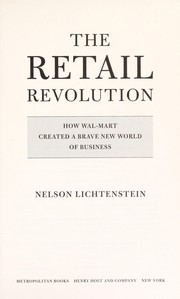
The Retail Revolution: How Wal-Mart Created a Brave New World of Business
A labour historian on Wal-Mart as the new template for capitalist organisation.
Labor historian on Walmart as a new template for capitalism.
Summary
Nelson Lichtenstein is a labour historian, and he argues that Wal-Mart represents a new template for capitalist organisation in the way that the Pennsylvania Railroad, Ford and General Motors did in earlier periods, and that its practices have reshaped the American economy.
His historical argument places the company in the context of American retail development and of the shift of economic power from manufacturers to retailers. He documents how Wal-Mart's scale allowed it to dictate terms to suppliers, requiring price reductions annually and imposing its own logistics and data standards, and how this reversed the relationship in which manufacturers had previously set prices and controlled distribution. Procter and Gamble's accommodation to Wal-Mart is his central case.
The labour material covers the company's employment practices, its opposition to unionisation, its wage and scheduling policies, and the litigation over off-the-clock work and discrimination. Lichtenstein connects these to the broader decline in American labour standards, arguing that Wal-Mart's model set a benchmark that competitors had to match. He also covers the company's origins in the rural South and the cultural and political character that came with it, and the supply chain's relocation to China.
The book is written from a labour perspective and gives limited weight to the consumer benefit that the economic literature attributes to the company. It is more analytical and less journalistic than Bianco's Bully of Bentonville and situates the company in a longer history of American business organisation.
Key takeaways 7
- Wal-Mart's scale reversed the relationship between manufacturers and retailers, transferring pricing power to the channel.
- Requiring annual supplier price reductions forced manufacturing relocation and reorganisation across entire industries.
- Imposing its own logistics and data standards on suppliers made Wal-Mart the coordinator of supply chains it did not own.
- Lichtenstein argues that Wal-Mart's employment model set a benchmark competitors had to match, which lowered standards across retail.
- The company's origins in the rural South shaped its culture, its labour relations and its political positioning.
- Retail rather than manufacturing became the organising centre of the American economy, and Wal-Mart is the case that demonstrates it.
- The book is written from a labour perspective and gives limited weight to the consumer surplus the economic literature measures.
Who should read it
Investors and operators who want Wal-Mart analysed as a template for how economic power shifted from manufacturers to retailers.
Similar books 6
Chosen by shared topics, the entries that hold them, and the people who recommended both.

Essays on Wal-Mart as an economic and social institution, its supply chain included.

The costs Wal-Mart imposes on its workers, suppliers, rivals and towns.
What Wal-Mart's scale does to its suppliers, its towns and prices everywhere.

A critical history of Walmart and Sam Walton by a reporter who covered the company.

How Walmart grew from one Arkansas store by cutting costs and prices.
Recommended by: David Cancel, David Perell, Mohnish Pabrai and 4 others
The Dukes v. Wal-Mart sex discrimination case and the women who brought it.
Where it sits in the reference 2
Topics 3
As an Amazon Associate I earn from qualifying purchases.