Updates

  1. Person pages list letters, writing, profiles and links as sortable tables with filters, and show each person's companies as links; Fund letters show each letter's description in its own column.
  2. Experts show a checked job title and a short description of each person; 30 more people have photographs.
  3. Every company, fund, university and publication the experts work for has a page listing the people there.
  4. Fund letters show each letter's thesis and filter by it; 225 person pages list the essays, columns and newsletter issues the person wrote.
  5. Person pages list every essay and newsletter issue a person wrote, and their own books as a table in List view.
  6. Recommends shows the five largest kinds of book and the rest under More; browse pictures load sooner.
  7. Podcasts and talks link the original episode, filter by Audio and video or Press, and list each publisher once.
  8. Pages are wider, Recommends has List and Grid, and a filter clicked again turns off.
  9. Book cards sit in a ruled grid with Open Library and Goodreads links and each book's one-line note.
  10. Funds is now Investors; each investor's styles are buttons that filter the table.
  11. Podcasts and talks on a person's page filter by year and publisher and show as a list or a grid of pictures.
  12. Quotes show only people's own words: 472 summaries written by list sites are gone.
  13. Country pages open from Browse again, and every link on the shelf lands on a page.
  14. Subject and person pages show their sections as tabs, and each book appears once on a person's page.
  15. Book cards show the quote, who said it and the source; grids show five cards to a row.
  16. On a phone, a menu holds the sections, search, Updates, Feedback and dark mode.
  17. Feedback takes a screenshot of the page with no browser prompt, opens a screenshot full size when you click it, and clears itself once sent.
  18. Book cards are centred, search names the topic each book sits in, and any text cut short shows whole on hover.
  19. Search groups its results by kind: people, companies, geographies, subjects, topics, books, funds, fund letters and papers.
  20. The Books table lists who recommended each book by name, and the browser tab names the section you are in.
  21. Feedback can take a screenshot of the page, or one you paste or choose, and opens in the corner beside Updates.
  22. Each rail button reopens its section where you left it, and Browse, Table and People show on every book and subject page.
  23. Filters grey out choices that hold nothing instead of hiding them, and Books › People filters by authors or recommenders.
  24. Feedback takes a subject line and up to three screenshots.
  25. Biographies are grouped by the person they are about: 41 new pages, from Abraham Lincoln to Lee Kuan Yew.
  26. Sport splits into 23 sports, and Religion into one topic per faith.
  27. Book lists show as cards: the cover, one recommendation quote and every recommender by name.
  28. Seventeen subjects that had two or three pages under different names now have one page each.
  29. Every page lists its Experts as authors and recommenders, with a link to them on the Experts tab.
  30. Economics, Financial history, Financial panics and Accounting are subjects of their own, with one page per financial crisis.
  31. Book, person and subject pages open inside the app, so the tabs stay in view.
  32. 996 more book covers, and photographs or logos for 227 more people and companies.
  33. Books › Browse shows every subject as cards, and the rail holds Fund letters, Papers, Experts, Books and Funds.
  34. Every topic over 150 books splits into narrower topics, each with a page of its own.

Send feedback

What is it?
Screenshots, up to 3 (optional)
or paste one with Ctrl+V

We use your email only to reply to you.

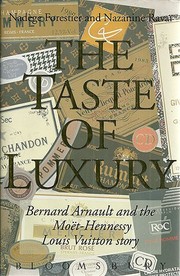
The Taste of Luxury: Bernard Arnault and the

The Taste of Luxury: Bernard Arnault and the Moet-Hennessy Louis Vuitton Story

Nadège Forestier, Nazanine Ravaï
1992
T3 214 pages · about 3h 34m to read Open Librarygoodreads

The takeover battles that assembled the group under Arnault.

Summary

Nadege Forestier and Nazanine Ravai, French journalists, wrote this account of Bernard Arnault's acquisition of control over LVMH, published in 1992 when the events were recent.

The narrative covers Arnault's background, his acquisition of the Boussac textile group in 1984 with backing from Lazard, which came with Christian Dior attached and which he restructured by selling most of the assets, and then the LVMH conflict. Moet Hennessy and Louis Vuitton had merged in 1987 and their respective managements, Alain Chevalier and Henry Racamier, fell into conflict. Racamier invited Arnault in as an ally against Chevalier. Arnault, financed by Lazard and Guinness, built a position and then used it against both of them, taking control by 1989.

The book is written close to the events and reflects the French business establishment's shock at the methods. It covers the legal proceedings, the alliances and the personalities. It predates the construction of the modern LVMH, including the acquisitions of Givenchy, Fendi, Sephora, DKNY, Bulgari, Loro Piana and Tiffany, and the group's transformation into the dominant luxury conglomerate. Readers wanting that should go to more recent accounts. Its value is the detailed record of a contested takeover in a market where such conduct was unfamiliar.

Key takeaways 7

  1. Arnault's Boussac acquisition gave him Christian Dior, and selling the remaining assets funded the position from which everything followed.
  2. He was invited into LVMH as an ally by one faction and used the resulting position against both sides.
  3. Financial backing from Lazard and Guinness gave him the capacity to build a position neither incumbent could match.
  4. The merger of Moet Hennessy and Louis Vuitton created a management conflict that made the group vulnerable to an outside acquirer.
  5. French business practice at the time did not anticipate the methods Arnault used, which is why the incumbents were unprepared.
  6. The book predates the acquisitions that built the modern LVMH and covers only the initial takeover.
  7. A family or founder-managed business that merges without resolving control creates the conditions for a third party to take it.

Who should read it

Readers interested in contested takeovers and in the origin of the luxury conglomerate, with the caveat that the book stops in 1992.

Similar books 6

Chosen by shared topics, the entries that hold them, and the people who recommended both.

Bernard Arnault, Yves Messarovitch · 2000

Insider account: Arnault interview book; French only.
Dana Thomas · 2015

Galliano and McQueen inside the LVMH and Kering machine.
Sara Gay Forden · 2000

Gucci from a Florence leather shop through family collapse to its Tom Ford revival.

Dana Thomas · 2007

How family luxury houses became conglomerates selling to the mass affluent.

Teri Agins · 1999

How fashion became a branded consumer-goods business.

Where it sits in the reference 2

Companies
Biographies

Topics

Company HistoriesBiography and MemoirTycoons and Business Dynasties