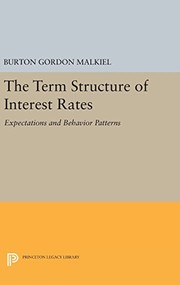
The Term Structure of Interest Rates: Expectations and Behavior Patterns
Why interest rates differ by maturity: a study of the yield curve.
Summary
Burton Malkiel wrote this study of the yield curve in 1966, before A Random Walk Down Wall Street made him widely known. It examines why interest rates differ by maturity and what the shape of the curve indicates.
The theoretical content assesses the competing explanations then current: the pure expectations theory, under which long rates are averages of expected future short rates; the liquidity preference theory, under which long rates include a premium because lenders prefer short maturities; and market segmentation, under which different maturities are separate markets with their own supply and demand. Malkiel develops a version emphasising expectations while incorporating institutional behaviour, and tests it against data.
The book also contains the propositions about bond price behaviour that are known as Malkiel's theorems and are still taught: that bond prices move inversely to yields; that for a given change in yield, longer maturity bonds change in price more; that the price sensitivity increases with maturity at a decreasing rate; that a yield decline raises price more than an equivalent yield rise lowers it, which is convexity; and that lower coupon bonds are more price-sensitive than higher coupon bonds of the same maturity. These were derived before duration became the standard measure and remain the intuitive statement of what duration formalises.
Key takeaways 7
- Bond prices move inversely to yields, and for a given yield change longer maturity bonds move more in price.
- Price sensitivity increases with maturity at a decreasing rate, so extending maturity produces diminishing additional risk.
- A yield decline raises price by more than an equivalent yield rise lowers it, which is the property later formalised as convexity.
- Lower coupon bonds are more price-sensitive than higher coupon bonds of the same maturity.
- Long rates reflect expectations of future short rates, modified by premia that institutional behaviour produces.
- Market segmentation by maturity exists because different institutions have different liability structures and do not substitute freely.
- Malkiel's propositions predate duration as a standard measure and remain the intuitive statement of what it formalises.
Who should read it
Fixed income practitioners who want the intuitive propositions about bond price behaviour and the early treatment of yield curve theory.
About Burton G. Malkiel
Chemical Bank Chairman's Professor of Economics Emeritus, Princeton University; Chief Investment Officer, Wealthfront; former Vanguard director
A Random Walk Down Wall Street, now in its thirteenth edition after fifty years, is the primary popular source for the index-fund case.
Similar books 6
Chosen by shared topics, the entries that hold them, and the people who recommended both.
Interest rates from Babylonian lending through Rome and Europe to modern bonds.
“Courtesy of Homer and Sylla’s A History of Interest Rates, I’ve plotted the market price of the 5% prestiti in the 14th and 15th centuries: Even taking these stumbles into account, investors in medieval and Renaissance Europe earned healthy returns on their capital.” — William J. Bernstein
Source: Efficient Frontier, issue 901 (2001)
Recommended by: Mohnish Pabrai, William J. Bernstein
The standard text on bonds: instruments, valuation, risk and portfolio strategy.
The CFA Institute's fixed-income text: bond valuation, risk and analysis.
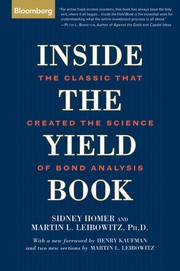
Bond maths made usable: price and yield, interest on interest, and bond swaps.
A practitioner's introduction to trading rates, swaps and futures.
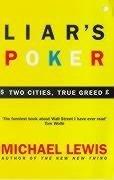
Life on Salomon Brothers' bond trading floor in the 1980s mortgage-bond boom.
“And then "Liar's Poker" from Michael Lewis, love that. I really like - I mythologize like Lewis Ranieri and all these guys when I read it.” — Chamath Palihapitiya
Source: Transcript: Chamath Palihapitiya
Recommended by: Chamath Palihapitiya, Michael Burry and 5 others
Where it sits in the reference 2
Topics 2
As an Amazon Associate I earn from qualifying purchases.