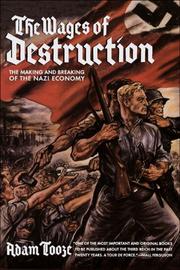
The Wages of Destruction
The economic history of Nazi Germany.
The Nazi economy as an exercise in resource and financial constraint.
Summary
Tooze writes the economic history of Nazi Germany and argues that its war was shaped by resource constraints. After Germany failed to defeat Britain in 1940, the economic logic of the war drove it to invade the Soviet Union in 1941, because Hitler needed natural resources to challenge two economic superpowers, the United States and the British Empire. The same constraints made victory over the Soviet Union impossible, especially once the Americans and British supplied it to supplement the resources still under Soviet control.
Tooze makes the case that the British and later Anglo-American strategic bombing campaign had a real economic effect, while arguing that it often chose the wrong targets. He challenges the idea of an armaments miracle under Albert Speer, and he rejects the claim that the Nazi economy could have mobilised significantly more women for war production. Allen Lane published the book in 2006, and it won the Wolfson History Prize and the 2007 Longman/History Today Book of the Year Prize, with praise from Michael Burleigh, Richard Overy and Niall Ferguson.
Key takeaways 4
- Germany's war strategy followed from its shortage of resources relative to the United States and the British Empire.
- The invasion of the Soviet Union was an attempt to seize resources, and the same shortages made it fail.
- Strategic bombing damaged the German economy, though many targets were poorly chosen.
- Speer's armaments miracle was smaller than its legend, and the economy had little slack to mobilise.
Who should read it
Readers who want to see how economic capacity and resources decided the outcome of a war, and investors interested in the economics of conflict.
Similar books 6
Chosen by shared topics, the entries that hold them, and the people who recommended both.
The German social market economy, its strengths and its rigidities.
The year that could have stalled the Allies, and how the war turned.
Recommended by: Keith Rabois

A biography of General Douglas MacArthur.
Recommended by: Jim Collins, Mohnish Pabrai, Elon Musk
The Nazi and Stalinist mass murders in the lands between, told as one history.
Recommended by: Eric Weinstein, Peter Thiel
The sinking of the Lusitania, told from both the hunter and the hunted.
Recommended by: Chris Dixon, Sahil Bloom
The commander of Britain's 14th Army on retaking Burma from Japan.
Recommended by: Mohnish Pabrai