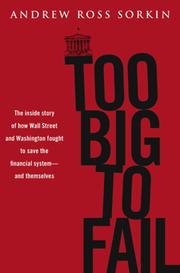
Too Big to Fail
Inside the meetings of bankers and regulators during the 2008 financial crisis.
Crisis-wide narrative in which the AIG rescue is the central set piece.
Summary
Sorkin reconstructs the autumn of 2008 through the meetings, phone calls and negotiations among bank chief executives, Treasury Secretary Hank Paulson, Federal Reserve chairman Ben Bernanke and New York Fed president Tim Geithner. He drew on more than five hundred hours of interviews with nearly every principal, and the book is written as continuous narrative with reconstructed dialogue.
The sequence covers Bear Stearns and the JPMorgan purchase, the conservatorship of Fannie Mae and Freddie Mac, the weekend when Lehman Brothers failed after Barclays was blocked by British regulators and no buyer emerged, the AIG rescue two days later, the Merrill Lynch sale to Bank of America, the Reserve Primary Fund breaking the buck, the conversion of Goldman Sachs and Morgan Stanley to bank holding companies, and the forced capital injections into nine banks in October.
The book's contribution is the record of what individuals knew and decided in real time, including the inconsistency between letting Lehman fail and rescuing AIG, the personal antagonisms among the chief executives, and the improvisation involved in decisions later described as policy.
It is journalism rather than analysis. Sorkin does not explain the securitisation mechanics, the regulatory failures that preceded the crisis, or the economic consequences, and readers wanting those should go elsewhere. The reconstructed dialogue is a method that some historians object to. Sorkin's access came from the participants, which shapes the sympathies. It remains the most detailed account of what happened in those specific weeks and of how institutional failure looks from inside the room.
Key takeaways 8
- The decisions of September 2008 were improvised under time pressure by a small number of people and were not the application of any consistent policy.
- Lehman Brothers failed partly because Barclays could not complete a purchase without a shareholder vote that British regulators would not waive.
- The distinction between rescuing AIG and letting Lehman fail rested on the availability of collateral and on the perceived systemic exposure rather than on principle.
- Firms that appeared solvent by their own accounting were unable to fund themselves, which made liquidity rather than capital the immediate cause of failure.
- Chief executives consistently misjudged their own institutions' exposure and continued to state solvency days before requiring rescue.
- The nine largest banks were required to accept capital injections together so that no individual bank would be identified as the weak one.
- Personal relationships and antagonisms among a small group of executives and officials materially affected which transactions were possible.
- Short-term wholesale funding was the mechanism that transmitted the crisis between institutions, since it could be withdrawn instantly and without warning.
Who should read it
Investors and executives who want the hour-by-hour record of institutional decision-making under extreme time pressure during a systemic crisis.
About Andrew Ross Sorkin
New York Times columnist, founder and editor-at-large of DealBook; CNBC Squawk Box co-anchor
Too Big to Fail is the standard blow-by-blow reconstruction of the 2008 crisis and is cited across the crisis literature.
Who recommended it 5 · 3 direct
“I thought Too Big to Fail was terrific, and Sorkin's newest book is just as thoroughly researched as his last one.”
“Andrew Ross Sorkin’s Too Big to Fail10 is fabulous, as is Roger Lowenstein’s The End of Wall Street.11 In fact, all of Roger Lowenstein’s books are excellent, and so we should read everything Roger has written.”
Similar books 6
Chosen by shared topics, the entries that hold them, and the people who recommended both.

How the savings and loan crisis foreshadowed the mortgage crisis.
The few investors who saw subprime mortgage bonds would fail, and bet against them.
“Lewis, Michael, The Big Short: Inside the Doomsday Machine (New York: W.W. Norton & Company, 2010)” — Michael Mauboussin
Source: Blaming the Rat: Incentives, Motivation, and How They Interact, page 15
Recommended by: Jim Collins, Michael Mauboussin and 7 others
The 2008 crisis traced back 25 years to mortgage bonds, Fannie Mae and subprime.
“Bethany McLean and Joe Nocera, All the Devils Are Here: The Hidden History of the Financial Crisis (New York: Portfolio, 2010), 128-134” — Michael Mauboussin
Source: Blaming the Rat: Incentives, Motivation, and How They Interact, page 14
Recommended by: Michael Mauboussin
The 2008 crisis and its aftermath, from inside the New York Fed and the Treasury.
Recommended by: Bill Gates, Mohnish Pabrai and 2 others
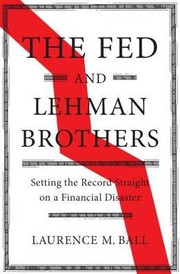
Evidence that the Fed could legally have saved Lehman Brothers in 2008.

The 2008 crisis from inside the FDIC, which closed failed banks and guarded deposits.
Recommended by: Mohnish Pabrai, Nassim Nicholas Taleb
Where it sits in the reference 9
Topics 2
As an Amazon Associate I earn from qualifying purchases.