Updates

  1. Person pages list letters, writing, profiles and links as sortable tables with filters, and show each person's companies as links; Fund letters show each letter's description in its own column.
  2. Experts show a checked job title and a short description of each person; 30 more people have photographs.
  3. Every company, fund, university and publication the experts work for has a page listing the people there.
  4. Fund letters show each letter's thesis and filter by it; 225 person pages list the essays, columns and newsletter issues the person wrote.
  5. Person pages list every essay and newsletter issue a person wrote, and their own books as a table in List view.
  6. Recommends shows the five largest kinds of book and the rest under More; browse pictures load sooner.
  7. Podcasts and talks link the original episode, filter by Audio and video or Press, and list each publisher once.
  8. Pages are wider, Recommends has List and Grid, and a filter clicked again turns off.
  9. Book cards sit in a ruled grid with Open Library and Goodreads links and each book's one-line note.
  10. Funds is now Investors; each investor's styles are buttons that filter the table.
  11. Podcasts and talks on a person's page filter by year and publisher and show as a list or a grid of pictures.
  12. Quotes show only people's own words: 472 summaries written by list sites are gone.
  13. Country pages open from Browse again, and every link on the shelf lands on a page.
  14. Subject and person pages show their sections as tabs, and each book appears once on a person's page.
  15. Book cards show the quote, who said it and the source; grids show five cards to a row.
  16. On a phone, a menu holds the sections, search, Updates, Feedback and dark mode.
  17. Feedback takes a screenshot of the page with no browser prompt, opens a screenshot full size when you click it, and clears itself once sent.
  18. Book cards are centred, search names the topic each book sits in, and any text cut short shows whole on hover.
  19. Search groups its results by kind: people, companies, geographies, subjects, topics, books, funds, fund letters and papers.
  20. The Books table lists who recommended each book by name, and the browser tab names the section you are in.
  21. Feedback can take a screenshot of the page, or one you paste or choose, and opens in the corner beside Updates.
  22. Each rail button reopens its section where you left it, and Browse, Table and People show on every book and subject page.
  23. Filters grey out choices that hold nothing instead of hiding them, and Books › People filters by authors or recommenders.
  24. Feedback takes a subject line and up to three screenshots.
  25. Biographies are grouped by the person they are about: 41 new pages, from Abraham Lincoln to Lee Kuan Yew.
  26. Sport splits into 23 sports, and Religion into one topic per faith.
  27. Book lists show as cards: the cover, one recommendation quote and every recommender by name.
  28. Seventeen subjects that had two or three pages under different names now have one page each.
  29. Every page lists its Experts as authors and recommenders, with a link to them on the Experts tab.
  30. Economics, Financial history, Financial panics and Accounting are subjects of their own, with one page per financial crisis.
  31. Book, person and subject pages open inside the app, so the tabs stay in view.
  32. 996 more book covers, and photographs or logos for 227 more people and companies.
  33. Books › Browse shows every subject as cards, and the rail holds Fund letters, Papers, Experts, Books and Funds.
  34. Every topic over 150 books splits into narrower topics, each with a page of its own.

Send feedback

What is it?
Screenshots, up to 3 (optional)
or paste one with Ctrl+V

We use your email only to reply to you.

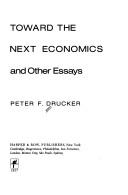
Toward the Next Economics and Other Essays

Toward the Next Economics and Other Essays

Peter F. Drucker
1981
T4 212 pages · about 3h 32m to read Open Librarygoodreads

Summary

The reference has not verified this book in detail; the summary states only what the title, author and subject establish.

Peter Drucker collected these essays, written across the 1970s, on economics, on management and on the relationship between them. The title essay argues that the economic theory of the postwar period had exhausted itself and that a successor would have to account for productivity, for innovation and for the position of the firm, none of which Keynesian macroeconomics addressed.

Other pieces cover the multinational corporation and the changing structure of world trade, the productivity problem in developed economies, pension funds and their ownership of business, the management of service institutions, and Drucker's recurring argument that economists treat the economy as a closed system while the important changes arrive from outside it. There are also essays on individuals and on the intellectual history of economics, including his assessments of Keynes and Schumpeter.

As with Drucker's other collections, the pieces were written separately and repeat each other, and several are tied to conditions of the 1970s that no longer obtain. The essay on Keynes and Schumpeter states his position most directly: that Schumpeter's concern with innovation, entrepreneurship and structural change describes what actually determines economic outcomes, while Keynesian aggregate management addresses a narrower question. Readers wanting Drucker's arguments developed should go to the books.

Key takeaways 7

  1. Drucker argues that postwar economic theory could not account for productivity, innovation or the firm, which are what determine outcomes.
  2. Schumpeter's focus on innovation and structural change explains more than Keynesian aggregate demand management does.
  3. Economists treat the economy as a closed system while the changes that matter arrive from outside it.
  4. Pension funds had become the owners of business without acquiring any capacity to exercise ownership.
  5. Productivity in service work was the coming economic problem and no method for raising it existed.
  6. Multinational corporations were reorganising world trade in ways that national economic statistics did not capture.
  7. The essays repeat each other and several are tied to conditions of the 1970s that no longer apply.

Who should read it

Readers of Drucker interested in his criticism of economics as a discipline, though the books state his arguments more completely.

About Peter F. Drucker

Management writer and consultant; professor at Bennington, NYU and Claremont Graduate University

He invented management as a field of study, and The Practice of Management and The Effective Executive remain the primary sources every later writer builds on.

NYU, Claremont Graduate University

Similar books 6

Chosen by shared topics, the entries that hold them, and the people who recommended both.
Peter F. Drucker · 1969

Four breaks with the postwar world, from a global economy to knowledge as capital.

Recommended by: Patrick Collison
Peter F. Drucker · 1993

Essays on 'social ecology': how societies and institutions change, Japan included.

Peter F. Drucker · 2003

Selections on community and society

Where it sits in the reference 2

Strategists
Economics

Topics

EconomicsSociology and CultureWork, labour and industrial society