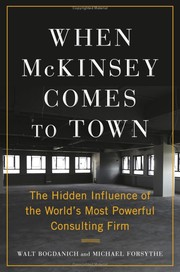
When McKinsey Comes to Town
What McKinsey did for its clients and what followed, from internal documents.
Investigative account of who pays for consulting advice.
Summary
Bogdanich and Forsythe, New York Times investigative reporters, examine McKinsey's work for specific clients and the consequences, based on internal documents, court filings and interviews with current and former partners.
The cases are the substance. The firm advised Purdue Pharma on increasing OxyContin sales, including proposals to target high-volume prescribers and to pay distributors rebates for overdoses, work for which McKinsey later paid nearly six hundred million dollars in settlements. It advised the Food and Drug Administration's drug division while also advising the pharmaceutical companies that division regulated. It advised Immigration and Customs Enforcement on detention cost reductions including cuts to food and medical care that the agency's own staff considered unsafe. It advised insurers including Allstate on claims handling in ways designed to reduce payouts to policyholders. It advised authoritarian governments including Saudi Arabia and China, in one case producing a report that identified critics of the Saudi government by name. It advised tobacco companies, coal producers and polluting industries while marketing its climate practice.
The institutional argument is that the firm's professed values and its actual conduct diverge, that the partnership's economics reward revenue generation, and that the confidentiality it maintains prevents any accountability for outcomes.
The book is adversarial and McKinsey has disputed characterisations of specific engagements. The documentary basis is strong and much of the Purdue material comes from litigation records. Read alongside Duff McDonald's more sympathetic institutional history.
Key takeaways 7
- McKinsey advised Purdue Pharma on increasing OxyContin sales, including targeting high-volume prescribers, and paid nearly six hundred million dollars in settlements.
- The firm advised the Food and Drug Administration's drug division while simultaneously advising the pharmaceutical companies that division regulated.
- Insurance claims handling advice was designed to reduce payouts to policyholders, which transferred value from claimants to the insurer client.
- The firm advises both polluting industries and climate initiatives, which it presents as serving all clients rather than as a conflict.
- Confidentiality prevents any external assessment of whether the firm's advice produced the outcomes claimed, which removes accountability entirely.
- Partnership economics reward revenue generation, which makes declining a lucrative engagement a personal cost to the partner who would decline it.
- Work for authoritarian governments included analysis that identified named critics of those governments, which the firm characterised as a routine social media study.
Who should read it
Directors and operators who buy consulting services and need the documented record of specific engagements and their consequences.
Similar books 6
Chosen by shared topics, the entries that hold them, and the people who recommended both.
How McKinsey built the modern consulting partnership and its influence.
Recommended by: Andrew Chen
How McKinsey consultants approach problems, described by a former associate.
McKinsey's history and principles, told by the partner who led it for 17 years.
Recommended by: Patrick Collison
How Bruce Henderson and three others invented corporate strategy as a discipline.
“Kiechel, Walter, The Lords of Strategy: The Secret Intellectual History of the New Corporate World (Boston, MA: Harvard Business Press, 2010)” — Michael Mauboussin
Source: Measuring the Moat: Assessing the Magnitude and Sustainability of Value Creation, page 64
Recommended by: Michael Mauboussin
How firms that sell expertise set their ratio of juniors to partners, and price.
Why consultants should charge for the value they create rather than their time.
“My college girlfriend's rich dad gave me this because I wanted to get rich too. He said read it and you'll be rich. Good advice.” — Noah Kagan
Source: The 25 Best Business Books I Ever Read (Out of 697)
Recommended by: Nat Eliason, Noah Kagan