Updates

  1. Person pages list letters, writing, profiles and links as sortable tables with filters, and show each person's companies as links; Fund letters show each letter's description in its own column.
  2. Experts show a checked job title and a short description of each person; 30 more people have photographs.
  3. Every company, fund, university and publication the experts work for has a page listing the people there.
  4. Fund letters show each letter's thesis and filter by it; 225 person pages list the essays, columns and newsletter issues the person wrote.
  5. Person pages list every essay and newsletter issue a person wrote, and their own books as a table in List view.
  6. Recommends shows the five largest kinds of book and the rest under More; browse pictures load sooner.
  7. Podcasts and talks link the original episode, filter by Audio and video or Press, and list each publisher once.
  8. Pages are wider, Recommends has List and Grid, and a filter clicked again turns off.
  9. Book cards sit in a ruled grid with Open Library and Goodreads links and each book's one-line note.
  10. Funds is now Investors; each investor's styles are buttons that filter the table.
  11. Podcasts and talks on a person's page filter by year and publisher and show as a list or a grid of pictures.
  12. Quotes show only people's own words: 472 summaries written by list sites are gone.
  13. Country pages open from Browse again, and every link on the shelf lands on a page.
  14. Subject and person pages show their sections as tabs, and each book appears once on a person's page.
  15. Book cards show the quote, who said it and the source; grids show five cards to a row.
  16. On a phone, a menu holds the sections, search, Updates, Feedback and dark mode.
  17. Feedback takes a screenshot of the page with no browser prompt, opens a screenshot full size when you click it, and clears itself once sent.
  18. Book cards are centred, search names the topic each book sits in, and any text cut short shows whole on hover.
  19. Search groups its results by kind: people, companies, geographies, subjects, topics, books, funds, fund letters and papers.
  20. The Books table lists who recommended each book by name, and the browser tab names the section you are in.
  21. Feedback can take a screenshot of the page, or one you paste or choose, and opens in the corner beside Updates.
  22. Each rail button reopens its section where you left it, and Browse, Table and People show on every book and subject page.
  23. Filters grey out choices that hold nothing instead of hiding them, and Books › People filters by authors or recommenders.
  24. Feedback takes a subject line and up to three screenshots.
  25. Biographies are grouped by the person they are about: 41 new pages, from Abraham Lincoln to Lee Kuan Yew.
  26. Sport splits into 23 sports, and Religion into one topic per faith.
  27. Book lists show as cards: the cover, one recommendation quote and every recommender by name.
  28. Seventeen subjects that had two or three pages under different names now have one page each.
  29. Every page lists its Experts as authors and recommenders, with a link to them on the Experts tab.
  30. Economics, Financial history, Financial panics and Accounting are subjects of their own, with one page per financial crisis.
  31. Book, person and subject pages open inside the app, so the tabs stay in view.
  32. 996 more book covers, and photographs or logos for 227 more people and companies.
  33. Books › Browse shows every subject as cards, and the rail holds Fund letters, Papers, Experts, Books and Funds.
  34. Every topic over 150 books splits into narrower topics, each with a page of its own.

Send feedback

What is it?
Screenshots, up to 3 (optional)
or paste one with Ctrl+V

We use your email only to reply to you.

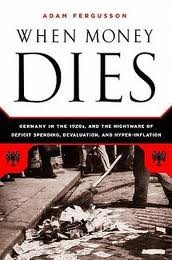
When Money Dies

When Money Dies

Adam Fergusson
1975
T1 288 pages · about 4h 48m to read Open Librarygoodreads

The canonical narrative account of the 1923 inflation and what it did to savers and creditors.

Summary

Fergusson reconstructs the German hyperinflation of 1921 to 1923 from diaries, letters, newspaper accounts and contemporary official records, alongside shorter treatments of the parallel Austrian and Hungarian inflations. The book is descriptive rather than theoretical: it shows what happened to people, prices, wages, savings and social order as the mark went from about sixty to the dollar to over four trillion.

The mechanism Fergusson describes is a government financing deficits by discounting its own bills at the Reichsbank, an occupation of the Ruhr that removed a large part of the tax base while the government paid striking workers, and a central bank leadership that believed the depreciation was caused by the balance of payments rather than by note issue and therefore kept printing. He documents the distributional consequences precisely: fixed-income holders, pensioners, bondholders and the professional middle class were destroyed, while debtors, holders of real assets, farmers with land and industrialists with foreign currency receipts gained.

For investors the value is in the observed sequence of behaviour. Fergusson shows that people adapted slowly, that the flight from money happened suddenly and late, that wage indexation accelerated the process, and that price controls produced shortages rather than stability. The book has been criticised for weak monetary analysis, since Fergusson was a journalist and politician rather than an economist, and for drawing a straighter line from the inflation to the rise of the Nazis than the evidence supports, given that Hitler took power a decade later after a deflationary depression. Read it for the social and behavioural record.

Key takeaways 7

  1. The German hyperinflation was caused by the government financing its deficits through central bank note issue, and officials continued because they believed the depreciation had external causes.
  2. The flight from money happens abruptly and late, after a long period in which holders continue to accept the currency out of habit.
  3. Hyperinflation transfers wealth from creditors, pensioners and savers to debtors and holders of real assets, and the transfer is the point at which the political consequences begin.
  4. Indexing wages to prices accelerates the inflation rather than protecting the worker, because it removes the last lag in the process.
  5. Price controls during rapid inflation produce shortages, hoarding and black markets rather than lower prices.
  6. The professional middle class was destroyed as a class, because its wealth was held in exactly the forms inflation eliminates.
  7. Stabilisation, when it came, was accomplished quickly through a new currency and a hard budget constraint, which shows the problem was always fiscal rather than technical.

Who should read it

Investors who want the observed behavioural and distributional record of a currency collapse rather than a monetary theory of it.

Who recommended it 1 · 1 direct

Similar books 6

Chosen by shared topics, the entries that hold them, and the people who recommended both.

Barry Eichengreen · 1992

How the gold standard spread the Depression, and why leaving it early meant recovery.

Steven B. Webb · 1989

Monthly data tested against explanations of Germany's 1919 to 1923 inflation.

Frederick Taylor · 2013

Modern retelling with more on the stabilisation and the Rentenmark.

Carl-Ludwig Holtfrerich · 1986

Germany's 1914 to 1923 inflation, with a more sympathetic view of its policy.

Gerald D. Feldman · 1993

The full political, social and economic history of Germany's 1914 to 1924 inflation.

Constantino Bresciani-Turroni · 1937

An economist's first-hand analysis of Germany's inflation from 1914 to 1923.

Where it sits in the reference 2

Geographies
Financial history

Topics

Financial HistoryEconomicsGeneral HistoryFinancial History