Updates

  1. Person pages list letters, writing, profiles and links as sortable tables with filters, and show each person's companies as links; Fund letters show each letter's description in its own column.
  2. Experts show a checked job title and a short description of each person; 30 more people have photographs.
  3. Every company, fund, university and publication the experts work for has a page listing the people there.
  4. Fund letters show each letter's thesis and filter by it; 225 person pages list the essays, columns and newsletter issues the person wrote.
  5. Person pages list every essay and newsletter issue a person wrote, and their own books as a table in List view.
  6. Recommends shows the five largest kinds of book and the rest under More; browse pictures load sooner.
  7. Podcasts and talks link the original episode, filter by Audio and video or Press, and list each publisher once.
  8. Pages are wider, Recommends has List and Grid, and a filter clicked again turns off.
  9. Book cards sit in a ruled grid with Open Library and Goodreads links and each book's one-line note.
  10. Funds is now Investors; each investor's styles are buttons that filter the table.
  11. Podcasts and talks on a person's page filter by year and publisher and show as a list or a grid of pictures.
  12. Quotes show only people's own words: 472 summaries written by list sites are gone.
  13. Country pages open from Browse again, and every link on the shelf lands on a page.
  14. Subject and person pages show their sections as tabs, and each book appears once on a person's page.
  15. Book cards show the quote, who said it and the source; grids show five cards to a row.
  16. On a phone, a menu holds the sections, search, Updates, Feedback and dark mode.
  17. Feedback takes a screenshot of the page with no browser prompt, opens a screenshot full size when you click it, and clears itself once sent.
  18. Book cards are centred, search names the topic each book sits in, and any text cut short shows whole on hover.
  19. Search groups its results by kind: people, companies, geographies, subjects, topics, books, funds, fund letters and papers.
  20. The Books table lists who recommended each book by name, and the browser tab names the section you are in.
  21. Feedback can take a screenshot of the page, or one you paste or choose, and opens in the corner beside Updates.
  22. Each rail button reopens its section where you left it, and Browse, Table and People show on every book and subject page.
  23. Filters grey out choices that hold nothing instead of hiding them, and Books › People filters by authors or recommenders.
  24. Feedback takes a subject line and up to three screenshots.
  25. Biographies are grouped by the person they are about: 41 new pages, from Abraham Lincoln to Lee Kuan Yew.
  26. Sport splits into 23 sports, and Religion into one topic per faith.
  27. Book lists show as cards: the cover, one recommendation quote and every recommender by name.
  28. Seventeen subjects that had two or three pages under different names now have one page each.
  29. Every page lists its Experts as authors and recommenders, with a link to them on the Experts tab.
  30. Economics, Financial history, Financial panics and Accounting are subjects of their own, with one page per financial crisis.
  31. Book, person and subject pages open inside the app, so the tabs stay in view.
  32. 996 more book covers, and photographs or logos for 227 more people and companies.
  33. Books › Browse shows every subject as cards, and the rail holds Fund letters, Papers, Experts, Books and Funds.
  34. Every topic over 150 books splits into narrower topics, each with a page of its own.

Send feedback

What is it?
Screenshots, up to 3 (optional)
or paste one with Ctrl+V

We use your email only to reply to you.

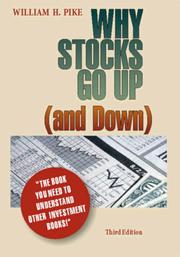
Why Stocks Go Up and Down

Why Stocks Go Up and Down

William H. Pike
1983
T3 323 pages · about 5h 23m to read Open Librarygoodreads

Plain-language primer on financial statements and how securities work

Summary

Pike wrote an introductory text explaining how corporate securities work and what determines their prices, aimed at readers with no financial background. It has been revised through several editions, later with co-author Patrick Gregory.

The structure follows a company through its financing life. Pike starts with a small business raising money, introduces common stock and what a share represents, then adds debt, preferred stock and convertible securities, explaining in each case what the holder is entitled to and what happens in trouble. He builds the balance sheet and income statement from the transactions of the company being described rather than presenting them as abstract forms, which makes the accounting section unusually concrete. He then covers earnings per share, book value, dividends, and the ratios investors use, before turning to bond pricing, yield, the relationship between interest rates and bond prices, and finally to what determines stock prices.

The treatment of stock valuation is conventional: prices reflect expected future earnings discounted at a rate that varies with interest rates and perceived risk, so stock prices move on changes in expected earnings, in interest rates and in risk appetite.

The book is a primer and does not attempt to be more. It contains no original argument and no advanced material on options, derivatives or portfolio theory. Its value is that the explanations are genuinely clear and the accounting is built up from transactions rather than asserted. Readers with a finance background will find nothing new.

Key takeaways 7

  1. A share of common stock is a residual claim, so its holder receives whatever remains after every other claimant is satisfied.
  2. Financial statements are best understood by constructing them from the transactions of a business rather than by learning the formats.
  3. Bond prices move inversely to interest rates because the fixed coupon must be repriced to the current required yield.
  4. Preferred stock and convertible securities sit between debt and equity, and their terms determine which they resemble in practice.
  5. Earnings per share can be increased through financing decisions that do not improve the underlying business.
  6. Stock prices change on revisions to expected future earnings, to interest rates, and to the risk premium investors demand.
  7. Book value records what was paid for assets rather than what they are worth, which limits its use in valuation.

Who should read it

Readers new to finance who want securities and financial statements explained from first principles before moving to investment texts.

Who recommended it 1 · 1 direct

“I highly recommend Janet Lowe's Value Investing Made Easy as a primer. I'd follow that book with Why Stocks Go Up (and Down) by William Pike.”

Similar books 6

Chosen by shared topics, the entries that hold them, and the people who recommended both.

Benjamin Graham, David L. Dodd · 1934

How to read financial statements sceptically and value bonds and stocks.

“I've spent more time with all of the editions of Benjamin Graham and David Dodd's Security Analysis than with any other book” — Christopher Bloomstran

Source: Semper Augustus 2024 Letter to Clients, 'Books and Tunes for Walking', p. 95

Recommended by: Christopher Bloomstran, Howard Marks and 11 others

Where it sits in the reference 2

Assets
Accounting

Topics

InvestingFinance and Markets