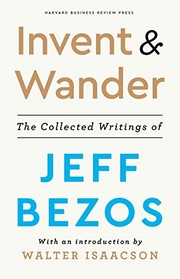
Invent and Wander
Insider: Bezos's collected shareholder letters and speeches.
Summary
This volume collects Jeff Bezos's annual letters to Amazon shareholders from 1997 to 2019, along with selected speeches and interviews, with an introduction by Walter Isaacson. The primary material is Bezos's own writing rather than commentary about him.
The letters set out a consistent set of positions maintained over two decades. Long-term thinking is stated as the organising principle in the first letter and reprinted with every subsequent one. Free cash flow rather than earnings per share is named as the metric the company manages to, with the argument that accounting earnings can be produced by decisions that destroy value. Customer obsession is presented as strategically superior to competitor focus, because customers remain dissatisfied even when a company is ahead. High-velocity decision making requires distinguishing one-way doors from two-way doors and deciding the reversible ones fast with about seventy per cent of the information. Failure and invention are described as inseparable, with the argument that a company willing to take large bets must accept correspondingly large losses. Day One versus Day Two describes institutional decline as proxy-driven, meaning that processes become substitutes for the outcomes they were meant to produce.
The operational material includes the six-page narrative memo replacing slide presentations, the working backwards method starting from a press release, the distinction between controllable inputs and output metrics, and the two-pizza team.
The letters are corporate documents written to shape how investors understood Amazon, so they present the company's decisions in the most favourable available frame. They say nothing about labour conditions, seller relations, tax structures or the competitive practices that later drew regulatory attention. Read as an unusually clear statement of a management philosophy, not as an account of what the company did.
Key takeaways 7
- Free cash flow rather than reported earnings per share is the correct measure of a business, because earnings can be manufactured by value-destroying decisions.
- Customer obsession beats competitor focus because customers remain dissatisfied even when a company leads its market.
- Reversible decisions should be made quickly with about seventy per cent of the information a decider would like to have.
- A company willing to take large bets must accept losses proportional to those bets, so failure scale rises with company scale.
- Institutional decline shows up as process becoming a proxy for the outcome the process was created to produce.
- Written narrative memos force clearer thinking than slide presentations and change what a meeting can accomplish.
- Teams should be measured on controllable input metrics rather than on output metrics they cannot directly move.
Who should read it
Founders and operators who want Amazon's management philosophy in its primary form, understanding that it is corporate communication rather than independent account.
About Walter Isaacson
American biographer and professor of history at Tulane University; formerly editor of Time and chief executive of CNN and the Aspen Institute.
The biographies are built on long direct access - years of interviews with Jobs, then with Musk - and reconstruct how each subject decided, hired and treated the people around them. The Innovators does the same for computing, presenting it as a chain of collaborations rather than a sequence of lone inventions.
Where it sits in the reference 3
Similar books 6
Chosen by shared topics, the entries that hold them, and the people who recommended both.