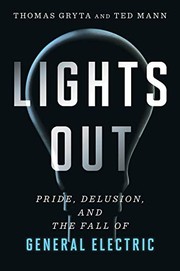
Lights Out: Pride, Delusion, and the Fall of General Electric
WSJ reporters on GE Capital and the accounting culture.
Summary
Gryta and Mann, Wall Street Journal reporters, document GE's decline from the most valuable company in the world to a broken conglomerate that was removed from the Dow Jones index in 2018 and eventually split into three companies.
Their central argument is that the performance under Welch depended substantially on GE Capital and on accounting practices that smoothed reported earnings, and that Immelt inherited a company whose industrial operations were weaker than the reported numbers indicated and whose financial arm carried risks that were not visible.
The specific material covers GE Capital's growth into a substantial share of earnings funded by short-term commercial paper, which required a federal guarantee programme in 2008; the practice of using asset sales, reserve releases and timing to hit quarterly targets, which the authors document across decades; the acquisition of Alstom's power business in 2015, made just as gas turbine demand collapsed and which produced enormous writedowns; the long-term service agreements in power, where revenue was recognised on assumptions about future maintenance that proved wrong; and the insurance reserves in a run-off long-term care book that required a fifteen billion dollar charge.
They also document the culture, in which reporting a problem upward was career-ending and in which every business unit was expected to make its number regardless of conditions. The book is journalism and the authors did not have company cooperation. It is unsympathetic throughout. It says less about what GE did well than a balanced account would. Read alongside Welch's own book, which describes the same period as a triumph.
Key takeaways 8
- GE's reported performance depended substantially on its financial arm and on accounting practices that smoothed earnings across quarters.
- GE Capital was funded by short-term commercial paper, which required a federal guarantee programme when that market closed in 2008.
- Asset sales, reserve releases and the timing of charges were used to hit quarterly targets, which the authors document across decades.
- The Alstom power acquisition was completed just as gas turbine demand collapsed, producing writedowns that exceeded the purchase price.
- Long-term service agreements recognised revenue on assumptions about future maintenance costs that proved substantially wrong.
- An insurance run-off book that management had stopped tracking required a fifteen billion dollar charge that surprised the company itself.
- A culture in which reporting a problem upward was career-ending meant that senior management received the numbers they expected rather than the actual ones.
- The book is unsympathetic throughout and should be read alongside accounts describing the same period as a success.
Who should read it
Investors and directors who want a documented case of how earnings management and a financial arm concealed industrial deterioration for two decades.
Where it sits in the reference 3
Who recommended it 2 · 2 direct
Similar books 6
Chosen by shared topics, the entries that hold them, and the people who recommended both.