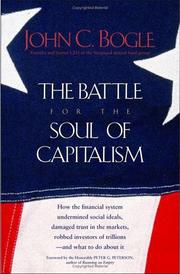
The Battle for the Soul of Capitalism
Summary
Bogle argues that American capitalism has been transformed from a system in which owners controlled companies into one in which managers and financial intermediaries extract value from both companies and investors, and that the failure of institutional owners to act as owners is the central mechanism.
His analysis of corporate America covers the growth of executive compensation relative to worker pay and to company performance, the use of stock options which reward share price movement rather than value creation and which were unexpensed for decades, the earnings management practices that produce reported results matching guidance, the failure of boards and compensation committees to act as agents of shareholders, and the conflicts of accounting firms earning consulting fees from audit clients.
His analysis of investment America covers the transformation of fund management from a profession into a marketing business, the growth of costs relative to returns, the conflict between fund company profitability and fund shareholder returns, and the failure of fund managers to vote proxies or engage with the companies they own on behalf of their investors.
His analysis of mutual fund America covers the ownership structure of fund management companies and the argument for the mutual structure Vanguard uses. His proposed remedies centre on requiring institutional owners to act as owners, on disclosure of proxy voting, and on a federal standard of fiduciary duty. The book repeats arguments from his other work and the moralising register is heavy. Written in 2005, it anticipated several of the governance failures that the financial crisis exposed. The analysis of why institutional owners do not act as owners is the most durable part.
Key takeaways 8
- American capitalism has moved from owners controlling companies to managers and intermediaries extracting value from both companies and investors.
- Institutional owners hold most corporate equity and do not act as owners, which leaves managers effectively unsupervised.
- Stock options reward share price movement rather than value creation, and were unexpensed for decades which concealed their cost.
- Earnings management produces reported results that match guidance, which means the guidance rather than the business determines the reported numbers.
- Boards and compensation committees do not function as agents of shareholders, and the mechanisms by which they fail are structural rather than personal.
- Accounting firms earning consulting fees from audit clients cannot function as an independent check.
- Fund management changed from a profession into a marketing business, which changed the objective from returns to asset gathering.
- Fund managers do not vote proxies or engage with companies on behalf of their investors, which removes the last available owner.
Who should read it
Investors and trustees who want a systematic account of why the ownership chain fails to supervise corporate managers.
About John C. Bogle
Founder and CEO, The Vanguard Group 1974-1996; creator of the first retail index mutual fund
He built the institution and wrote the primary-source case for low-cost indexing that every later index advocate builds on.
Where it sits in the reference 3
Who recommended it 2 · 1 direct
Similar books 6
Chosen by shared topics, the entries that hold them, and the people who recommended both.