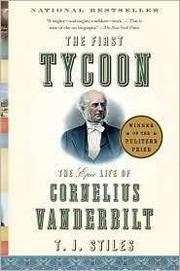
The First Tycoon: The Epic Life of Cornelius Vanderbilt
Pulitzer and National Book Award winner; the definitive life.
Summary
Stiles won the Pulitzer Prize and the National Book Award for this biography, which is the definitive life of Cornelius Vanderbilt and is built on extensive archival research.
The business material traces a career across three industries. Vanderbilt began in Staten Island ferries and coastal steamboats, where he competed by cutting fares below cost until incumbents paid him to leave a route, a tactic he repeated for decades. He then built the Nicaragua transit route during the California gold rush, moving passengers across Central America faster and cheaper than the Panama alternative. He entered railroads late, in his seventies, and assembled the New York Central system through the Harlem, Hudson River and Central lines.
The financial material is what makes the book important. Stiles shows Vanderbilt operating in a period when the corporation as an institution was still being invented, when the distinction between a company's money and its owner's was not established, and when stock market manipulation including the Erie corner and the Harlem corners were legitimate competitive tactics. He argues Vanderbilt's real innovation was recognising that a corporation could be a vehicle for accumulating and deploying capital at a scale no individual could manage, and that his contemporaries had not grasped this.
The book is long and Stiles is careful about evidence, distinguishing what the records establish from what the legends assert. It is the best available account of American business during the corporation's formative period.
Key takeaways 7
- Vanderbilt competed by cutting fares below cost until incumbents paid him to leave a route, which he used repeatedly across decades and industries.
- His fortune was built across ferries, steamboats, ocean transit and railroads, and the common element was competing on cost and being willing to lose money longer than rivals could.
- The Nicaragua transit route during the gold rush moved passengers faster and cheaper than the Panama alternative and was built from nothing in months.
- He entered railroads in his seventies and assembled the New York Central system, which shows the capital and method transferred across industries.
- The corporation as an institution was still being invented, and the distinction between company money and owner money was not established.
- Stock market corners were legitimate competitive tactics in the period, and Vanderbilt used them against rivals as a normal part of business.
- His real innovation was recognising that a corporation could accumulate and deploy capital at a scale no individual could manage.
Who should read it
Investors and operators interested in American business during the corporation's formative period, in the definitive biography of its first great practitioner.
Where it sits in the reference 2
Who recommended it 1 · 1 direct
Similar books 6
Chosen by shared topics, the entries that hold them, and the people who recommended both.