Updates

  1. Person pages list letters, writing, profiles and links as sortable tables with filters, and show each person's companies as links; Fund letters show each letter's description in its own column.
  2. Experts show a checked job title and a short description of each person; 30 more people have photographs.
  3. Every company, fund, university and publication the experts work for has a page listing the people there.
  4. Fund letters show each letter's thesis and filter by it; 225 person pages list the essays, columns and newsletter issues the person wrote.
  5. Person pages list every essay and newsletter issue a person wrote, and their own books as a table in List view.
  6. Recommends shows the five largest kinds of book and the rest under More; browse pictures load sooner.
  7. Podcasts and talks link the original episode, filter by Audio and video or Press, and list each publisher once.
  8. Pages are wider, Recommends has List and Grid, and a filter clicked again turns off.
  9. Book cards sit in a ruled grid with Open Library and Goodreads links and each book's one-line note.
  10. Funds is now Investors; each investor's styles are buttons that filter the table.
  11. Podcasts and talks on a person's page filter by year and publisher and show as a list or a grid of pictures.
  12. Quotes show only people's own words: 472 summaries written by list sites are gone.
  13. Country pages open from Browse again, and every link on the shelf lands on a page.
  14. Subject and person pages show their sections as tabs, and each book appears once on a person's page.
  15. Book cards show the quote, who said it and the source; grids show five cards to a row.
  16. On a phone, a menu holds the sections, search, Updates, Feedback and dark mode.
  17. Feedback takes a screenshot of the page with no browser prompt, opens a screenshot full size when you click it, and clears itself once sent.
  18. Book cards are centred, search names the topic each book sits in, and any text cut short shows whole on hover.
  19. Search groups its results by kind: people, companies, geographies, subjects, topics, books, funds, fund letters and papers.
  20. The Books table lists who recommended each book by name, and the browser tab names the section you are in.
  21. Feedback can take a screenshot of the page, or one you paste or choose, and opens in the corner beside Updates.
  22. Each rail button reopens its section where you left it, and Browse, Table and People show on every book and subject page.
  23. Filters grey out choices that hold nothing instead of hiding them, and Books › People filters by authors or recommenders.
  24. Feedback takes a subject line and up to three screenshots.
  25. Biographies are grouped by the person they are about: 41 new pages, from Abraham Lincoln to Lee Kuan Yew.
  26. Sport splits into 23 sports, and Religion into one topic per faith.
  27. Book lists show as cards: the cover, one recommendation quote and every recommender by name.
  28. Seventeen subjects that had two or three pages under different names now have one page each.
  29. Every page lists its Experts as authors and recommenders, with a link to them on the Experts tab.
  30. Economics, Financial history, Financial panics and Accounting are subjects of their own, with one page per financial crisis.
  31. Book, person and subject pages open inside the app, so the tabs stay in view.
  32. 996 more book covers, and photographs or logos for 227 more people and companies.
  33. Books › Browse shows every subject as cards, and the rail holds Fund letters, Papers, Experts, Books and Funds.
  34. Every topic over 150 books splits into narrower topics, each with a page of its own.

Send feedback

What is it?
Screenshots, up to 3 (optional)
or paste one with Ctrl+V

We use your email only to reply to you.

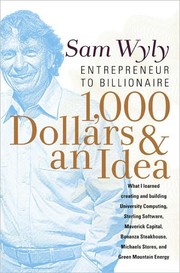
1,000 Dollars and an Idea

1,000 Dollars and an Idea

Sam Wyly
2008
T4 Open Librarygoodreads

Entrepreneur's memoir of building and selling successive companies

Summary

Sam Wyly founded and built several companies including University Computing, Sterling Software, Sterling Commerce, Michaels Stores and Bonanza Steakhouse, and this memoir covers that career from a Louisiana farm through the Dallas business community.

The business content covers his approach to acquisition-driven growth in software, where Sterling assembled a portfolio of mature enterprise software products and ran them for cash rather than for growth, and his early move into computer services and networking at University Computing. He also covers the retail businesses and his political and philanthropic activities.

The reference has not verified the specific claims and figures in this memoir. Readers should note that after publication Wyly and his brother faced Securities and Exchange Commission proceedings over the use of offshore trusts to conceal beneficial ownership of shares in companies they controlled, resulting in a substantial judgement and a personal bankruptcy filing. The book was written before that resolution and does not address it.

As an entrepreneurial memoir it is a first-hand account of building businesses through acquisition and of operating in the Texas business environment across several decades. It is not a management text and offers no framework. Its principal interest is as a record of a serial founder's own account of his decisions, read with the subsequent legal history in mind.

Key takeaways 7

  1. Wyly built businesses primarily through acquisition rather than organic growth, assembling portfolios in software, retail and services.
  2. Sterling Software acquired mature enterprise software products and operated them for cash generation rather than for growth.
  3. Enterprise software maintenance revenue continues long after new sales stop, which is what makes mature software products acquirable at attractive returns.
  4. Entering computer services and time-sharing early gave University Computing a position before the market was established.
  5. Operating across unrelated industries was Wyly's deliberate approach rather than a consequence of opportunity.
  6. The memoir does not address the securities proceedings over offshore trusts that followed its publication and resulted in a substantial judgement.
  7. The reference has not verified the specific claims and figures in this account.

Who should read it

Readers interested in a serial founder's own account of acquisition-driven company building, read with the subsequent legal history in mind.

Who recommended it 1

Similar books 6

Chosen by shared topics, the entries that hold them, and the people who recommended both.

Harvey Samuel Firestong, Samuel Crowther · 1926

Founder's account of building Firestone; business sense from the tyre trade

Derek Sivers · 2011

Lessons from building CD Baby from a side project to an $85 million business.

Where it sits in the reference 2

Business themes
Investment styles

Topics

Entrepreneurship and StartupsBiography and MemoirFounders and EntrepreneursFounder MemoirsFounder stories and advice