Updates

  1. Person pages list letters, writing, profiles and links as sortable tables with filters, and show each person's companies as links; Fund letters show each letter's description in its own column.
  2. Experts show a checked job title and a short description of each person; 30 more people have photographs.
  3. Every company, fund, university and publication the experts work for has a page listing the people there.
  4. Fund letters show each letter's thesis and filter by it; 225 person pages list the essays, columns and newsletter issues the person wrote.
  5. Person pages list every essay and newsletter issue a person wrote, and their own books as a table in List view.
  6. Recommends shows the five largest kinds of book and the rest under More; browse pictures load sooner.
  7. Podcasts and talks link the original episode, filter by Audio and video or Press, and list each publisher once.
  8. Pages are wider, Recommends has List and Grid, and a filter clicked again turns off.
  9. Book cards sit in a ruled grid with Open Library and Goodreads links and each book's one-line note.
  10. Funds is now Investors; each investor's styles are buttons that filter the table.
  11. Podcasts and talks on a person's page filter by year and publisher and show as a list or a grid of pictures.
  12. Quotes show only people's own words: 472 summaries written by list sites are gone.
  13. Country pages open from Browse again, and every link on the shelf lands on a page.
  14. Subject and person pages show their sections as tabs, and each book appears once on a person's page.
  15. Book cards show the quote, who said it and the source; grids show five cards to a row.
  16. On a phone, a menu holds the sections, search, Updates, Feedback and dark mode.
  17. Feedback takes a screenshot of the page with no browser prompt, opens a screenshot full size when you click it, and clears itself once sent.
  18. Book cards are centred, search names the topic each book sits in, and any text cut short shows whole on hover.
  19. Search groups its results by kind: people, companies, geographies, subjects, topics, books, funds, fund letters and papers.
  20. The Books table lists who recommended each book by name, and the browser tab names the section you are in.
  21. Feedback can take a screenshot of the page, or one you paste or choose, and opens in the corner beside Updates.
  22. Each rail button reopens its section where you left it, and Browse, Table and People show on every book and subject page.
  23. Filters grey out choices that hold nothing instead of hiding them, and Books › People filters by authors or recommenders.
  24. Feedback takes a subject line and up to three screenshots.
  25. Biographies are grouped by the person they are about: 41 new pages, from Abraham Lincoln to Lee Kuan Yew.
  26. Sport splits into 23 sports, and Religion into one topic per faith.
  27. Book lists show as cards: the cover, one recommendation quote and every recommender by name.
  28. Seventeen subjects that had two or three pages under different names now have one page each.
  29. Every page lists its Experts as authors and recommenders, with a link to them on the Experts tab.
  30. Economics, Financial history, Financial panics and Accounting are subjects of their own, with one page per financial crisis.
  31. Book, person and subject pages open inside the app, so the tabs stay in view.
  32. 996 more book covers, and photographs or logos for 227 more people and companies.
  33. Books › Browse shows every subject as cards, and the rail holds Fund letters, Papers, Experts, Books and Funds.
  34. Every topic over 150 books splits into narrower topics, each with a page of its own.

Send feedback

What is it?
Screenshots, up to 3 (optional)
or paste one with Ctrl+V

We use your email only to reply to you.

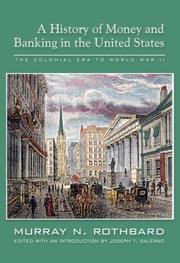
A History of Money and Banking in the United

A History of Money and Banking in the United States

Murray N. Rothbard
2002
T3 510 pages · about 8h 30m to read Open Librarygoodreads

The Austrian counter-history of American banking; polemical but factual.

Summary

Rothbard wrote this from an explicitly Austrian and anti-central-banking position, and it was assembled posthumously from his separate writings on American monetary history from the colonial period to the Second World War.

His interpretive framework holds that fractional reserve banking is inherently unstable and, in his view, fraudulent, because banks issue claims to money they do not hold. From this he reads American monetary history as a series of episodes in which banks and the state combined to expand credit, produced booms and consequent busts, and then used each crisis to argue for further centralisation.

The historical narrative covers colonial paper money, the First and Second Banks of the United States, Jackson's destruction of the Second Bank, the free banking era which Rothbard argues was not genuinely free because of state restrictions, the National Banking Acts and the pyramiding of reserves they created, the panics that followed, and the creation of the Federal Reserve. He treats the Federal Reserve's founding as the outcome of a campaign by large banks, particularly those associated with Morgan and Kuhn Loeb, to obtain a lender of last resort and to cartelise the industry, rather than as a response to public demand. He then argues that Federal Reserve credit expansion during the 1920s produced the 1929 crash, following Mises and Hayek's business cycle theory.

The book is polemical throughout and Rothbard makes no attempt at neutrality. Mainstream monetary historians reject the central claims: the Austrian account of the 1920s and 1929 is not supported by the monetary data, which Friedman and Schwartz read very differently, and the characterisation of fractional reserve banking as fraud is a normative position rather than an analytical finding. The account of the political interests behind the Federal Reserve's creation is closer to the historical consensus than the rest of the book.

Key takeaways 7

  1. Fractional reserve banking issues claims exceeding the money held, which Rothbard treats as the source of banking instability.
  2. The National Banking Acts pyramided reserves through correspondent relationships, which transmitted local shocks nationally.
  3. The free banking era was constrained by state bond collateral requirements and branching restrictions, so it did not test free banking.
  4. The Federal Reserve was created through a campaign by large banking interests rather than in response to public demand.
  5. Each banking crisis was used to argue for further centralisation, which produced the institution the crises were attributed to.
  6. Rothbard attributes the 1929 crash to Federal Reserve credit expansion during the 1920s, following Austrian business cycle theory.
  7. The book argues one position throughout and the central claims are rejected by mainstream monetary historians.

Who should read it

Readers who want the Austrian reading of American monetary history stated fully, alongside the mainstream accounts it argues against.

Similar books 6

Chosen by shared topics, the entries that hold them, and the people who recommended both.

Ben S. Bernanke · 2022

Insider account of the Fed from Burns through the QE era.

Charles P. Kindleberger · 1984

European finance from the Middle Ages on: money, banking, markets and public debt.

Allan H. Meltzer · 2003

The Fed from 1913 to 1951, told from its own minutes and internal memos.

Milton Friedman, Anna Jacobson Schwartz · 1963

The US money stock from 1867 to 1960, and how changes in it drove prices and income.

Where it sits in the reference 1

Financial history

Topics

Financial HistoryEconomics