Updates

  1. Person pages list letters, writing, profiles and links as sortable tables with filters, and show each person's companies as links; Fund letters show each letter's description in its own column.
  2. Experts show a checked job title and a short description of each person; 30 more people have photographs.
  3. Every company, fund, university and publication the experts work for has a page listing the people there.
  4. Fund letters show each letter's thesis and filter by it; 225 person pages list the essays, columns and newsletter issues the person wrote.
  5. Person pages list every essay and newsletter issue a person wrote, and their own books as a table in List view.
  6. Recommends shows the five largest kinds of book and the rest under More; browse pictures load sooner.
  7. Podcasts and talks link the original episode, filter by Audio and video or Press, and list each publisher once.
  8. Pages are wider, Recommends has List and Grid, and a filter clicked again turns off.
  9. Book cards sit in a ruled grid with Open Library and Goodreads links and each book's one-line note.
  10. Funds is now Investors; each investor's styles are buttons that filter the table.
  11. Podcasts and talks on a person's page filter by year and publisher and show as a list or a grid of pictures.
  12. Quotes show only people's own words: 472 summaries written by list sites are gone.
  13. Country pages open from Browse again, and every link on the shelf lands on a page.
  14. Subject and person pages show their sections as tabs, and each book appears once on a person's page.
  15. Book cards show the quote, who said it and the source; grids show five cards to a row.
  16. On a phone, a menu holds the sections, search, Updates, Feedback and dark mode.
  17. Feedback takes a screenshot of the page with no browser prompt, opens a screenshot full size when you click it, and clears itself once sent.
  18. Book cards are centred, search names the topic each book sits in, and any text cut short shows whole on hover.
  19. Search groups its results by kind: people, companies, geographies, subjects, topics, books, funds, fund letters and papers.
  20. The Books table lists who recommended each book by name, and the browser tab names the section you are in.
  21. Feedback can take a screenshot of the page, or one you paste or choose, and opens in the corner beside Updates.
  22. Each rail button reopens its section where you left it, and Browse, Table and People show on every book and subject page.
  23. Filters grey out choices that hold nothing instead of hiding them, and Books › People filters by authors or recommenders.
  24. Feedback takes a subject line and up to three screenshots.
  25. Biographies are grouped by the person they are about: 41 new pages, from Abraham Lincoln to Lee Kuan Yew.
  26. Sport splits into 23 sports, and Religion into one topic per faith.
  27. Book lists show as cards: the cover, one recommendation quote and every recommender by name.
  28. Seventeen subjects that had two or three pages under different names now have one page each.
  29. Every page lists its Experts as authors and recommenders, with a link to them on the Experts tab.
  30. Economics, Financial history, Financial panics and Accounting are subjects of their own, with one page per financial crisis.
  31. Book, person and subject pages open inside the app, so the tabs stay in view.
  32. 996 more book covers, and photographs or logos for 227 more people and companies.
  33. Books › Browse shows every subject as cards, and the rail holds Fund letters, Papers, Experts, Books and Funds.
  34. Every topic over 150 books splits into narrower topics, each with a page of its own.

Send feedback

What is it?
Screenshots, up to 3 (optional)
or paste one with Ctrl+V

We use your email only to reply to you.

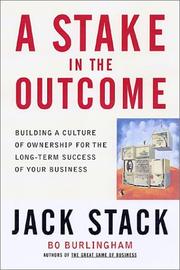
A Stake in the Outcome

A Stake in the Outcome

Jack Stack, Bo Burlingham
2002
T2 272 pages · about 4h 32m to read Open Librarygoodreads

The follow-on on building an ownership culture, not just an ESOP.

Summary

Stack led a management buyout of a Springfield, Missouri engine remanufacturing division from International Harvester in 1983, in a transaction with extreme leverage, and wrote about the ownership culture he built there. This is his second book, following The Great Game of Business.

The method is open-book management. Every employee sees the company's complete financial statements, is taught to read them, and understands how their own work affects the numbers. Weekly meetings review the forecast, with each department reporting its own line and explaining variances. Employees are trained in the income statement, balance sheet and cash flow before being asked to influence them. Bonus plans are tied to a small number of company-level measures that everyone can affect, and the targets change annually to address whatever the business most needs.

The ownership argument is the subject of this book specifically. Stack argues that an employee stock ownership plan alone produces nothing, because employees who do not understand what creates value cannot act on ownership. What matters is teaching people to think like owners, which requires the financial education, the transparency and the connection between decisions and outcomes. He also addresses the harder problems: how to value the shares, how to fund repurchases when employees retire, how to sustain the culture as the company grows and acquires, and what happens when the ownership becomes valuable enough that people leave to realise it.

The evidence is a single company over two decades. Stack is describing what worked in a manufacturing business with a stable product and measurable unit economics, and the transferability to other settings is asserted rather than demonstrated. The book is repetitive and the writing is plain. The practical detail on financial education and on the mechanics of employee ownership funding is what distinguishes it from general advocacy for ownership culture.

Key takeaways 7

  1. Employee ownership produces nothing unless employees understand what creates value in the business.
  2. Every employee should be taught to read the income statement, balance sheet and cash flow before being asked to influence them.
  3. Weekly forecast meetings where each department reports its own line make the connection between work and numbers concrete.
  4. Bonus targets should be few, company-level, and changed annually to address whatever the business most needs.
  5. An employee stock ownership plan creates a funding obligation to repurchase shares from departing employees that must be planned decades ahead.
  6. Sharing complete financial information with employees requires accepting that competitors and customers may learn it.
  7. The value of shares in a private employee-owned company must be established by a defensible method, or the ownership creates disputes rather than commitment.

Who should read it

Owners and operators considering employee ownership who want the practical mechanics of financial education, bonus design and share repurchase funding.

Similar books 6

Chosen by shared topics, the entries that hold them, and the people who recommended both.

David Erdal · 2011

An owner who converted his own firm, on employee ownership in practice.
Corey Rosen, John Case, Martin Staubus · 2005

The NCEO's evidence on when shared ownership raises performance.
Joseph R. Blasi, Douglas L. Kruse, Aaron Bernstein · 2003

Broad-based stock options and what they did to company performance.

Corey Rosen, John Case · 2022

Current survey of ESOPs, worker co-ops and employee trusts.
Jack Stack, Bo Burlingham · 1992

Open-book management: teach every worker to read the financials and share the gains.
Where it sits in the reference 3

Business models
Business themes
Business themes

Topics

Business and ManagementLeadership