Updates

  1. Person pages list letters, writing, profiles and links as sortable tables with filters, and show each person's companies as links; Fund letters show each letter's description in its own column.
  2. Experts show a checked job title and a short description of each person; 30 more people have photographs.
  3. Every company, fund, university and publication the experts work for has a page listing the people there.
  4. Fund letters show each letter's thesis and filter by it; 225 person pages list the essays, columns and newsletter issues the person wrote.
  5. Person pages list every essay and newsletter issue a person wrote, and their own books as a table in List view.
  6. Recommends shows the five largest kinds of book and the rest under More; browse pictures load sooner.
  7. Podcasts and talks link the original episode, filter by Audio and video or Press, and list each publisher once.
  8. Pages are wider, Recommends has List and Grid, and a filter clicked again turns off.
  9. Book cards sit in a ruled grid with Open Library and Goodreads links and each book's one-line note.
  10. Funds is now Investors; each investor's styles are buttons that filter the table.
  11. Podcasts and talks on a person's page filter by year and publisher and show as a list or a grid of pictures.
  12. Quotes show only people's own words: 472 summaries written by list sites are gone.
  13. Country pages open from Browse again, and every link on the shelf lands on a page.
  14. Subject and person pages show their sections as tabs, and each book appears once on a person's page.
  15. Book cards show the quote, who said it and the source; grids show five cards to a row.
  16. On a phone, a menu holds the sections, search, Updates, Feedback and dark mode.
  17. Feedback takes a screenshot of the page with no browser prompt, opens a screenshot full size when you click it, and clears itself once sent.
  18. Book cards are centred, search names the topic each book sits in, and any text cut short shows whole on hover.
  19. Search groups its results by kind: people, companies, geographies, subjects, topics, books, funds, fund letters and papers.
  20. The Books table lists who recommended each book by name, and the browser tab names the section you are in.
  21. Feedback can take a screenshot of the page, or one you paste or choose, and opens in the corner beside Updates.
  22. Each rail button reopens its section where you left it, and Browse, Table and People show on every book and subject page.
  23. Filters grey out choices that hold nothing instead of hiding them, and Books › People filters by authors or recommenders.
  24. Feedback takes a subject line and up to three screenshots.
  25. Biographies are grouped by the person they are about: 41 new pages, from Abraham Lincoln to Lee Kuan Yew.
  26. Sport splits into 23 sports, and Religion into one topic per faith.
  27. Book lists show as cards: the cover, one recommendation quote and every recommender by name.
  28. Seventeen subjects that had two or three pages under different names now have one page each.
  29. Every page lists its Experts as authors and recommenders, with a link to them on the Experts tab.
  30. Economics, Financial history, Financial panics and Accounting are subjects of their own, with one page per financial crisis.
  31. Book, person and subject pages open inside the app, so the tabs stay in view.
  32. 996 more book covers, and photographs or logos for 227 more people and companies.
  33. Books › Browse shows every subject as cards, and the rail holds Fund letters, Papers, Experts, Books and Funds.
  34. Every topic over 150 books splits into narrower topics, each with a page of its own.

Send feedback

What is it?
Screenshots, up to 3 (optional)
or paste one with Ctrl+V

We use your email only to reply to you.

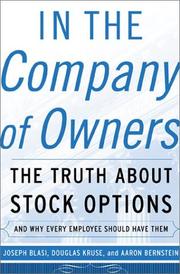
In the Company of Owners

In the Company of Owners

Joseph R. Blasi, Douglas L. Kruse, Aaron Bernstein
2003
T3 256 pages · about 4h 16m to read Open Librarygoodreads

Broad-based stock options and what they did to company performance.

Summary

Joseph Blasi, Douglas Kruse and Aaron Bernstein examine broad-based employee stock options in American companies, particularly in technology, and argue for extending the practice across the economy. Blasi and Kruse are labour economists at Rutgers who have studied employee ownership for decades, and the book combines their empirical work with reporting on specific firms.

The empirical core compares the hundred largest technology companies of the late 1990s with the broader corporate population. The authors find that the technology firms granted options far more widely, that a substantially larger share of the option value went to non-executive employees, and that these firms outperformed on several measures. They argue this partnership capitalism, in which employees hold meaningful equity and participate in decisions about their work, explains part of the performance difference. They contrast it with the pattern in most large companies, where option grants concentrate at the top and function as executive compensation rather than as shared ownership.

The timing is a problem. The book appeared in 2003, drawing on data from a period whose technology valuations were later shown to be inflated, and the accounting change requiring options to be expensed from 2006 substantially reduced broad-based granting. The causal claim is also hard to establish: firms that grant options widely differ from other firms in many ways. The authors are advocates and acknowledge it. The policy chapters proposing tax treatment favouring broad-based plans remain relevant to founders designing equity programmes.

Key takeaways 7

  1. Technology companies of the 1990s distributed option value far more widely across their workforces than the rest of corporate America did.
  2. Broad-based ownership improves performance only when it is combined with actual participation in workplace decisions.
  3. Concentrating equity grants among senior executives converts an ownership mechanism into an ordinary compensation scheme.
  4. Employees holding meaningful equity supply monitoring of their peers that management cannot buy.
  5. The authors argue that tax policy should favour plans that distribute equity broadly over plans that concentrate it.
  6. Employee ownership does not require workers to bear undiversified retirement risk if the equity sits outside the pension plan.
  7. The productivity advantage the authors measure survives controls for industry and firm size, though not for selection into the practice.

Who should read it

Founders and boards designing equity compensation who want the empirical case for distributing ownership widely rather than concentrating it.

Similar books 6

Chosen by shared topics, the entries that hold them, and the people who recommended both.
Corey Rosen, John Case, Martin Staubus · 2005

The NCEO's evidence on when shared ownership raises performance.
Jack Stack, Bo Burlingham · 2002

Building an ownership culture in which employees think and act like owners.

David Erdal · 2011

An owner who converted his own firm, on employee ownership in practice.

Corey Rosen, John Case · 2022

Current survey of ESOPs, worker co-ops and employee trusts.
Jack Stack, Bo Burlingham · 1992

Open-book management: teach every worker to read the financials and share the gains.
Where it sits in the reference 3

Business models
Business themes
Business themes

Topics

Business and ManagementSociology and CultureWork, labour and industrial society