Updates

  1. Person pages list letters, writing, profiles and links as sortable tables with filters, and show each person's companies as links; Fund letters show each letter's description in its own column.
  2. Experts show a checked job title and a short description of each person; 30 more people have photographs.
  3. Every company, fund, university and publication the experts work for has a page listing the people there.
  4. Fund letters show each letter's thesis and filter by it; 225 person pages list the essays, columns and newsletter issues the person wrote.
  5. Person pages list every essay and newsletter issue a person wrote, and their own books as a table in List view.
  6. Recommends shows the five largest kinds of book and the rest under More; browse pictures load sooner.
  7. Podcasts and talks link the original episode, filter by Audio and video or Press, and list each publisher once.
  8. Pages are wider, Recommends has List and Grid, and a filter clicked again turns off.
  9. Book cards sit in a ruled grid with Open Library and Goodreads links and each book's one-line note.
  10. Funds is now Investors; each investor's styles are buttons that filter the table.
  11. Podcasts and talks on a person's page filter by year and publisher and show as a list or a grid of pictures.
  12. Quotes show only people's own words: 472 summaries written by list sites are gone.
  13. Country pages open from Browse again, and every link on the shelf lands on a page.
  14. Subject and person pages show their sections as tabs, and each book appears once on a person's page.
  15. Book cards show the quote, who said it and the source; grids show five cards to a row.
  16. On a phone, a menu holds the sections, search, Updates, Feedback and dark mode.
  17. Feedback takes a screenshot of the page with no browser prompt, opens a screenshot full size when you click it, and clears itself once sent.
  18. Book cards are centred, search names the topic each book sits in, and any text cut short shows whole on hover.
  19. Search groups its results by kind: people, companies, geographies, subjects, topics, books, funds, fund letters and papers.
  20. The Books table lists who recommended each book by name, and the browser tab names the section you are in.
  21. Feedback can take a screenshot of the page, or one you paste or choose, and opens in the corner beside Updates.
  22. Each rail button reopens its section where you left it, and Browse, Table and People show on every book and subject page.
  23. Filters grey out choices that hold nothing instead of hiding them, and Books › People filters by authors or recommenders.
  24. Feedback takes a subject line and up to three screenshots.
  25. Biographies are grouped by the person they are about: 41 new pages, from Abraham Lincoln to Lee Kuan Yew.
  26. Sport splits into 23 sports, and Religion into one topic per faith.
  27. Book lists show as cards: the cover, one recommendation quote and every recommender by name.
  28. Seventeen subjects that had two or three pages under different names now have one page each.
  29. Every page lists its Experts as authors and recommenders, with a link to them on the Experts tab.
  30. Economics, Financial history, Financial panics and Accounting are subjects of their own, with one page per financial crisis.
  31. Book, person and subject pages open inside the app, so the tabs stay in view.
  32. 996 more book covers, and photographs or logos for 227 more people and companies.
  33. Books › Browse shows every subject as cards, and the rail holds Fund letters, Papers, Experts, Books and Funds.
  34. Every topic over 150 books splits into narrower topics, each with a page of its own.

Send feedback

What is it?
Screenshots, up to 3 (optional)
or paste one with Ctrl+V

We use your email only to reply to you.

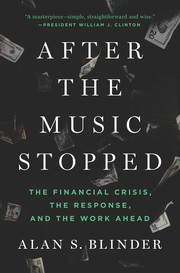
After the Music Stopped

After the Music Stopped

Alan S. Blinder
2013
T2 476 pages · about 7h 56m to read Open Librarygoodreads

The clearest economist's account of the crisis and the policy response.

Summary

Blinder, a Princeton economist and former Federal Reserve vice chairman, wrote an explanation of the financial crisis, the policy response and the aftermath, aimed at general readers but written by someone who understands the technical material.

The causal account identifies multiple contributing factors rather than a single cause: the housing bubble; the deterioration of mortgage underwriting; the securitisation chain that separated the originator from the ultimate holder and removed the incentive to assess credit; the rating agencies' failure and the conflict created by issuer payment; excessive leverage across the financial system, particularly at investment banks and in off-balance-sheet vehicles; the growth of credit derivatives without central clearing or collateral discipline; regulatory gaps including the exemption of derivatives and the absence of any regulator with a systemic mandate; and compensation structures rewarding volume and short-term results.

The policy chapters explain what was done and defend most of it. Blinder walks through the Federal Reserve facilities, the Troubled Asset Relief Program, the stress tests which he regards as the single most effective intervention, the automobile rescues, and the fiscal stimulus. He argues that the response prevented a depression, that it was less costly than the public believes since most of the capital was repaid, and that it was politically catastrophic because it appeared to rescue the people responsible.

The reform chapters assess the Dodd-Frank Act, identifying what it addressed and what it did not.

Blinder is a participant in the policy world defending broadly the actions taken, and readers should weigh that. His treatment of alternatives, particularly on mortgage principal reduction where he is critical of what was done, is more nuanced than his defence of the bank rescues. The book is one of the clearest single-volume explanations of the technical mechanisms for a non-specialist reader.

Key takeaways 7

  1. Securitisation separated the mortgage originator from the ultimate holder, which removed the incentive to assess whether the borrower could pay.
  2. Rating agencies were paid by issuers and rated instruments whose models they had helped design, which is a structural conflict rather than negligence.
  3. Leverage at investment banks and in off-balance-sheet vehicles meant small asset value declines eliminated equity entirely.
  4. No regulator had a mandate covering the financial system as a whole, so risks that crossed institutional boundaries were nobody's responsibility.
  5. The 2009 bank stress tests were the most effective single intervention because they resolved uncertainty about which institutions were solvent.
  6. Most of the capital deployed in the rescue programmes was repaid, so the fiscal cost was far smaller than the public believes.
  7. The rescue succeeded economically and failed politically, because it appeared to protect the people who caused the crisis.

Who should read it

Readers who want one clear explanation of the crisis mechanisms and the policy response from someone who understands both.

Similar books 6

Chosen by shared topics, the entries that hold them, and the people who recommended both.

Adam Tooze · 2018

The 2008 crash, the eurozone crisis and the politics after as one connected story.

Viral V. Acharya, Matthew Richardson, Stijn van Nieuwerburgh, Lawrence J. White · 2011

Recommended by: Mohnish Pabrai

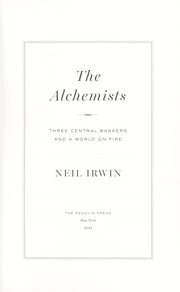
Neil Irwin · 2013

The 2007 to 2012 crises through three central bankers: Bernanke, King and Trichet.

Sheila Bair · 2012

The 2008 crisis from inside the FDIC, which closed failed banks and guarded deposits.

Recommended by: Mohnish Pabrai

Raghuram G. Rajan · 2010

The 2008 crisis grew from political and economic imbalances, not just banker greed.

Where it sits in the reference 1

Financial panics

Topics

Financial HistoryEconomicsPolitics and GovernmentRegulation, central banks and public policy