Updates

  1. Person pages list letters, writing, profiles and links as sortable tables with filters, and show each person's companies as links; Fund letters show each letter's description in its own column.
  2. Experts show a checked job title and a short description of each person; 30 more people have photographs.
  3. Every company, fund, university and publication the experts work for has a page listing the people there.
  4. Fund letters show each letter's thesis and filter by it; 225 person pages list the essays, columns and newsletter issues the person wrote.
  5. Person pages list every essay and newsletter issue a person wrote, and their own books as a table in List view.
  6. Recommends shows the five largest kinds of book and the rest under More; browse pictures load sooner.
  7. Podcasts and talks link the original episode, filter by Audio and video or Press, and list each publisher once.
  8. Pages are wider, Recommends has List and Grid, and a filter clicked again turns off.
  9. Book cards sit in a ruled grid with Open Library and Goodreads links and each book's one-line note.
  10. Funds is now Investors; each investor's styles are buttons that filter the table.
  11. Podcasts and talks on a person's page filter by year and publisher and show as a list or a grid of pictures.
  12. Quotes show only people's own words: 472 summaries written by list sites are gone.
  13. Country pages open from Browse again, and every link on the shelf lands on a page.
  14. Subject and person pages show their sections as tabs, and each book appears once on a person's page.
  15. Book cards show the quote, who said it and the source; grids show five cards to a row.
  16. On a phone, a menu holds the sections, search, Updates, Feedback and dark mode.
  17. Feedback takes a screenshot of the page with no browser prompt, opens a screenshot full size when you click it, and clears itself once sent.
  18. Book cards are centred, search names the topic each book sits in, and any text cut short shows whole on hover.
  19. Search groups its results by kind: people, companies, geographies, subjects, topics, books, funds, fund letters and papers.
  20. The Books table lists who recommended each book by name, and the browser tab names the section you are in.
  21. Feedback can take a screenshot of the page, or one you paste or choose, and opens in the corner beside Updates.
  22. Each rail button reopens its section where you left it, and Browse, Table and People show on every book and subject page.
  23. Filters grey out choices that hold nothing instead of hiding them, and Books › People filters by authors or recommenders.
  24. Feedback takes a subject line and up to three screenshots.
  25. Biographies are grouped by the person they are about: 41 new pages, from Abraham Lincoln to Lee Kuan Yew.
  26. Sport splits into 23 sports, and Religion into one topic per faith.
  27. Book lists show as cards: the cover, one recommendation quote and every recommender by name.
  28. Seventeen subjects that had two or three pages under different names now have one page each.
  29. Every page lists its Experts as authors and recommenders, with a link to them on the Experts tab.
  30. Economics, Financial history, Financial panics and Accounting are subjects of their own, with one page per financial crisis.
  31. Book, person and subject pages open inside the app, so the tabs stay in view.
  32. 996 more book covers, and photographs or logos for 227 more people and companies.
  33. Books › Browse shows every subject as cards, and the rail holds Fund letters, Papers, Experts, Books and Funds.
  34. Every topic over 150 books splits into narrower topics, each with a page of its own.

Send feedback

What is it?
Screenshots, up to 3 (optional)
or paste one with Ctrl+V

We use your email only to reply to you.

All the Devils Are Here: The Hidden History

All the Devils Are Here: The Hidden History of the Financial Crisis

Bethany McLean, Joe Nocera
2010
T1 389 pages · about 6h 29m to read Open Librarygoodreads

Traces AIG Financial Products' swap book back to its origins.

Summary

McLean and Nocera trace the 2008 crisis back to the 1980s rather than to the housing bubble, following the institutions and individuals over twenty-five years: Lewis Ranieri's creation of the mortgage-backed securities market at Salomon, the growth of Fannie Mae and Freddie Mac under Jim Johnson, the subprime lenders including Household, Ameriquest and Countrywide, the credit default swap business at AIG Financial Products, the rating agencies, and the regulators who declined to act.

The argument is that the crisis required all of these to fail simultaneously and that each failure had a specific institutional cause. Fannie and Freddie used their implicit government guarantee to build enormous leveraged portfolios while lobbying successfully against any capital requirement that would constrain them. Rating agencies were paid by issuers and competed on the ratings they would assign. Subprime originators sold loans immediately and therefore had no exposure to their performance. AIG wrote credit protection with no reserve because the accounting treated it as insurance rather than as a derivative. Regulators, particularly the Federal Reserve under Greenspan, declined to use authority they possessed over mortgage underwriting standards.

The reporting is detailed and the authors are careful about apportioning responsibility, which distinguishes it from accounts that identify a single villain. It is the best available single-volume institutional history of the crisis. Its limitation is scope: the mechanics of the funding run and the policy response during 2008 itself get less attention than the origins, and readers wanting those should pair it with accounts focused on the crisis weeks.

Key takeaways 7

  1. The crisis had a twenty-five-year origin in the creation of the mortgage securitisation market, not a five-year one in the housing bubble.
  2. Originators who sold loans immediately had no exposure to their performance, which removed the only party with an incentive to verify borrower quality.
  3. Rating agencies were paid by the issuers whose securities they rated and competed for that business on the ratings they would give.
  4. Fannie Mae and Freddie Mac used an implicit government guarantee to fund leveraged portfolios and defeated every attempt to impose adequate capital requirements through lobbying.
  5. AIG wrote credit default protection without reserves because the accounting treated the exposure as insurance rather than as a derivative position requiring collateral.
  6. Regulators possessed the legal authority to set mortgage underwriting standards and declined to use it as a matter of policy.
  7. Each institution behaved rationally given its own incentives, which is why identifying individual villains explains less than examining the structure does.

Who should read it

Investors and risk managers who want the institutional origins of the 2008 crisis traced through the specific incentive failures at each participant.

About Bethany McLean

Investigative business journalist; Vanity Fair contributing editor, formerly Fortune

The Smartest Guys in the Room remains the definitive account of Enron and her Fortune reporting broke the story before the collapse.

Vanity Fair, Fortune

Similar books 6

Chosen by shared topics, the entries that hold them, and the people who recommended both.
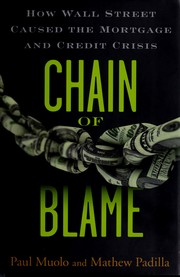
Paul Muolo, Mathew Padilla · 2008

Closest coverage: Countrywide is a central thread in the trade-press account of the industry.

Michael W. Hudson · 2010

Origination-floor reporting on the subprime lenders Countrywide competed against and copied.

Andrew Ross Sorkin · 2009

Inside the meetings of bankers and regulators during the 2008 financial crisis.

Roddy Boyd · 2011

How AIG's derivatives unit led the world's largest insurer to a $180 billion rescue.
Where it sits in the reference 4

Journalists
Companies
Companies
Financial panics

Topics

Financial HistoryFinance and Markets