Updates

  1. Person pages list letters, writing, profiles and links as sortable tables with filters, and show each person's companies as links; Fund letters show each letter's description in its own column.
  2. Experts show a checked job title and a short description of each person; 30 more people have photographs.
  3. Every company, fund, university and publication the experts work for has a page listing the people there.
  4. Fund letters show each letter's thesis and filter by it; 225 person pages list the essays, columns and newsletter issues the person wrote.
  5. Person pages list every essay and newsletter issue a person wrote, and their own books as a table in List view.
  6. Recommends shows the five largest kinds of book and the rest under More; browse pictures load sooner.
  7. Podcasts and talks link the original episode, filter by Audio and video or Press, and list each publisher once.
  8. Pages are wider, Recommends has List and Grid, and a filter clicked again turns off.
  9. Book cards sit in a ruled grid with Open Library and Goodreads links and each book's one-line note.
  10. Funds is now Investors; each investor's styles are buttons that filter the table.
  11. Podcasts and talks on a person's page filter by year and publisher and show as a list or a grid of pictures.
  12. Quotes show only people's own words: 472 summaries written by list sites are gone.
  13. Country pages open from Browse again, and every link on the shelf lands on a page.
  14. Subject and person pages show their sections as tabs, and each book appears once on a person's page.
  15. Book cards show the quote, who said it and the source; grids show five cards to a row.
  16. On a phone, a menu holds the sections, search, Updates, Feedback and dark mode.
  17. Feedback takes a screenshot of the page with no browser prompt, opens a screenshot full size when you click it, and clears itself once sent.
  18. Book cards are centred, search names the topic each book sits in, and any text cut short shows whole on hover.
  19. Search groups its results by kind: people, companies, geographies, subjects, topics, books, funds, fund letters and papers.
  20. The Books table lists who recommended each book by name, and the browser tab names the section you are in.
  21. Feedback can take a screenshot of the page, or one you paste or choose, and opens in the corner beside Updates.
  22. Each rail button reopens its section where you left it, and Browse, Table and People show on every book and subject page.
  23. Filters grey out choices that hold nothing instead of hiding them, and Books › People filters by authors or recommenders.
  24. Feedback takes a subject line and up to three screenshots.
  25. Biographies are grouped by the person they are about: 41 new pages, from Abraham Lincoln to Lee Kuan Yew.
  26. Sport splits into 23 sports, and Religion into one topic per faith.
  27. Book lists show as cards: the cover, one recommendation quote and every recommender by name.
  28. Seventeen subjects that had two or three pages under different names now have one page each.
  29. Every page lists its Experts as authors and recommenders, with a link to them on the Experts tab.
  30. Economics, Financial history, Financial panics and Accounting are subjects of their own, with one page per financial crisis.
  31. Book, person and subject pages open inside the app, so the tabs stay in view.
  32. 996 more book covers, and photographs or logos for 227 more people and companies.
  33. Books › Browse shows every subject as cards, and the rail holds Fund letters, Papers, Experts, Books and Funds.
  34. Every topic over 150 books splits into narrower topics, each with a page of its own.

Send feedback

What is it?
Screenshots, up to 3 (optional)
or paste one with Ctrl+V

We use your email only to reply to you.

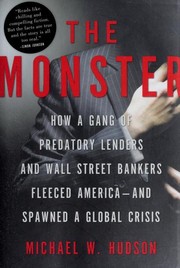
The Monster: How a Gang of Predatory Lenders

The Monster: How a Gang of Predatory Lenders and Wall Street Bankers Fleeced America

Michael W. Hudson
2010
T3 365 pages · about 6h 5m to read Open Librarygoodreads

Origination-floor reporting on the subprime lenders Countrywide competed against and copied.

Summary

Michael Hudson, an investigative reporter who covered consumer lending for years before the crisis, traces subprime mortgage lending from its origins in the 1990s through the collapse. Ameriquest and its founder Roland Arnall are the central subject.

The reporting is at ground level. Hudson interviewed loan officers, branch managers and borrowers, and documents the specific sales practices: falsifying income documentation, altering appraisals, misrepresenting loan terms at closing, switching documents at signing, and targeting elderly and minority borrowers with existing home equity. He documents the compensation structure, in which loan officers earned yield spread premiums for placing borrowers in higher-rate loans than they qualified for, and the branch culture that produced the behaviour.

The second thread is the Wall Street funding that made it possible. Hudson shows how investment banks bought these loans, securitised them, and eventually acquired originators outright to secure supply, and how the due diligence firms they engaged found large defect rates in loan pools that were securitised anyway. He also documents the regulatory failures, including the preemption of state consumer protection laws for federally chartered institutions and the political access that Arnall obtained through political donations. The book is angry and one-sided, and Hudson does not engage the argument that many borrowers understood what they were signing. The documentation of origination practices is unmatched.

Key takeaways 7

  1. Loan officers earned yield spread premiums for placing borrowers in higher-rate loans than they qualified for.
  2. Hudson documents systematic falsification of income documents, appraisals and closing paperwork at large originators.
  3. Investment banks acquired originators outright to secure loan supply for their securitisation pipelines.
  4. Due diligence firms found high defect rates in loan pools that were securitised without disclosure of those findings.
  5. Federal preemption removed state consumer protection laws from institutions that chose federal charters.
  6. Subprime lending targeted borrowers with existing home equity rather than borrowers seeking to buy, which made it an extraction rather than a credit expansion.
  7. Hudson does not engage the argument that many borrowers understood the terms, which is the account's principal gap.

Who should read it

Investors and regulators who want ground-level documentation of subprime origination practices and of how securitisation demand shaped them.

Similar books 6

Chosen by shared topics, the entries that hold them, and the people who recommended both.
Bethany McLean, Joe Nocera · 2010

The 2008 crisis traced back 25 years to mortgage bonds, Fannie Mae and subprime.
Paul Muolo, Mathew Padilla · 2008

Closest coverage: Countrywide is a central thread in the trade-press account of the industry.

Gillian Tett · 2009

How a JPMorgan team invented credit default swaps that other banks then misused.
Michael Lewis · 2008

Journalism written during four crises, from the 1987 crash to LTCM's collapse.

Recommended by: Mohnish Pabrai, Seth Klarman

Where it sits in the reference 2

Companies
Financial panics

Topics

Financial HistoryFinance and Markets