Updates

  1. Person pages list letters, writing, profiles and links as sortable tables with filters, and show each person's companies as links; Fund letters show each letter's description in its own column.
  2. Experts show a checked job title and a short description of each person; 30 more people have photographs.
  3. Every company, fund, university and publication the experts work for has a page listing the people there.
  4. Fund letters show each letter's thesis and filter by it; 225 person pages list the essays, columns and newsletter issues the person wrote.
  5. Person pages list every essay and newsletter issue a person wrote, and their own books as a table in List view.
  6. Recommends shows the five largest kinds of book and the rest under More; browse pictures load sooner.
  7. Podcasts and talks link the original episode, filter by Audio and video or Press, and list each publisher once.
  8. Pages are wider, Recommends has List and Grid, and a filter clicked again turns off.
  9. Book cards sit in a ruled grid with Open Library and Goodreads links and each book's one-line note.
  10. Funds is now Investors; each investor's styles are buttons that filter the table.
  11. Podcasts and talks on a person's page filter by year and publisher and show as a list or a grid of pictures.
  12. Quotes show only people's own words: 472 summaries written by list sites are gone.
  13. Country pages open from Browse again, and every link on the shelf lands on a page.
  14. Subject and person pages show their sections as tabs, and each book appears once on a person's page.
  15. Book cards show the quote, who said it and the source; grids show five cards to a row.
  16. On a phone, a menu holds the sections, search, Updates, Feedback and dark mode.
  17. Feedback takes a screenshot of the page with no browser prompt, opens a screenshot full size when you click it, and clears itself once sent.
  18. Book cards are centred, search names the topic each book sits in, and any text cut short shows whole on hover.
  19. Search groups its results by kind: people, companies, geographies, subjects, topics, books, funds, fund letters and papers.
  20. The Books table lists who recommended each book by name, and the browser tab names the section you are in.
  21. Feedback can take a screenshot of the page, or one you paste or choose, and opens in the corner beside Updates.
  22. Each rail button reopens its section where you left it, and Browse, Table and People show on every book and subject page.
  23. Filters grey out choices that hold nothing instead of hiding them, and Books › People filters by authors or recommenders.
  24. Feedback takes a subject line and up to three screenshots.
  25. Biographies are grouped by the person they are about: 41 new pages, from Abraham Lincoln to Lee Kuan Yew.
  26. Sport splits into 23 sports, and Religion into one topic per faith.
  27. Book lists show as cards: the cover, one recommendation quote and every recommender by name.
  28. Seventeen subjects that had two or three pages under different names now have one page each.
  29. Every page lists its Experts as authors and recommenders, with a link to them on the Experts tab.
  30. Economics, Financial history, Financial panics and Accounting are subjects of their own, with one page per financial crisis.
  31. Book, person and subject pages open inside the app, so the tabs stay in view.
  32. 996 more book covers, and photographs or logos for 227 more people and companies.
  33. Books › Browse shows every subject as cards, and the rail holds Fund letters, Papers, Experts, Books and Funds.
  34. Every topic over 150 books splits into narrower topics, each with a page of its own.

Send feedback

What is it?
Screenshots, up to 3 (optional)
or paste one with Ctrl+V

We use your email only to reply to you.

The Foreclosure of America: The Inside Story

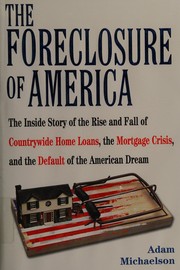
The Foreclosure of America: The Inside Story of the Rise and Fall of Countrywide Home Loans, the Mortgage Crisis, and the Default of the American Dream

Adam Michaelson
2009
T3 354 pages · about 5h 54m to read Open Librarygoodreads

Insider account by a Countrywide marketing executive; the one dedicated book.

Summary

Adam Michaelson was a marketing executive at Countrywide Financial, the largest American mortgage originator before its collapse, and wrote this account from inside the company.

His perspective is unusual: he worked on the marketing of the products rather than on their underwriting or funding, and the book describes how the loans were sold. He covers the pay-option adjustable rate mortgage, which allowed borrowers to make payments smaller than the accruing interest so that the balance grew, and describes the internal discussions about how to market it. He describes the growth targets, the market share objective that Angelo Mozilo set, and the competitive dynamic in which Countrywide matched whatever underwriting standards its competitors abandoned.

Michaelson is candid that he participated and that he raised concerns only weakly, and he writes about the internal culture in which questioning the products was career-limiting. The book is a memoir rather than an investigation and does not cover the funding structure, the securitisation, the regulatory position or the legal aftermath in any depth. Readers wanting those should go elsewhere, including to Michael Hudson's The Monster and to the Securities and Exchange Commission's case against Mozilo. Its value is the account of how these products were presented to borrowers and to the sales force.

Key takeaways 7

  1. Pay-option mortgages allowed borrowers to make payments below accruing interest, so balances grew while borrowers believed they were paying.
  2. Countrywide matched whatever underwriting standards its competitors abandoned, because market share was the stated objective.
  3. Marketing presented negative amortisation products in terms of monthly payment rather than of total obligation.
  4. Employees who questioned the products found it career-limiting, which Michaelson describes from personal experience.
  5. Growth targets set at the top translated into underwriting decisions at the bottom without any explicit instruction to lower standards.
  6. Michaelson participated and raised concerns only weakly, which he states directly.
  7. The book covers marketing and internal culture and does not address funding, securitisation or the regulatory position.

Who should read it

Readers wanting an insider account of how subprime and option mortgage products were marketed, with awareness of the narrow perspective.

Similar books 6

Chosen by shared topics, the entries that hold them, and the people who recommended both.
Bethany McLean, Joe Nocera · 2010

The 2008 crisis traced back 25 years to mortgage bonds, Fannie Mae and subprime.
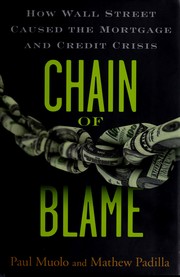
Paul Muolo, Mathew Padilla · 2008

Closest coverage: Countrywide is a central thread in the trade-press account of the industry.

Michael W. Hudson · 2010

Origination-floor reporting on the subprime lenders Countrywide competed against and copied.
Alex Brummer · 2008

By the Daily Mail City editor; Northern Rock as the opening of the crisis.

Where it sits in the reference 2

Companies
Financial panics

Topics

Company HistoriesFinancial History