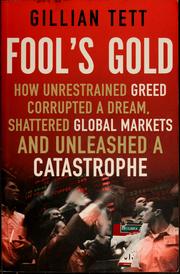
Fool's Gold
The J.P. Morgan derivatives team that built the modern credit swap.
Summary
Tett, an anthropologist by training who covered capital markets for the Financial Times, follows the small JPMorgan derivatives team that developed the credit default swap and the synthetic collateralised debt obligation in the mid-1990s, and tracks what happened when the techniques spread beyond the people who built them.
The narrative centres on the 1997 BISTRO transaction, in which JPMorgan transferred the credit risk of a large corporate loan portfolio to investors, freeing regulatory capital. Tett shows the team understood the instrument's limits, that they concluded the mathematics did not work for mortgage risk because there was no reliable way to model correlation in a housing downturn, and that JPMorgan therefore stayed out of the subprime CDO business that other banks built with the same tools.
The wider argument is anthropological. Tett attributes the failure to the silo structure of banks, where the people who priced risk, the people who held it and the people responsible for the bank as a whole did not communicate, and to the social dynamics of a specialist community whose language excluded outsiders including regulators and senior management. She was one of the few journalists writing about credit derivative risks before 2007.
The book is strongest on the instruments' invention and weakest on the crisis's resolution, and its sympathetic treatment of the JPMorgan team reflects her access to them. It is best paired with an account that covers the institutions that actually blew up.
Key takeaways 7
- The credit default swap and the synthetic collateralised debt obligation were invented by a small JPMorgan team to free regulatory capital against corporate loan portfolios.
- The inventors concluded the technique could not be applied to mortgage risk because correlation in a housing downturn could not be modelled, and JPMorgan stayed out of that business as a result.
- Regulatory capital arbitrage, not risk transfer, was the primary commercial purpose of the early structures.
- Banks failed to see the accumulating risk because the functions that priced, held and supervised it were organised in separate silos that did not share information.
- The technical language of a specialist community excluded senior management and regulators from understanding what the community was doing.
- Once an instrument spreads beyond the people who built it, its assumptions are applied in contexts the designers had explicitly ruled out.
- Correlation assumptions were the single point of failure in mortgage CDO pricing, and they were adopted because they made the instruments saleable rather than because they were defensible.
Who should read it
Investors and risk managers interested in how a financial instrument's assumptions get lost as it spreads, and in the organisational reasons banks failed to see their own exposure.
About Gillian Tett
Financial Times columnist and editorial board member, and Provost of King's College, Cambridge; trained as a social anthropologist.
Fool's Gold follows credit derivatives from the J.P. Morgan team that designed them to the losses of 2008, showing how an instrument built to transfer risk was used instead to add leverage. The Silo Effect applies anthropological fieldwork to organisations, examining why specialised teams inside banks and technology firms stop passing information to each other.
Similar books 6
Chosen by shared topics, the entries that hold them, and the people who recommended both.
The 2008 crisis traced back 25 years to mortgage bonds, Fannie Mae and subprime.
Closest coverage: Countrywide is a central thread in the trade-press account of the industry.

Regulatory history explaining how a thrift-charter lender grew unsupervised.
Journalism written during four crises, from the 1987 crash to LTCM's collapse.
Recommended by: Mohnish Pabrai, Seth Klarman
Papers explaining the 2007 crisis as a run on the repo and securitisation system.
The few investors who saw subprime mortgage bonds would fail, and bet against them.
Recommended by: Mohnish Pabrai and 5 others
Where it sits in the reference 3
Topics