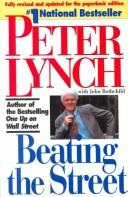
Beating the Street
A stock-by-stock account of how the Magellan Fund's picks were chosen.
Lynch's stock-by-stock walkthrough of how he picked them.
Summary
Lynch's second book, published in 1993 after he retired from managing Magellan, is more practical and more specific than One Up on Wall Street. Its centrepiece is a detailed account of how he selected the twenty-one stocks he recommended in Barron's in 1992, showing the reasoning, the data he examined and the questions he asked management.
The book also covers his method of managing Magellan, including the volume of company visits and calls he made, the turnover, the willingness to hold hundreds of positions, and how he handled the fund growing from twenty million to fourteen billion dollars. He is candid that size forced changes in the approach and eventually made his original method impossible.
The most useful section for individual investors is his account of the St Agnes School portfolio, where a class of seventh graders selecting companies they knew outperformed the market, which Lynch uses to argue for the value of ordinary observation combined with basic financial checking. He gives sector-specific guidance on retailers, on cyclicals, on savings and loan institutions and on utilities in distress, with the specific metrics to check in each. His work on savings and loans after the crisis, buying institutions trading below book value with adequate capital, is a well-documented example of buying in a category everyone was avoiding.
The book is dated in its data sources and in its market conditions, and Lynch's methods depend on time few individuals have. The retail investor advantage he describes has narrowed. The sector checklists and the account of how he actually made specific decisions remain the most concrete published record of a successful stock picker's process.
Key takeaways 8
- Lynch documents the specific reasoning behind twenty-one recommendations, which makes his method checkable rather than merely described.
- An individual investor's advantage lies in following a small number of companies closely rather than in covering a wide market.
- Fund size forces changes in method, and Lynch states that Magellan's growth made his original approach impossible.
- Different sectors require different metrics, and applying a general framework to cyclicals, retailers or financial institutions produces predictable errors.
- Whole categories become mispriced when a crisis makes them untouchable, and Lynch bought savings and loan institutions on that basis after the crisis.
- A company's story should be checkable against a small number of specific numbers, and Lynch gives the ones he examined for each type of business.
- Calling companies and asking direct questions about competitors, costs and expansion plans produced information not available in the filings.
- Selling a good company because the price rose, and holding a deteriorating one because the price fell, is the most common and most expensive pattern among individual investors.
Who should read it
Individual investors who want a documented record of how a successful stock picker actually reached specific decisions, with sector-level checklists.
About Peter Lynch
Manager, Fidelity Magellan Fund 1977-1990
A documented 29% annualized record at Magellan plus three books that outlived their news cycle and put 'buy what you know' into general use.
Who recommended it 6 · 4 direct
“Peter Lynch wrote an excellent paragraph on this subject in “Beating the Street”, an exceptional book that I read when I started out in 1992.”
“I strongly recommend all of Peter Lynch's book esp. this one and One up on Wall Street.”
Similar books 6
Chosen by shared topics, the entries that hold them, and the people who recommended both.
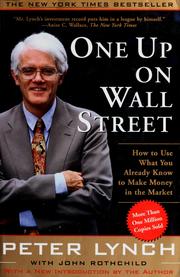
How individual investors can use what they know to find stocks before professionals.
“In November 1992, after juggling with all sorts of investing approaches, I read “One Up on Wall Street” by Peter Lynch.” — Francois Rochon
Source: Giverny Capital Annual Letter to Partners 2011, page 6
Recommended by: David Rolfe, Francisco Garcia Parames and 10 others
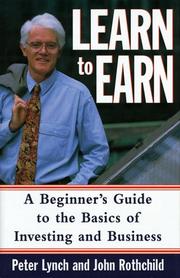
An introduction to business and investing for teenagers and beginners.
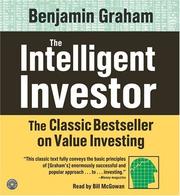
Treat stocks as parts of businesses and buy only with a margin of safety.
“Although I’ve been reading The Intelligent Investor on a regular basis over the years, I never reread the 1958 speech, until I came across a Latin quote from Ben Graham and searched far and wide for its origin.” — Francois Rochon
Source: Giverny Capital Annual Letter to Partners 2018, page 9
Recommended by: Benjamin Graham, Christopher Bloomstran and 32 others
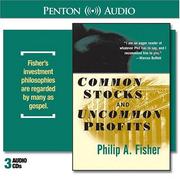
Buy a few outstanding growth companies, research them by scuttlebutt, and hold.
“In his book « Common stocks and Uncommon Profits », the legendary investor Philip Fisher devoted a complete chapter on “when to buy”.” — Francois Rochon
Source: Giverny Capital Annual Letter to Partners 2003, page 3
Recommended by: Arnold Van Den Berg, Bill Stewart and 12 others
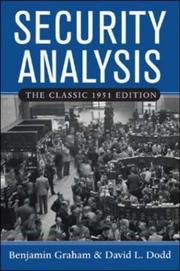
How to read financial statements sceptically and value bonds and stocks.
“I am reminded once again of the quote that sits in the front of Ben Graham’s Security Analysis, from Horace’s Ars Poetica: “Many shall be restored that now are fallen and many shall fall that now are in honor.” — Bill Miller
Source: 2007 Q3 Market Commentary
Recommended by: Bill Miller, Christopher Bloomstran and 18 others
Buffett's method as tests of the business, its managers, its finances and price.
“Tim, there's a book out called The Warren Buffett Way, and I was asked to write the foreword for the latest edition” — Howard Marks
Source: The Tim Ferriss Show Transcripts: Howard Marks (#338)
Recommended by: Howard Marks, Mohnish Pabrai, Bill Ackman and 1 other
Where it sits in the reference 4
Topics 1
As an Amazon Associate I earn from qualifying purchases.