Updates

  1. Person pages list letters, writing, profiles and links as sortable tables with filters, and show each person's companies as links; Fund letters show each letter's description in its own column.
  2. Experts show a checked job title and a short description of each person; 30 more people have photographs.
  3. Every company, fund, university and publication the experts work for has a page listing the people there.
  4. Fund letters show each letter's thesis and filter by it; 225 person pages list the essays, columns and newsletter issues the person wrote.
  5. Person pages list every essay and newsletter issue a person wrote, and their own books as a table in List view.
  6. Recommends shows the five largest kinds of book and the rest under More; browse pictures load sooner.
  7. Podcasts and talks link the original episode, filter by Audio and video or Press, and list each publisher once.
  8. Pages are wider, Recommends has List and Grid, and a filter clicked again turns off.
  9. Book cards sit in a ruled grid with Open Library and Goodreads links and each book's one-line note.
  10. Funds is now Investors; each investor's styles are buttons that filter the table.
  11. Podcasts and talks on a person's page filter by year and publisher and show as a list or a grid of pictures.
  12. Quotes show only people's own words: 472 summaries written by list sites are gone.
  13. Country pages open from Browse again, and every link on the shelf lands on a page.
  14. Subject and person pages show their sections as tabs, and each book appears once on a person's page.
  15. Book cards show the quote, who said it and the source; grids show five cards to a row.
  16. On a phone, a menu holds the sections, search, Updates, Feedback and dark mode.
  17. Feedback takes a screenshot of the page with no browser prompt, opens a screenshot full size when you click it, and clears itself once sent.
  18. Book cards are centred, search names the topic each book sits in, and any text cut short shows whole on hover.
  19. Search groups its results by kind: people, companies, geographies, subjects, topics, books, funds, fund letters and papers.
  20. The Books table lists who recommended each book by name, and the browser tab names the section you are in.
  21. Feedback can take a screenshot of the page, or one you paste or choose, and opens in the corner beside Updates.
  22. Each rail button reopens its section where you left it, and Browse, Table and People show on every book and subject page.
  23. Filters grey out choices that hold nothing instead of hiding them, and Books › People filters by authors or recommenders.
  24. Feedback takes a subject line and up to three screenshots.
  25. Biographies are grouped by the person they are about: 41 new pages, from Abraham Lincoln to Lee Kuan Yew.
  26. Sport splits into 23 sports, and Religion into one topic per faith.
  27. Book lists show as cards: the cover, one recommendation quote and every recommender by name.
  28. Seventeen subjects that had two or three pages under different names now have one page each.
  29. Every page lists its Experts as authors and recommenders, with a link to them on the Experts tab.
  30. Economics, Financial history, Financial panics and Accounting are subjects of their own, with one page per financial crisis.
  31. Book, person and subject pages open inside the app, so the tabs stay in view.
  32. 996 more book covers, and photographs or logos for 227 more people and companies.
  33. Books › Browse shows every subject as cards, and the rail holds Fund letters, Papers, Experts, Books and Funds.
  34. Every topic over 150 books splits into narrower topics, each with a page of its own.

Send feedback

What is it?
Screenshots, up to 3 (optional)
or paste one with Ctrl+V

We use your email only to reply to you.

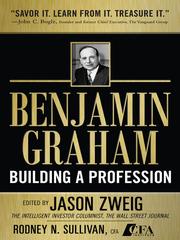
Benjamin Graham, Building a Profession

Benjamin Graham, Building a Profession

Jason Zweig, Rodney N. Sullivan
2010
T4 Open Librarygoodreads

Edited collection of Graham's own writings and interviews

Summary

Zweig and Sullivan assembled this for the CFA Institute, collecting Graham's writings, lectures, testimony and interviews that appeared in the Financial Analysts Journal and its predecessor, along with material about him.

The collection's organising theme is Graham's role in creating security analysis as a profession. He helped establish the New York Society of Security Analysts, argued for a certification programme that became the Chartered Financial Analyst designation, and wrote repeatedly about what would distinguish analysis as a profession: a body of knowledge, standards of conduct, and a duty to the client that overrides the analyst's own interest.

The substantive material includes his writing on valuation methods, on the distinction between investment and speculation defined by whether the purchase rests on analysis and promises safety of principal and an adequate return, on the margin of safety, on the behaviour of the market as a voting machine in the short run and a weighing machine in the long run, and on the limits of what analysis can accomplish.

The later interviews are the most quoted part, in which Graham said that he no longer advocated detailed security analysis for most investors, that the profession's growth had reduced the returns available to it, and that simple mechanical criteria on price, earnings and financial position would serve as well as elaborate work.

Zweig's connecting commentary is useful and he knows the material as well as anyone.

The book is a compilation and has no argument of its own. Much of the material appears in other collections and Graham's own books remain the primary sources. Its distinct value is the professional and institutional material, which is not collected elsewhere.

Key takeaways 7

  1. Graham defined investment as a purchase resting on analysis that promises safety of principal and an adequate return, and everything else as speculation.
  2. He argued for professional certification and conduct standards for analysts, which produced the Chartered Financial Analyst designation.
  3. The market functions as a voting machine in the short run and a weighing machine in the long run.
  4. Margin of safety means buying at a price low enough that the investment survives errors in the analysis.
  5. Graham concluded late in life that the growth of professional analysis had reduced the returns available to it.
  6. He argued that simple mechanical criteria on price, earnings and financial position would serve most investors as well as detailed analysis.
  7. A profession requires a duty to the client that overrides the practitioner's own interest, which Graham treated as the defining test.

Who should read it

Investment professionals interested in Graham's role in creating the analyst profession and in his late revisions to his own method.

About Jason Zweig

Columnist, 'The Intelligent Investor', The Wall Street Journal; previously Money, Time and Forbes

Your Money and Your Brain brought neuroeconomics to a general investing audience, and his annotated edition of Benjamin Graham keeps a canonical text usable for modern readers.

The Wall Street Journal, Money, Time, Forbes

Similar books 6

Chosen by shared topics, the entries that hold them, and the people who recommended both.

Russell Napier · 2005

What markets looked like at the US stock bottoms of 1921, 1932, 1949 and 1982.

Peter L. Bernstein · 1992

How Markowitz, Sharpe, Fama, Black and Scholes built the theory of modern finance.
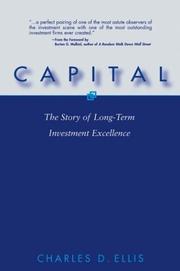
Charles D. Ellis · 2004

How Capital Group built its long-term investing culture.

Recommended by: Mohnish Pabrai

Where it sits in the reference 2

Journalists
Financial history

Topics

InvestingFinancial History