Updates

  1. Person pages list letters, writing, profiles and links as sortable tables with filters, and show each person's companies as links; Fund letters show each letter's description in its own column.
  2. Experts show a checked job title and a short description of each person; 30 more people have photographs.
  3. Every company, fund, university and publication the experts work for has a page listing the people there.
  4. Fund letters show each letter's thesis and filter by it; 225 person pages list the essays, columns and newsletter issues the person wrote.
  5. Person pages list every essay and newsletter issue a person wrote, and their own books as a table in List view.
  6. Recommends shows the five largest kinds of book and the rest under More; browse pictures load sooner.
  7. Podcasts and talks link the original episode, filter by Audio and video or Press, and list each publisher once.
  8. Pages are wider, Recommends has List and Grid, and a filter clicked again turns off.
  9. Book cards sit in a ruled grid with Open Library and Goodreads links and each book's one-line note.
  10. Funds is now Investors; each investor's styles are buttons that filter the table.
  11. Podcasts and talks on a person's page filter by year and publisher and show as a list or a grid of pictures.
  12. Quotes show only people's own words: 472 summaries written by list sites are gone.
  13. Country pages open from Browse again, and every link on the shelf lands on a page.
  14. Subject and person pages show their sections as tabs, and each book appears once on a person's page.
  15. Book cards show the quote, who said it and the source; grids show five cards to a row.
  16. On a phone, a menu holds the sections, search, Updates, Feedback and dark mode.
  17. Feedback takes a screenshot of the page with no browser prompt, opens a screenshot full size when you click it, and clears itself once sent.
  18. Book cards are centred, search names the topic each book sits in, and any text cut short shows whole on hover.
  19. Search groups its results by kind: people, companies, geographies, subjects, topics, books, funds, fund letters and papers.
  20. The Books table lists who recommended each book by name, and the browser tab names the section you are in.
  21. Feedback can take a screenshot of the page, or one you paste or choose, and opens in the corner beside Updates.
  22. Each rail button reopens its section where you left it, and Browse, Table and People show on every book and subject page.
  23. Filters grey out choices that hold nothing instead of hiding them, and Books › People filters by authors or recommenders.
  24. Feedback takes a subject line and up to three screenshots.
  25. Biographies are grouped by the person they are about: 41 new pages, from Abraham Lincoln to Lee Kuan Yew.
  26. Sport splits into 23 sports, and Religion into one topic per faith.
  27. Book lists show as cards: the cover, one recommendation quote and every recommender by name.
  28. Seventeen subjects that had two or three pages under different names now have one page each.
  29. Every page lists its Experts as authors and recommenders, with a link to them on the Experts tab.
  30. Economics, Financial history, Financial panics and Accounting are subjects of their own, with one page per financial crisis.
  31. Book, person and subject pages open inside the app, so the tabs stay in view.
  32. 996 more book covers, and photographs or logos for 227 more people and companies.
  33. Books › Browse shows every subject as cards, and the rail holds Fund letters, Papers, Experts, Books and Funds.
  34. Every topic over 150 books splits into narrower topics, each with a page of its own.

Send feedback

What is it?
Screenshots, up to 3 (optional)
or paste one with Ctrl+V

We use your email only to reply to you.

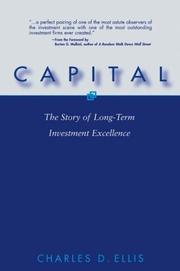
Capital: The Story of Long-Term Investment E

Capital: The Story of Long-Term Investment Excellence

Charles D. Ellis
2004
T4 336 pages · about 5h 36m to read Open Librarygoodreads

History of Capital Group

Summary

Ellis wrote an institutional history of Capital Group, the Los Angeles fund manager that runs the American Funds, based on interviews and company records. It is an authorised account and Ellis had a long professional relationship with the firm.

The organisational design is the reason to read it. Capital runs what it calls the multiple portfolio counsellor system, in which a single fund is divided into segments and each is managed independently by a different portfolio manager, with a portion allocated to the research analysts directly. Ellis argues this solves several problems at once: it removes key-person risk, it allows the firm to grow assets without any individual managing more than they can, it lets managers with different styles coexist within one product, and it produces results that are more consistent than any individual would generate. He also documents the compensation system, which rewards long-horizon results measured over rolling multi-year periods rather than annual performance, and the private ownership structure that lets the firm avoid quarterly pressure.

Ellis also covers the distribution strategy through financial advisers rather than direct to retail, the deliberate refusal to launch products for market fashions, and the firm's international expansion.

The book is admiring and does not examine periods of underperformance seriously, nor does it engage with the question of whether the record survives fee and survivorship adjustment. Capital's active funds have faced the same pressure from indexing as everyone else since publication. The organisational design remains the durable contribution and it has been copied selectively elsewhere.

Key takeaways 7

  1. Dividing a single fund among several independently managed segments removes key-person risk and lets a firm grow assets without any manager exceeding their capacity.
  2. Compensating portfolio managers on rolling multi-year results rather than annual performance changes what positions they are willing to hold.
  3. Private ownership allows an asset manager to decline products that would sell well and perform badly, which a listed competitor cannot do.
  4. Distributing through financial advisers rather than direct to retail produces stickier assets, because the adviser relationship absorbs the client's reaction to drawdowns.
  5. Research analysts managing money directly, rather than only recommending, improves the quality of research because the analyst bears the consequence.
  6. Consistency of long-run results matters more to an asset gatherer than peak performance, because clients leave after drawdowns rather than after mediocre gains.
  7. An investment firm's organisational structure determines its results more reliably than the talent of any individual within it.

Who should read it

Asset managers and allocators interested in organisational design, manager compensation and how a firm scales investment capacity.

About Charles D. Ellis

Founder of Greenwich Associates; chair of the Yale endowment investment committee; author of 'The Loser's Game'

His 1975 essay 'The Loser's Game' is the primary source that reframed active management as a negative-sum contest, and the argument is still cited verbatim.

Greenwich Associates

Who recommended it 1 · 1 direct

Similar books 6

Chosen by shared topics, the entries that hold them, and the people who recommended both.
Charles D. Ellis, James R. Vertin · 2001

Edited anthology, two volumes

Recommended by: Mohnish Pabrai

Charles D. Ellis · 1998

Why active investing became a loser's game, decided by errors, not by skill.

“In his marvelous book, Winning the Loser's Game, Charlie Ellis says” — Bill Miller

Source: Bill Miller 2Q 2020 Market Letter

Recommended by: Bill Miller, Mohnish Pabrai, Howard Marks
Where it sits in the reference 3

Investors
Industries
Financial history

Topics

InvestingFinancial History