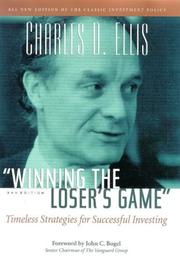
Winning the Loser's Game
Why active management is a loser's game for most investors.
Summary
Ellis founded Greenwich Associates and advised institutional investors for decades, and his central argument comes from a 1975 article. Borrowing Simon Ramo's analysis of tennis, he distinguishes a winner's game, decided by the winning actions of experts, from a loser's game, decided by the errors of the participants. He argues that professional investment management became a loser's game once institutions came to dominate trading, because the professionals are now trading against each other rather than against amateurs.
The consequence is that trying to win through superior selection and timing produces errors and costs that exceed any advantage, and that the correct strategy is avoiding mistakes. He documents the failure of active managers to beat their benchmarks after fees over long periods, the effect of costs, and the destructive consequences of investors switching managers after poor performance.
His positive prescription is that the investor's real work is setting an appropriate long-term policy: determining the asset allocation that matches their actual time horizon and their tolerance for drawdowns, writing it down, and holding it through market conditions that make it uncomfortable. He argues that this policy decision explains nearly all of the outcome and receives almost none of the attention.
He also writes about the institutional investment committee, arguing that committees make worse decisions than individuals because they act on recent performance and because responsibility is diffuse. The book has gone through many editions with updated data. It is short and repeats its central point. The argument is essentially the same as Bogle's with an institutional rather than a retail focus, and the loser's game framing is the distinctive contribution.
Key takeaways 8
- Professional investment management became a loser's game once institutions dominated trading, because professionals now trade against each other rather than against amateurs.
- In a loser's game the outcome is determined by avoiding errors rather than by producing winning actions.
- Active managers as a group cannot beat the market after costs, because they collectively are the market and the costs are certain.
- The investor's real work is setting a long-term policy matched to their actual horizon and drawdown tolerance, which explains nearly all of the outcome.
- Switching managers after poor performance systematically destroys returns, because it sells low and buys high at the manager level.
- Investment committees make worse decisions than individuals because they respond to recent results and because responsibility is diffuse.
- An investment policy should be written down while conditions are calm, because it will only be tested when conditions are not.
- The most damaging investor behaviour occurs during market extremes, which is why the policy exists to remove decisions at those moments.
Who should read it
Institutional investors, trustees and committee members who need the argument for policy discipline over manager selection and timing.
About Charles D. Ellis
Founder of Greenwich Associates; chair of the Yale endowment investment committee; author of 'The Loser's Game'
His 1975 essay 'The Loser's Game' is the primary source that reframed active management as a negative-sum contest, and the argument is still cited verbatim.
Who recommended it 3 · 2 direct
Similar books 6
Chosen by shared topics, the entries that hold them, and the people who recommended both.

Vanguard's founder on costs, turnover and fund structure.
“Wonderful Book. I highly recommend all of John Bogle's writings to any investor.” — Mohnish Pabrai
Source: Mohnish's Bookshelf — Books on Investing & Capital Allocation, entry 50
Recommended by: Mohnish Pabrai, Jason Zweig and 3 others

History of indexing; Bogle and Vanguard are its central thread.

Recommended by: Mohnish Pabrai

Recommended by: Mohnish Pabrai
Stock prices follow a random walk, so a low-cost index fund beats stock picking.
Recommended by: Nat Eliason, Mohnish Pabrai
How Capital Group built its long-term investing culture.
Recommended by: Mohnish Pabrai
Where it sits in the reference 5
Topics