Updates

  1. Person pages list letters, writing, profiles and links as sortable tables with filters, and show each person's companies as links; Fund letters show each letter's description in its own column.
  2. Experts show a checked job title and a short description of each person; 30 more people have photographs.
  3. Every company, fund, university and publication the experts work for has a page listing the people there.
  4. Fund letters show each letter's thesis and filter by it; 225 person pages list the essays, columns and newsletter issues the person wrote.
  5. Person pages list every essay and newsletter issue a person wrote, and their own books as a table in List view.
  6. Recommends shows the five largest kinds of book and the rest under More; browse pictures load sooner.
  7. Podcasts and talks link the original episode, filter by Audio and video or Press, and list each publisher once.
  8. Pages are wider, Recommends has List and Grid, and a filter clicked again turns off.
  9. Book cards sit in a ruled grid with Open Library and Goodreads links and each book's one-line note.
  10. Funds is now Investors; each investor's styles are buttons that filter the table.
  11. Podcasts and talks on a person's page filter by year and publisher and show as a list or a grid of pictures.
  12. Quotes show only people's own words: 472 summaries written by list sites are gone.
  13. Country pages open from Browse again, and every link on the shelf lands on a page.
  14. Subject and person pages show their sections as tabs, and each book appears once on a person's page.
  15. Book cards show the quote, who said it and the source; grids show five cards to a row.
  16. On a phone, a menu holds the sections, search, Updates, Feedback and dark mode.
  17. Feedback takes a screenshot of the page with no browser prompt, opens a screenshot full size when you click it, and clears itself once sent.
  18. Book cards are centred, search names the topic each book sits in, and any text cut short shows whole on hover.
  19. Search groups its results by kind: people, companies, geographies, subjects, topics, books, funds, fund letters and papers.
  20. The Books table lists who recommended each book by name, and the browser tab names the section you are in.
  21. Feedback can take a screenshot of the page, or one you paste or choose, and opens in the corner beside Updates.
  22. Each rail button reopens its section where you left it, and Browse, Table and People show on every book and subject page.
  23. Filters grey out choices that hold nothing instead of hiding them, and Books › People filters by authors or recommenders.
  24. Feedback takes a subject line and up to three screenshots.
  25. Biographies are grouped by the person they are about: 41 new pages, from Abraham Lincoln to Lee Kuan Yew.
  26. Sport splits into 23 sports, and Religion into one topic per faith.
  27. Book lists show as cards: the cover, one recommendation quote and every recommender by name.
  28. Seventeen subjects that had two or three pages under different names now have one page each.
  29. Every page lists its Experts as authors and recommenders, with a link to them on the Experts tab.
  30. Economics, Financial history, Financial panics and Accounting are subjects of their own, with one page per financial crisis.
  31. Book, person and subject pages open inside the app, so the tabs stay in view.
  32. 996 more book covers, and photographs or logos for 227 more people and companies.
  33. Books › Browse shows every subject as cards, and the rail holds Fund letters, Papers, Experts, Books and Funds.
  34. Every topic over 150 books splits into narrower topics, each with a page of its own.

Send feedback

What is it?
Screenshots, up to 3 (optional)
or paste one with Ctrl+V

We use your email only to reply to you.

The Investor's Dilemma: How Mutual Funds Are

The Investor's Dilemma: How Mutual Funds Are Betraying Your Trust And What To Do About It

Louis Lowenstein
2008
T4 230 pages · about 3h 50m to read Open Librarygoodreads

Summary

Lowenstein, a Columbia law professor and former corporate executive, argues that the American mutual fund industry is organised against the interests of the people whose money it manages. The conflict is structural: fund management companies are separate businesses that profit from assets gathered, so their incentive is to market aggressively and to launch whatever product sells, while shareholders need low costs and durable strategies.

His evidence is empirical and specific. He examines the largest funds by assets and shows high expense ratios, high portfolio turnover, closet indexing and returns that lag both the index and the funds' own reported time-weighted figures once investor cash flows are accounted for. He contrasts these with a group of ten low-turnover value funds, several of them closed to new money, that beat the market over long periods while charging less and trading rarely. He also dissects the 2003 market-timing and late-trading scandals, arguing that independent directors approved arrangements that plainly harmed shareholders and that regulatory response was weak.

The policy argument follows from the diagnosis. Lowenstein wants meaningful independent boards, real disclosure of costs and turnover, and a legal standard that treats fund advisers as fiduciaries rather than as vendors.

The book predates the full rise of index funds and exchange-traded funds, which delivered much of what Lowenstein wanted through competition rather than regulation. His sample of successful value funds is small and chosen with hindsight, and several of the managers he praised later underperformed.

Key takeaways 7

  1. Fund management companies and fund shareholders have opposed economic interests because one profits from assets and the other from returns.
  2. Marketing expenditure and product proliferation, not investment skill, drive most fund company growth.
  3. High portfolio turnover reduces investor returns through costs and taxes without improving performance.
  4. Reported fund returns overstate what investors actually earned because money arrives after good performance and leaves after bad.
  5. Independent fund directors approved fee and trading arrangements that a genuine fiduciary would have refused.
  6. A small group of concentrated, low-turnover value funds beat the market over decades while charging less than average.
  7. Closing a fund to new money is evidence that the manager is prioritising returns over fee income.

Who should read it

Investors choosing active managers, and anyone running an asset management business who needs to see how the incentive structure looks from the client side.

Who recommended it 1 · 1 direct

Similar books 6

Chosen by shared topics, the entries that hold them, and the people who recommended both.

John C. Bogle · 1999

Vanguard's founder on costs, turnover and fund structure.

“Wonderful Book. I highly recommend all of John Bogle's writings to any investor.” — Mohnish Pabrai

Source: Mohnish's Bookshelf — Books on Investing & Capital Allocation, entry 50

Recommended by: Mohnish Pabrai, Jason Zweig and 3 others
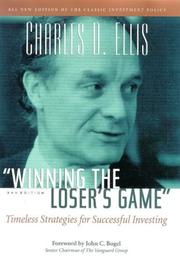
Charles D. Ellis · 1998

Why active investing became a loser's game, decided by errors, not by skill.

“In his marvelous book, Winning the Loser's Game, Charlie Ellis says” — Bill Miller

Source: Bill Miller 2Q 2020 Market Letter

Recommended by: Bill Miller, Mohnish Pabrai, Howard Marks

Where it sits in the reference 2

Industries
Business models

Topics

InvestingFinance and Markets