Updates

  1. Person pages list letters, writing, profiles and links as sortable tables with filters, and show each person's companies as links; Fund letters show each letter's description in its own column.
  2. Experts show a checked job title and a short description of each person; 30 more people have photographs.
  3. Every company, fund, university and publication the experts work for has a page listing the people there.
  4. Fund letters show each letter's thesis and filter by it; 225 person pages list the essays, columns and newsletter issues the person wrote.
  5. Person pages list every essay and newsletter issue a person wrote, and their own books as a table in List view.
  6. Recommends shows the five largest kinds of book and the rest under More; browse pictures load sooner.
  7. Podcasts and talks link the original episode, filter by Audio and video or Press, and list each publisher once.
  8. Pages are wider, Recommends has List and Grid, and a filter clicked again turns off.
  9. Book cards sit in a ruled grid with Open Library and Goodreads links and each book's one-line note.
  10. Funds is now Investors; each investor's styles are buttons that filter the table.
  11. Podcasts and talks on a person's page filter by year and publisher and show as a list or a grid of pictures.
  12. Quotes show only people's own words: 472 summaries written by list sites are gone.
  13. Country pages open from Browse again, and every link on the shelf lands on a page.
  14. Subject and person pages show their sections as tabs, and each book appears once on a person's page.
  15. Book cards show the quote, who said it and the source; grids show five cards to a row.
  16. On a phone, a menu holds the sections, search, Updates, Feedback and dark mode.
  17. Feedback takes a screenshot of the page with no browser prompt, opens a screenshot full size when you click it, and clears itself once sent.
  18. Book cards are centred, search names the topic each book sits in, and any text cut short shows whole on hover.
  19. Search groups its results by kind: people, companies, geographies, subjects, topics, books, funds, fund letters and papers.
  20. The Books table lists who recommended each book by name, and the browser tab names the section you are in.
  21. Feedback can take a screenshot of the page, or one you paste or choose, and opens in the corner beside Updates.
  22. Each rail button reopens its section where you left it, and Browse, Table and People show on every book and subject page.
  23. Filters grey out choices that hold nothing instead of hiding them, and Books › People filters by authors or recommenders.
  24. Feedback takes a subject line and up to three screenshots.
  25. Biographies are grouped by the person they are about: 41 new pages, from Abraham Lincoln to Lee Kuan Yew.
  26. Sport splits into 23 sports, and Religion into one topic per faith.
  27. Book lists show as cards: the cover, one recommendation quote and every recommender by name.
  28. Seventeen subjects that had two or three pages under different names now have one page each.
  29. Every page lists its Experts as authors and recommenders, with a link to them on the Experts tab.
  30. Economics, Financial history, Financial panics and Accounting are subjects of their own, with one page per financial crisis.
  31. Book, person and subject pages open inside the app, so the tabs stay in view.
  32. 996 more book covers, and photographs or logos for 227 more people and companies.
  33. Books › Browse shows every subject as cards, and the rail holds Fund letters, Papers, Experts, Books and Funds.
  34. Every topic over 150 books splits into narrower topics, each with a page of its own.

Send feedback

What is it?
Screenshots, up to 3 (optional)
or paste one with Ctrl+V

We use your email only to reply to you.

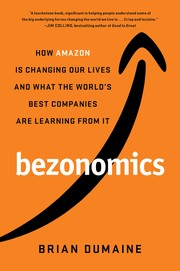
Bezonomics

Bezonomics

Brian Dumaine
2020
T3 315 pages · about 5h 15m to read Open Librarygoodreads

Business-model analysis rather than a life.

Summary

Dumaine, a former Fortune editor, wrote an account of Amazon's business model and its effects, based on interviews with executives, competitors, suppliers, workers and analysts.

The model he describes centres on what Amazon calls the flywheel: lower prices attract customers, more customers attract third-party sellers, more sellers widen selection, wider selection attracts more customers, and the resulting scale lowers cost, permitting lower prices. Dumaine adds that machine learning now runs inside every loop, setting prices, forecasting demand, routing inventory, recommending products and allocating advertising, which he argues compounds the advantage in a way that earlier retail scale did not. He treats Prime as the mechanism that converts customers into subscribers whose purchasing shifts almost entirely to the platform, and Amazon Web Services as the profit source that funded a decade of retail investment at low margin.

He also covers the costs: warehouse working conditions and injury rates, the effect on suppliers and on brands that become dependent on the platform, the use of third-party seller data, the effect on physical retail, and the regulatory questions.

The reporting is competent and the book is a reasonable single-volume description of Amazon around 2019. It does not attempt original analysis of the economics and it takes the flywheel framing largely from Amazon's own account of itself. Brad Stone's two books cover the corporate history more thoroughly. It predates the pandemic surge, the union campaigns, the antitrust cases brought in the United States and Europe, and the slowdown and cost reductions that followed, so the treatment of Amazon's trajectory is now dated.

Key takeaways 7

  1. Amazon's flywheel connects price, selection and scale so that improvement in any one reinforces the others.
  2. Amazon Web Services generated the profit that funded a decade of retail expansion at margins competitors could not sustain.
  3. Prime converts customers into subscribers whose purchasing consolidates onto the platform rather than being split across retailers.
  4. Machine learning applied to pricing, forecasting and routing compounds a scale advantage that older retailers could not extract.
  5. Third-party sellers supply selection without Amazon holding the inventory risk, while paying fees that have grown into a major revenue line.
  6. Brands that grow on the platform become dependent on it and lose the customer relationship and the data that come with it.
  7. Advertising revenue from sellers competing for placement has become a large profit source that changes what customers see.

Who should read it

Operators and investors who want a readable single-volume description of how Amazon's model works and what it does to suppliers and competitors.

Similar books 6

Chosen by shared topics, the entries that hold them, and the people who recommended both.
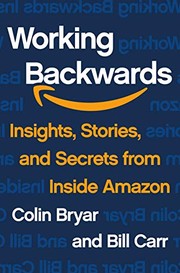
Colin Bryar, Bill Carr · 2021

Amazon's operating mechanisms, from leadership principles to the six-page memo.

Recommended by: Jeff Bezos

Bryce G. Hoffman · 2012

The 2006-2010 turnaround told with close management access.

Recommended by: Mohnish Pabrai

Where it sits in the reference 4

Biographies
Business themes
Industries
Business themes

Topics

Company HistoriesBusiness and Management