Updates

  1. Person pages list letters, writing, profiles and links as sortable tables with filters, and show each person's companies as links; Fund letters show each letter's description in its own column.
  2. Experts show a checked job title and a short description of each person; 30 more people have photographs.
  3. Every company, fund, university and publication the experts work for has a page listing the people there.
  4. Fund letters show each letter's thesis and filter by it; 225 person pages list the essays, columns and newsletter issues the person wrote.
  5. Person pages list every essay and newsletter issue a person wrote, and their own books as a table in List view.
  6. Recommends shows the five largest kinds of book and the rest under More; browse pictures load sooner.
  7. Podcasts and talks link the original episode, filter by Audio and video or Press, and list each publisher once.
  8. Pages are wider, Recommends has List and Grid, and a filter clicked again turns off.
  9. Book cards sit in a ruled grid with Open Library and Goodreads links and each book's one-line note.
  10. Funds is now Investors; each investor's styles are buttons that filter the table.
  11. Podcasts and talks on a person's page filter by year and publisher and show as a list or a grid of pictures.
  12. Quotes show only people's own words: 472 summaries written by list sites are gone.
  13. Country pages open from Browse again, and every link on the shelf lands on a page.
  14. Subject and person pages show their sections as tabs, and each book appears once on a person's page.
  15. Book cards show the quote, who said it and the source; grids show five cards to a row.
  16. On a phone, a menu holds the sections, search, Updates, Feedback and dark mode.
  17. Feedback takes a screenshot of the page with no browser prompt, opens a screenshot full size when you click it, and clears itself once sent.
  18. Book cards are centred, search names the topic each book sits in, and any text cut short shows whole on hover.
  19. Search groups its results by kind: people, companies, geographies, subjects, topics, books, funds, fund letters and papers.
  20. The Books table lists who recommended each book by name, and the browser tab names the section you are in.
  21. Feedback can take a screenshot of the page, or one you paste or choose, and opens in the corner beside Updates.
  22. Each rail button reopens its section where you left it, and Browse, Table and People show on every book and subject page.
  23. Filters grey out choices that hold nothing instead of hiding them, and Books › People filters by authors or recommenders.
  24. Feedback takes a subject line and up to three screenshots.
  25. Biographies are grouped by the person they are about: 41 new pages, from Abraham Lincoln to Lee Kuan Yew.
  26. Sport splits into 23 sports, and Religion into one topic per faith.
  27. Book lists show as cards: the cover, one recommendation quote and every recommender by name.
  28. Seventeen subjects that had two or three pages under different names now have one page each.
  29. Every page lists its Experts as authors and recommenders, with a link to them on the Experts tab.
  30. Economics, Financial history, Financial panics and Accounting are subjects of their own, with one page per financial crisis.
  31. Book, person and subject pages open inside the app, so the tabs stay in view.
  32. 996 more book covers, and photographs or logos for 227 more people and companies.
  33. Books › Browse shows every subject as cards, and the rail holds Fund letters, Papers, Experts, Books and Funds.
  34. Every topic over 150 books splits into narrower topics, each with a page of its own.

Send feedback

What is it?
Screenshots, up to 3 (optional)
or paste one with Ctrl+V

We use your email only to reply to you.

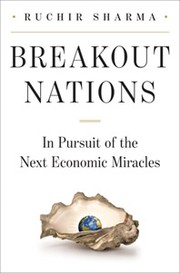
Breakout Nations

Breakout Nations

Ruchir Sharma
2012
T2 336 pages · about 5h 36m to read Open Librarygoodreads

Earlier and more country-by-country; useful as a record of which calls aged well.

Summary

Sharma, who ran emerging markets at Morgan Stanley Investment Management, argues that the assumption of continued rapid convergence by emerging economies is wrong, and that the 2003 to 2007 period was an unusual episode driven by a commodity boom and cheap global money rather than a permanent shift.

His method is comparative and empirical rather than theoretical. He argues that very few countries sustain high growth for more than a decade, that the historical base rate for maintaining above-average growth over long periods is low, and that the BRIC grouping was a marketing construct with no analytical content since the four countries share nothing structurally. He works through countries individually, assessing Brazil's high interest rates and low investment rate, Russia's dependence on oil, India's fiscal position and infrastructure, China's investment-heavy growth model and its coming slowdown, and the prospects for Turkey, Indonesia, South Korea, the Czech Republic and others.

His practical indicators are the useful part: watch the share of investment in GDP, the size of the largest companies relative to the economy, whether billionaires are in rent-seeking or productive sectors, whether inflation is being controlled, whether the currency is competitive, and whether the country appears on magazine covers, which he treats as a contrarian signal.

The book is from 2012 and its specific calls can be checked. He was right about the commodity supercycle ending, about Brazil and Russia disappointing, and about the general slowdown in emerging market convergence. He was too pessimistic on India over the following decade. The country-by-country material is dated but the indicators remain usable.

Key takeaways 7

  1. Very few countries sustain above-average growth for more than a decade, so extrapolating a strong decade is the most common error in emerging market forecasting.
  2. The 2003 to 2007 emerging market boom was driven by a commodity cycle and cheap global money rather than by structural improvement.
  3. The BRIC grouping had no analytical content, since the four countries shared no structural characteristic that would produce common outcomes.
  4. A high and rising investment share of GDP is the most reliable indicator of a country's growth prospects, provided the investment is productive rather than speculative.
  5. The composition of a country's billionaire list, meaning whether wealth comes from rent-seeking or productive sectors, predicts the durability of its growth.
  6. When one company or one family dominates a share of national output, the economy has a concentration risk that aggregate statistics conceal.
  7. Sustained attention from international media and investors is a contrarian signal, because the capital has usually already arrived by the time the story is told.

Who should read it

Emerging market investors who want practical country-level indicators and a corrective to convergence assumptions.

Who recommended it 1 · 1 direct

Similar books 6

Chosen by shared topics, the entries that hold them, and the people who recommended both.
Antoine van Agtmael · 1999

By the man who coined the term 'emerging markets'; the case for world-class EM operating companies.

Ruchir Sharma · 2016

Ten rules for judging whether a country's economy will rise or fall.

Recommended by: Patrick Collison
Michael Pettis · 2001

Emerging-market crises come from the structure of national balance sheets.

Jerome Booth · 2014

The argument that the risk is mispriced in the developed world, not the emerging one.

Jim Rogers · 2003

Driving through 116 countries scouting markets from the ground up

Recommended by: Mohnish Pabrai
Daron Acemoglu, James A. Robinson · 2012

Nations prosper under inclusive institutions and stagnate under extractive ones.

Where it sits in the reference 3

Geographies
Assets
Economics

Topics

EconomicsInvesting