Updates

  1. Person pages list letters, writing, profiles and links as sortable tables with filters, and show each person's companies as links; Fund letters show each letter's description in its own column.
  2. Experts show a checked job title and a short description of each person; 30 more people have photographs.
  3. Every company, fund, university and publication the experts work for has a page listing the people there.
  4. Fund letters show each letter's thesis and filter by it; 225 person pages list the essays, columns and newsletter issues the person wrote.
  5. Person pages list every essay and newsletter issue a person wrote, and their own books as a table in List view.
  6. Recommends shows the five largest kinds of book and the rest under More; browse pictures load sooner.
  7. Podcasts and talks link the original episode, filter by Audio and video or Press, and list each publisher once.
  8. Pages are wider, Recommends has List and Grid, and a filter clicked again turns off.
  9. Book cards sit in a ruled grid with Open Library and Goodreads links and each book's one-line note.
  10. Funds is now Investors; each investor's styles are buttons that filter the table.
  11. Podcasts and talks on a person's page filter by year and publisher and show as a list or a grid of pictures.
  12. Quotes show only people's own words: 472 summaries written by list sites are gone.
  13. Country pages open from Browse again, and every link on the shelf lands on a page.
  14. Subject and person pages show their sections as tabs, and each book appears once on a person's page.
  15. Book cards show the quote, who said it and the source; grids show five cards to a row.
  16. On a phone, a menu holds the sections, search, Updates, Feedback and dark mode.
  17. Feedback takes a screenshot of the page with no browser prompt, opens a screenshot full size when you click it, and clears itself once sent.
  18. Book cards are centred, search names the topic each book sits in, and any text cut short shows whole on hover.
  19. Search groups its results by kind: people, companies, geographies, subjects, topics, books, funds, fund letters and papers.
  20. The Books table lists who recommended each book by name, and the browser tab names the section you are in.
  21. Feedback can take a screenshot of the page, or one you paste or choose, and opens in the corner beside Updates.
  22. Each rail button reopens its section where you left it, and Browse, Table and People show on every book and subject page.
  23. Filters grey out choices that hold nothing instead of hiding them, and Books › People filters by authors or recommenders.
  24. Feedback takes a subject line and up to three screenshots.
  25. Biographies are grouped by the person they are about: 41 new pages, from Abraham Lincoln to Lee Kuan Yew.
  26. Sport splits into 23 sports, and Religion into one topic per faith.
  27. Book lists show as cards: the cover, one recommendation quote and every recommender by name.
  28. Seventeen subjects that had two or three pages under different names now have one page each.
  29. Every page lists its Experts as authors and recommenders, with a link to them on the Experts tab.
  30. Economics, Financial history, Financial panics and Accounting are subjects of their own, with one page per financial crisis.
  31. Book, person and subject pages open inside the app, so the tabs stay in view.
  32. 996 more book covers, and photographs or logos for 227 more people and companies.
  33. Books › Browse shows every subject as cards, and the rail holds Fund letters, Papers, Experts, Books and Funds.
  34. Every topic over 150 books splits into narrower topics, each with a page of its own.

Send feedback

What is it?
Screenshots, up to 3 (optional)
or paste one with Ctrl+V

We use your email only to reply to you.

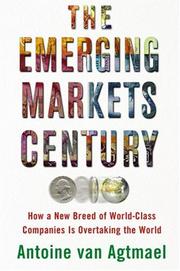
The Emerging Markets Century

The Emerging Markets Century

Antoine van Agtmael
1999
T3 384 pages · about 6h 24m to read Open Librarygoodreads

By the man who coined the term 'emerging markets'; the case for world-class EM operating companies.

Summary

Van Agtmael coined the term emerging markets in 1981 while at the International Finance Corporation, replacing third world, and he spent his career running emerging market equity funds. This book argues that companies in these countries would produce world-class competitors rather than remaining low-cost suppliers.

The evidence is company-level. Van Agtmael profiles twenty-five firms he considered world class, including Samsung Electronics, TSMC, Infosys, Embraer, Cemex, Hyundai, Grupo Modelo and others, and argues that each competed on capability rather than on cost: process technology at TSMC, design and brand at Samsung, delivery model at Infosys, engineering at Embraer. He argues that Western investors and executives systematically underestimated these firms because they classified them by country rather than by capability.

His wider claims concern the shift in economic weight, the growth of middle-class consumption in these markets, and the argument that emerging market equities deserved a much larger allocation than institutional portfolios then held.

The company thesis has been substantially vindicated. Samsung and TSMC became global leaders, and emerging market firms compete at the frontier in several industries.

The investment thesis has not. Emerging market equity indices delivered poor returns over the fifteen years after publication, underperforming American equities substantially, because index composition included large weights in state-owned enterprises and commodity producers rather than in the firms van Agtmael profiled, and because valuation at the time of writing was already high. The book illustrates a general problem: identifying which companies will succeed does not by itself produce an investment return, because the index does not hold them and the price already reflects the expectation.

Key takeaways 7

  1. Emerging market firms began competing on capability rather than on cost, which Western analysts classified by country and therefore missed.
  2. TSMC's advantage came from process technology and the foundry model rather than from cheap labour.
  3. Samsung built brand and design capability that let it charge premium prices in markets its competitors had defined.
  4. Investors underestimate firms by classifying them by their country of origin rather than by their competitive position.
  5. Middle-class consumption growth in these markets creates demand that domestic firms are best positioned to serve.
  6. The term emerging markets was invented as a marketing device to make these countries investable to institutions.
  7. Correctly identifying which companies will succeed does not produce investment returns if the index does not hold them and prices already reflect it.

Who should read it

Investors in emerging markets who want the company-level case for capability-based competition, alongside the lesson that a correct thesis did not produce index returns.

Similar books 6

Chosen by shared topics, the entries that hold them, and the people who recommended both.
Ruchir Sharma · 2012

Why emerging economies will not all keep converging, and tests for which can grow.

Recommended by: Mohnish Pabrai

Ruchir Sharma · 2016

Ten rules for judging whether a country's economy will rise or fall.

Recommended by: Patrick Collison

Michael Pettis · 2001

Emerging-market crises come from the structure of national balance sheets.

Jerome Booth · 2014

The argument that the risk is mispriced in the developed world, not the emerging one.

Jim Rogers · 2003

Driving through 116 countries scouting markets from the ground up

Recommended by: Mohnish Pabrai
Ha-Joon Chang · 2007

Rich countries urge poor ones to adopt the opposite of the policies they once used.

Where it sits in the reference 3

Geographies
Assets
Economics

Topics

InvestingEconomics