Updates

  1. Person pages list letters, writing, profiles and links as sortable tables with filters, and show each person's companies as links; Fund letters show each letter's description in its own column.
  2. Experts show a checked job title and a short description of each person; 30 more people have photographs.
  3. Every company, fund, university and publication the experts work for has a page listing the people there.
  4. Fund letters show each letter's thesis and filter by it; 225 person pages list the essays, columns and newsletter issues the person wrote.
  5. Person pages list every essay and newsletter issue a person wrote, and their own books as a table in List view.
  6. Recommends shows the five largest kinds of book and the rest under More; browse pictures load sooner.
  7. Podcasts and talks link the original episode, filter by Audio and video or Press, and list each publisher once.
  8. Pages are wider, Recommends has List and Grid, and a filter clicked again turns off.
  9. Book cards sit in a ruled grid with Open Library and Goodreads links and each book's one-line note.
  10. Funds is now Investors; each investor's styles are buttons that filter the table.
  11. Podcasts and talks on a person's page filter by year and publisher and show as a list or a grid of pictures.
  12. Quotes show only people's own words: 472 summaries written by list sites are gone.
  13. Country pages open from Browse again, and every link on the shelf lands on a page.
  14. Subject and person pages show their sections as tabs, and each book appears once on a person's page.
  15. Book cards show the quote, who said it and the source; grids show five cards to a row.
  16. On a phone, a menu holds the sections, search, Updates, Feedback and dark mode.
  17. Feedback takes a screenshot of the page with no browser prompt, opens a screenshot full size when you click it, and clears itself once sent.
  18. Book cards are centred, search names the topic each book sits in, and any text cut short shows whole on hover.
  19. Search groups its results by kind: people, companies, geographies, subjects, topics, books, funds, fund letters and papers.
  20. The Books table lists who recommended each book by name, and the browser tab names the section you are in.
  21. Feedback can take a screenshot of the page, or one you paste or choose, and opens in the corner beside Updates.
  22. Each rail button reopens its section where you left it, and Browse, Table and People show on every book and subject page.
  23. Filters grey out choices that hold nothing instead of hiding them, and Books › People filters by authors or recommenders.
  24. Feedback takes a subject line and up to three screenshots.
  25. Biographies are grouped by the person they are about: 41 new pages, from Abraham Lincoln to Lee Kuan Yew.
  26. Sport splits into 23 sports, and Religion into one topic per faith.
  27. Book lists show as cards: the cover, one recommendation quote and every recommender by name.
  28. Seventeen subjects that had two or three pages under different names now have one page each.
  29. Every page lists its Experts as authors and recommenders, with a link to them on the Experts tab.
  30. Economics, Financial history, Financial panics and Accounting are subjects of their own, with one page per financial crisis.
  31. Book, person and subject pages open inside the app, so the tabs stay in view.
  32. 996 more book covers, and photographs or logos for 227 more people and companies.
  33. Books › Browse shows every subject as cards, and the rail holds Fund letters, Papers, Experts, Books and Funds.
  34. Every topic over 150 books splits into narrower topics, each with a page of its own.

Send feedback

What is it?
Screenshots, up to 3 (optional)
or paste one with Ctrl+V

We use your email only to reply to you.

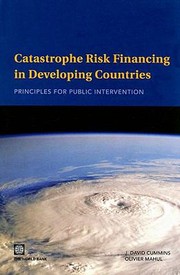
Catastrophe Risk Financing in Developing Cou

Catastrophe Risk Financing in Developing Countries

J. David Cummins, Olivier Mahul
2008
T4 Open Librarygoodreads

World Bank study of sovereign catastrophe risk transfer.

Summary

The reference has not verified this book in detail; the summary states only what the title, author and subject establish.

Cummins and Mahul wrote this for the World Bank as an analysis of how developing countries can finance the cost of natural disasters. The reference has not verified the detailed contents.

The problem the volume addresses is specific. Developing countries face disproportionate exposure to natural catastrophe, have limited fiscal capacity to absorb the cost, have thin or absent domestic insurance markets, and typically finance disasters after the event through budget reallocation, borrowing and donor assistance, all of which arrive slowly and at uncertain amounts.

The analytical framework distinguishes risk layers by frequency and severity. High-frequency low-severity losses are best retained and financed from reserves or contingent budget lines. Medium layers can be transferred to insurance and reinsurance markets. The highest-severity lowest-frequency layer, where the cost exceeds what insurance markets will absorb at acceptable prices, may require capital market instruments or sovereign arrangements.

The instruments covered include contingent credit lines drawn on when a defined event occurs; sovereign catastrophe insurance and regional risk pools, of which the Caribbean Catastrophe Risk Insurance Facility was the first and is the standard example; parametric insurance triggering on measured physical parameters, which pays quickly but carries basis risk; catastrophe bonds; and the development of domestic property insurance markets, which requires legal, regulatory and actuarial infrastructure that frequently does not exist.

Since 2009 the field has expanded, with the Pacific and African regional pools established, with parametric agricultural insurance programmes at scale in several countries, and with substantial evidence accumulated on take-up rates and basis risk. Readers should verify current programme design and evidence.

Key takeaways 7

  1. Developing countries typically finance disasters after the event through budget reallocation and donor assistance, which arrive slowly and uncertainly.
  2. Risk should be layered by frequency and severity, with frequent small losses retained and rare large losses transferred.
  3. Contingent credit lines provide immediate liquidity after a defined event without requiring a claims assessment.
  4. Regional risk pools let small countries diversify exposures that none could insure individually at acceptable cost.
  5. Parametric insurance pays quickly on measured physical parameters but carries basis risk between the trigger and the actual loss.
  6. Domestic property insurance markets require legal, regulatory and actuarial infrastructure that frequently does not exist.
  7. Financing arranged before a disaster costs less and arrives faster than financing arranged after one.

Who should read it

Practitioners in disaster risk finance and development who need the layering framework and instrument options, verified against current programmes.

Similar books 6

Chosen by shared topics, the entries that hold them, and the people who recommended both.

Ronen Palan, Richard Murphy, Christian Chavagneux · 2010

The academic account of what havens do and how they compete.
Michael Pettis · 2001

Emerging-market crises come from the structure of national balance sheets.

Alex Krutov · 2010

Covers cat bond pricing and the investor case for the asset.
Pauline Barrieu, Luca Albertini · 2009

The closest thing to a cat bond reference; several chapters on structure and triggers.
Ha-Joon Chang · 2007

Rich countries urge poor ones to adopt the opposite of the policies they once used.

Where it sits in the reference 1

Assets

Topics

Finance and MarketsEconomicsPolitics and GovernmentGlobalisation, development and offshore money