Updates

  1. Person pages list letters, writing, profiles and links as sortable tables with filters, and show each person's companies as links; Fund letters show each letter's description in its own column.
  2. Experts show a checked job title and a short description of each person; 30 more people have photographs.
  3. Every company, fund, university and publication the experts work for has a page listing the people there.
  4. Fund letters show each letter's thesis and filter by it; 225 person pages list the essays, columns and newsletter issues the person wrote.
  5. Person pages list every essay and newsletter issue a person wrote, and their own books as a table in List view.
  6. Recommends shows the five largest kinds of book and the rest under More; browse pictures load sooner.
  7. Podcasts and talks link the original episode, filter by Audio and video or Press, and list each publisher once.
  8. Pages are wider, Recommends has List and Grid, and a filter clicked again turns off.
  9. Book cards sit in a ruled grid with Open Library and Goodreads links and each book's one-line note.
  10. Funds is now Investors; each investor's styles are buttons that filter the table.
  11. Podcasts and talks on a person's page filter by year and publisher and show as a list or a grid of pictures.
  12. Quotes show only people's own words: 472 summaries written by list sites are gone.
  13. Country pages open from Browse again, and every link on the shelf lands on a page.
  14. Subject and person pages show their sections as tabs, and each book appears once on a person's page.
  15. Book cards show the quote, who said it and the source; grids show five cards to a row.
  16. On a phone, a menu holds the sections, search, Updates, Feedback and dark mode.
  17. Feedback takes a screenshot of the page with no browser prompt, opens a screenshot full size when you click it, and clears itself once sent.
  18. Book cards are centred, search names the topic each book sits in, and any text cut short shows whole on hover.
  19. Search groups its results by kind: people, companies, geographies, subjects, topics, books, funds, fund letters and papers.
  20. The Books table lists who recommended each book by name, and the browser tab names the section you are in.
  21. Feedback can take a screenshot of the page, or one you paste or choose, and opens in the corner beside Updates.
  22. Each rail button reopens its section where you left it, and Browse, Table and People show on every book and subject page.
  23. Filters grey out choices that hold nothing instead of hiding them, and Books › People filters by authors or recommenders.
  24. Feedback takes a subject line and up to three screenshots.
  25. Biographies are grouped by the person they are about: 41 new pages, from Abraham Lincoln to Lee Kuan Yew.
  26. Sport splits into 23 sports, and Religion into one topic per faith.
  27. Book lists show as cards: the cover, one recommendation quote and every recommender by name.
  28. Seventeen subjects that had two or three pages under different names now have one page each.
  29. Every page lists its Experts as authors and recommenders, with a link to them on the Experts tab.
  30. Economics, Financial history, Financial panics and Accounting are subjects of their own, with one page per financial crisis.
  31. Book, person and subject pages open inside the app, so the tabs stay in view.
  32. 996 more book covers, and photographs or logos for 227 more people and companies.
  33. Books › Browse shows every subject as cards, and the rail holds Fund letters, Papers, Experts, Books and Funds.
  34. Every topic over 150 books splits into narrower topics, each with a page of its own.

Send feedback

What is it?
Screenshots, up to 3 (optional)
or paste one with Ctrl+V

We use your email only to reply to you.

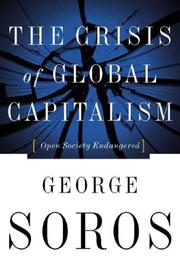
The Crisis of Global Capitalism

The Crisis of Global Capitalism

George Soros
1998
T3 245 pages · about 4h 5m to read Open Librarygoodreads

Summary

Soros wrote this immediately after the 1997 Asian and 1998 Russian crises, arguing that global financial markets are inherently unstable and that the international system had no adequate mechanism for managing them.

The theoretical foundation is his concept of reflexivity, which he had set out in The Alchemy of Finance. Participants in a market form views about it, act on those views, and their actions change the situation they were assessing, so there is a two-way connection between thinking and reality rather than the one-way relationship assumed by equilibrium theory. Prices therefore do not converge to a value determined independently of them, and self-reinforcing processes can run a long way before reversing.

His policy argument is that the international financial architecture was asymmetric: capital flowed to emerging economies during booms and withdrew during crises, the IMF's interventions protected creditors while imposing adjustment on debtors, and there was no lender of last resort or deposit insurance at the international level. He proposed international credit insurance and other mechanisms.

The wider political argument attacks what he calls market fundamentalism, the belief that markets tend toward equilibrium and that social outcomes should be left to them, and argues it is as dangerous to open society as the ideologies it replaced.

The book was written quickly and shows it. The reflexivity concept is presented more philosophically than usefully, and economists have generally found it too loose to be operational. Its forecast of imminent global collapse did not occur in 1998, though the mechanisms Soros identified operated in 2008.

Key takeaways 7

  1. Market participants act on views that change the situation they were assessing, which means prices and fundamentals influence each other in both directions.
  2. Self-reinforcing processes between perception and reality can run far from any equilibrium before reversing, and the reversal is what produces crises.
  3. Financial markets do not tend toward equilibrium, which makes the assumption underlying most policy and regulation incorrect.
  4. Capital flows to emerging economies during booms and withdraws during crises, which amplifies rather than smooths the cycle.
  5. The international financial system lacked any lender of last resort or deposit insurance, so crises had no mechanism for containment.
  6. IMF interventions protected creditors while imposing adjustment costs on debtor populations, which is a distributional choice presented as a technical necessity.
  7. Belief that markets should determine all social outcomes is an ideology rather than a finding, and Soros treats it as a threat to open society.

Who should read it

Investors interested in reflexivity as a market theory and in a contemporaneous critique of the international financial architecture after the 1997 crises.

About George Soros

Founder, Soros Fund Management and the Quantum Fund; founder, Open Society Foundations

The Alchemy of Finance introduced reflexivity, a primary-source framework macro traders and academics still build on.

Soros Fund Management, Open Society Foundations

Similar books 6

Chosen by shared topics, the entries that hold them, and the people who recommended both.
Charles P. Kindleberger · 1996

Financial crises follow a repeated sequence of boom, mania, panic and crash.

Recommended by: Howard Marks, Li Lu
George Soros · 1987

Reflexivity, where beliefs move prices and prices move facts, tested in a live diary.

“The Alchemy joins Reminiscences of a Stock Operator as a timeless instructional guide to the marketplace.” — Paul Tudor Jones

Source: Tudor Jones pairing it with Reminiscences of a Stock Operator

Recommended by: Guy Spier, Paul Tudor Jones, Peter Cundill and 3 others

Raghuram G. Rajan · 2010

The 2008 crisis grew from political and economic imbalances, not just banker greed.

Where it sits in the reference 4

Investors
Mental models
Financial panics
Economics

Topics

EconomicsFinance and MarketsPolitics and GovernmentGlobalisation, development and offshore money