Updates

  1. Person pages list letters, writing, profiles and links as sortable tables with filters, and show each person's companies as links; Fund letters show each letter's description in its own column.
  2. Experts show a checked job title and a short description of each person; 30 more people have photographs.
  3. Every company, fund, university and publication the experts work for has a page listing the people there.
  4. Fund letters show each letter's thesis and filter by it; 225 person pages list the essays, columns and newsletter issues the person wrote.
  5. Person pages list every essay and newsletter issue a person wrote, and their own books as a table in List view.
  6. Recommends shows the five largest kinds of book and the rest under More; browse pictures load sooner.
  7. Podcasts and talks link the original episode, filter by Audio and video or Press, and list each publisher once.
  8. Pages are wider, Recommends has List and Grid, and a filter clicked again turns off.
  9. Book cards sit in a ruled grid with Open Library and Goodreads links and each book's one-line note.
  10. Funds is now Investors; each investor's styles are buttons that filter the table.
  11. Podcasts and talks on a person's page filter by year and publisher and show as a list or a grid of pictures.
  12. Quotes show only people's own words: 472 summaries written by list sites are gone.
  13. Country pages open from Browse again, and every link on the shelf lands on a page.
  14. Subject and person pages show their sections as tabs, and each book appears once on a person's page.
  15. Book cards show the quote, who said it and the source; grids show five cards to a row.
  16. On a phone, a menu holds the sections, search, Updates, Feedback and dark mode.
  17. Feedback takes a screenshot of the page with no browser prompt, opens a screenshot full size when you click it, and clears itself once sent.
  18. Book cards are centred, search names the topic each book sits in, and any text cut short shows whole on hover.
  19. Search groups its results by kind: people, companies, geographies, subjects, topics, books, funds, fund letters and papers.
  20. The Books table lists who recommended each book by name, and the browser tab names the section you are in.
  21. Feedback can take a screenshot of the page, or one you paste or choose, and opens in the corner beside Updates.
  22. Each rail button reopens its section where you left it, and Browse, Table and People show on every book and subject page.
  23. Filters grey out choices that hold nothing instead of hiding them, and Books › People filters by authors or recommenders.
  24. Feedback takes a subject line and up to three screenshots.
  25. Biographies are grouped by the person they are about: 41 new pages, from Abraham Lincoln to Lee Kuan Yew.
  26. Sport splits into 23 sports, and Religion into one topic per faith.
  27. Book lists show as cards: the cover, one recommendation quote and every recommender by name.
  28. Seventeen subjects that had two or three pages under different names now have one page each.
  29. Every page lists its Experts as authors and recommenders, with a link to them on the Experts tab.
  30. Economics, Financial history, Financial panics and Accounting are subjects of their own, with one page per financial crisis.
  31. Book, person and subject pages open inside the app, so the tabs stay in view.
  32. 996 more book covers, and photographs or logos for 227 more people and companies.
  33. Books › Browse shows every subject as cards, and the rail holds Fund letters, Papers, Experts, Books and Funds.
  34. Every topic over 150 books splits into narrower topics, each with a page of its own.

Send feedback

What is it?
Screenshots, up to 3 (optional)
or paste one with Ctrl+V

We use your email only to reply to you.

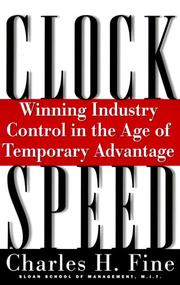
Clockspeed

Clockspeed

Charles H. Fine
1998
T2 272 pages · about 4h 32m to read Open Librarygoodreads

When to integrate and when to outsource, framed as an oscillating cycle.

Summary

Fine, an MIT operations professor, argues that industries evolve at different rates and that studying fast-evolving industries reveals dynamics that slow ones exhibit over decades. He calls the rate clockspeed and treats fast industries, particularly computing and electronics, as a laboratory for the rest.

His central structural claim is what he calls the double helix. Industries oscillate between vertical integration with proprietary architectures and horizontal disintegration with modular ones. When an industry is vertically integrated, the pressures of complexity, niche competition and organisational rigidity push toward modularity and specialised suppliers. Once horizontal and modular, suppliers of the most valuable subsystems accumulate market power, technical advances make integration attractive again, and the industry re-integrates around a new architecture. The cycle then repeats. He traces this through the computer industry's shift from IBM's integrated model to the horizontal structure of Intel, Microsoft and assemblers, and through the automotive supply base.

The practical argument is that all competitive advantage is temporary, so the durable capability is the ability to design supply chains repeatedly. Fine argues that a firm's most consequential decisions are what to make and what to buy, and that outsourcing a subsystem that later becomes the locus of value transfers the industry's profit to the supplier. He uses IBM's decisions on the personal computer's processor and operating system as the standard case, and treats three-dimensional concurrent engineering, meaning the simultaneous design of product, process and supply chain, as the operational method.

The framework is descriptive and Fine offers no way to predict when a phase will turn. The book predates the platform economy, the reintegration around cloud and mobile, and the recent semiconductor concentration, though those developments broadly fit the helix. The clockspeed metric itself is loosely defined and has not been adopted as a research construct.

Key takeaways 7

  1. Industries oscillate between vertically integrated proprietary architectures and horizontally disintegrated modular ones, and neither state is stable.
  2. Fast-moving industries reveal in years the structural dynamics that slow industries take decades to show.
  3. All competitive advantage is temporary, so the durable capability is designing supply chains repeatedly rather than holding a position.
  4. Outsourcing a subsystem that later becomes the locus of value transfers the industry's profit to the supplier permanently.
  5. Make-or-buy decisions determine industry structure and are made by firms that treat them as procurement questions.
  6. Product, process and supply chain should be designed simultaneously, because sequential design locks in choices that constrain the others.
  7. Modularity invites specialised entrants at every interface, which is why modular architectures fragment the industries that adopt them.

Who should read it

Operators and investors making outsourcing and architecture decisions who need to see how those choices determine where industry profit ends up.

Similar books 6

Chosen by shared topics, the entries that hold them, and the people who recommended both.
Michael F. Corbett · 2004

Practitioner survey of outsourcing decisions and their economics.

Yossi Sheffi · 2015

Deep-tier supply-chain risk, a decade on.
Yossi Sheffi · 2005

How firms recovered from disruptions such as 9/11 and a chip-plant fire.

Taiichi Ohno · 1988

The founder's account of just-in-time and automation with a human touch.
Jeremy Hope, Robin Fraser · 2003

Why the annual budget harms firms, and how some run without one.
Jr. George Stalk, Thomas M. Hout · 1990

Recommended by: Tim Cook

Where it sits in the reference 4

Business models
Business models
Business themes
Business themes

Topics

Business and Management