Updates

  1. Person pages list letters, writing, profiles and links as sortable tables with filters, and show each person's companies as links; Fund letters show each letter's description in its own column.
  2. Experts show a checked job title and a short description of each person; 30 more people have photographs.
  3. Every company, fund, university and publication the experts work for has a page listing the people there.
  4. Fund letters show each letter's thesis and filter by it; 225 person pages list the essays, columns and newsletter issues the person wrote.
  5. Person pages list every essay and newsletter issue a person wrote, and their own books as a table in List view.
  6. Recommends shows the five largest kinds of book and the rest under More; browse pictures load sooner.
  7. Podcasts and talks link the original episode, filter by Audio and video or Press, and list each publisher once.
  8. Pages are wider, Recommends has List and Grid, and a filter clicked again turns off.
  9. Book cards sit in a ruled grid with Open Library and Goodreads links and each book's one-line note.
  10. Funds is now Investors; each investor's styles are buttons that filter the table.
  11. Podcasts and talks on a person's page filter by year and publisher and show as a list or a grid of pictures.
  12. Quotes show only people's own words: 472 summaries written by list sites are gone.
  13. Country pages open from Browse again, and every link on the shelf lands on a page.
  14. Subject and person pages show their sections as tabs, and each book appears once on a person's page.
  15. Book cards show the quote, who said it and the source; grids show five cards to a row.
  16. On a phone, a menu holds the sections, search, Updates, Feedback and dark mode.
  17. Feedback takes a screenshot of the page with no browser prompt, opens a screenshot full size when you click it, and clears itself once sent.
  18. Book cards are centred, search names the topic each book sits in, and any text cut short shows whole on hover.
  19. Search groups its results by kind: people, companies, geographies, subjects, topics, books, funds, fund letters and papers.
  20. The Books table lists who recommended each book by name, and the browser tab names the section you are in.
  21. Feedback can take a screenshot of the page, or one you paste or choose, and opens in the corner beside Updates.
  22. Each rail button reopens its section where you left it, and Browse, Table and People show on every book and subject page.
  23. Filters grey out choices that hold nothing instead of hiding them, and Books › People filters by authors or recommenders.
  24. Feedback takes a subject line and up to three screenshots.
  25. Biographies are grouped by the person they are about: 41 new pages, from Abraham Lincoln to Lee Kuan Yew.
  26. Sport splits into 23 sports, and Religion into one topic per faith.
  27. Book lists show as cards: the cover, one recommendation quote and every recommender by name.
  28. Seventeen subjects that had two or three pages under different names now have one page each.
  29. Every page lists its Experts as authors and recommenders, with a link to them on the Experts tab.
  30. Economics, Financial history, Financial panics and Accounting are subjects of their own, with one page per financial crisis.
  31. Book, person and subject pages open inside the app, so the tabs stay in view.
  32. 996 more book covers, and photographs or logos for 227 more people and companies.
  33. Books › Browse shows every subject as cards, and the rail holds Fund letters, Papers, Experts, Books and Funds.
  34. Every topic over 150 books splits into narrower topics, each with a page of its own.

Send feedback

What is it?
Screenshots, up to 3 (optional)
or paste one with Ctrl+V

We use your email only to reply to you.

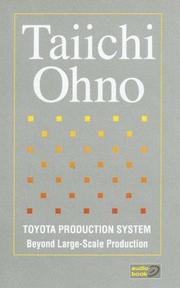
Toyota Production System: Beyond Large-Scale

Toyota Production System: Beyond Large-Scale Production

Taiichi Ohno
1988
T1 176 pages · about 2h 56m to read Open Librarygoodreads

Insider account: the system's architect explains it himself.

Summary

Ohno developed the Toyota Production System over decades as a Toyota executive and wrote this short book as a first-hand account of what he built and why. It is the primary source for the ideas that later became lean manufacturing.

The system rests on two pillars. Just-in-time means producing only what is needed, when it is needed, in the quantity needed, coordinated by the kanban signal that pulls production from downstream rather than pushing it from a schedule. Jidoka, which Ohno translates as automation with a human touch, means a machine or a line stops automatically when a defect occurs, so that problems are surfaced immediately rather than passed downstream and so that one worker can supervise several machines.

Ohno is explicit that the purpose is the elimination of waste, and he defines seven types: overproduction, waiting, transport, over-processing, inventory, motion and defects. Overproduction is the worst because it conceals every other waste. He also states the five whys method for root cause analysis, and he is clear that reducing inventory is valuable because it removes the buffer that hides problems, not because inventory itself is expensive.

The book is short, discursive and occasionally repetitive, and it assumes a manufacturing context. Ohno's account of his own reasoning includes the influence of American supermarkets on the pull concept and of Ford's flow ideas. Readers should note that the system took Toyota roughly thirty years to build and that most attempts to copy it have installed the visible tools without the problem-solving discipline that the tools exist to enable.

Key takeaways 7

  1. Production should be pulled by actual downstream demand through kanban signals rather than pushed by a forecast-driven schedule.
  2. Overproduction is the worst of the seven wastes because it generates inventory that conceals every other problem in the system.
  3. A machine or line should stop automatically when a defect occurs, so the problem is confronted immediately rather than passed downstream.
  4. Stopping the line for a defect reduces total downtime, because problems that are fixed at their source do not recur.
  5. Reducing inventory is valuable primarily because it removes the buffer that hides problems, not because holding inventory is expensive.
  6. Asking why five times reaches the root cause of a problem, and stopping earlier produces countermeasures against symptoms.
  7. The system took decades to build through continuous small improvements, and it cannot be installed as a set of tools.

Who should read it

Operators who want the Toyota system from its architect, including the reasoning behind pull scheduling, stopping the line and waste elimination.

Similar books 6

Chosen by shared topics, the entries that hold them, and the people who recommended both.

Emi Osono, Norihiko Shimizu, Hirotaka Takeuchi · 2008

Argues Toyota runs on deliberate internal contradictions.
James P. Womack, Daniel T. Jones, Daniel Roos · 1990

An MIT study of car plants worldwide that showed why Japanese lean production won.
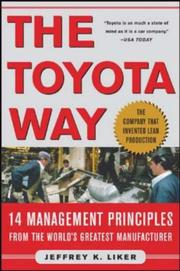
Jeffrey K. Liker · 2004

Toyota's management system as fourteen principles in four groups.

Jeffrey K. Liker, Timothy N. Ogden · 2011

The recall crisis and tsunami tested against the lean model.

Charles H. Fine · 1998

Fast-moving industries reveal supply-chain dynamics slow ones take decades to show.

Taiichi Ohno · 1988

Insider account: Ohno's shorter, blunter shop-floor essays.

Where it sits in the reference 4

Companies
Business models
Business themes
Business themes

Topics

Business and ManagementCompany Histories