Updates

  1. Person pages list letters, writing, profiles and links as sortable tables with filters, and show each person's companies as links; Fund letters show each letter's description in its own column.
  2. Experts show a checked job title and a short description of each person; 30 more people have photographs.
  3. Every company, fund, university and publication the experts work for has a page listing the people there.
  4. Fund letters show each letter's thesis and filter by it; 225 person pages list the essays, columns and newsletter issues the person wrote.
  5. Person pages list every essay and newsletter issue a person wrote, and their own books as a table in List view.
  6. Recommends shows the five largest kinds of book and the rest under More; browse pictures load sooner.
  7. Podcasts and talks link the original episode, filter by Audio and video or Press, and list each publisher once.
  8. Pages are wider, Recommends has List and Grid, and a filter clicked again turns off.
  9. Book cards sit in a ruled grid with Open Library and Goodreads links and each book's one-line note.
  10. Funds is now Investors; each investor's styles are buttons that filter the table.
  11. Podcasts and talks on a person's page filter by year and publisher and show as a list or a grid of pictures.
  12. Quotes show only people's own words: 472 summaries written by list sites are gone.
  13. Country pages open from Browse again, and every link on the shelf lands on a page.
  14. Subject and person pages show their sections as tabs, and each book appears once on a person's page.
  15. Book cards show the quote, who said it and the source; grids show five cards to a row.
  16. On a phone, a menu holds the sections, search, Updates, Feedback and dark mode.
  17. Feedback takes a screenshot of the page with no browser prompt, opens a screenshot full size when you click it, and clears itself once sent.
  18. Book cards are centred, search names the topic each book sits in, and any text cut short shows whole on hover.
  19. Search groups its results by kind: people, companies, geographies, subjects, topics, books, funds, fund letters and papers.
  20. The Books table lists who recommended each book by name, and the browser tab names the section you are in.
  21. Feedback can take a screenshot of the page, or one you paste or choose, and opens in the corner beside Updates.
  22. Each rail button reopens its section where you left it, and Browse, Table and People show on every book and subject page.
  23. Filters grey out choices that hold nothing instead of hiding them, and Books › People filters by authors or recommenders.
  24. Feedback takes a subject line and up to three screenshots.
  25. Biographies are grouped by the person they are about: 41 new pages, from Abraham Lincoln to Lee Kuan Yew.
  26. Sport splits into 23 sports, and Religion into one topic per faith.
  27. Book lists show as cards: the cover, one recommendation quote and every recommender by name.
  28. Seventeen subjects that had two or three pages under different names now have one page each.
  29. Every page lists its Experts as authors and recommenders, with a link to them on the Experts tab.
  30. Economics, Financial history, Financial panics and Accounting are subjects of their own, with one page per financial crisis.
  31. Book, person and subject pages open inside the app, so the tabs stay in view.
  32. 996 more book covers, and photographs or logos for 227 more people and companies.
  33. Books › Browse shows every subject as cards, and the rail holds Fund letters, Papers, Experts, Books and Funds.
  34. Every topic over 150 books splits into narrower topics, each with a page of its own.

Send feedback

What is it?
Screenshots, up to 3 (optional)
or paste one with Ctrl+V

We use your email only to reply to you.

Taiichi Ohno's Workplace Management

Taiichi Ohno's Workplace Management

Taiichi Ohno
1988
T3 155 pages · about 2h 35m to read Open Librarygoodreads

Insider account: Ohno's shorter, blunter shop-floor essays.

Summary

Taiichi Ohno created the Toyota Production System, and this book collects his own statements about it in a form closer to spoken instruction than to a treatise. The English translation appeared decades after the Japanese original and reads as a series of short chapters, each making one point.

Ohno's positions are frequently uncomfortable. He insists that managers must observe the work directly and at length, and describes making engineers stand in a circle on the shop floor for hours until they saw what was actually happening. He argues that averages conceal everything that matters, that data should be distrusted in favour of facts observed personally, and that the words of the person doing the work are more reliable than any report. He explains asking why five times to reach the cause of a problem rather than its symptom, and gives the worked example of a machine failure traced back to a missing filter.

On the production system itself he covers standard work as the baseline against which improvement is measured rather than as a fixed procedure, the deliberate creation of problems by reducing inventory so that they become visible, the andon cord that lets any worker stop the line, and the reversal of conventional thinking about production quantity. He is explicit that the system exists to reduce cost by eliminating waste, and that everything else follows. The book is short and repetitive and the translation is uneven. It is the primary source for ideas that most lean literature restates.

Key takeaways 7

  1. Managers must observe the work directly and at length, because reports and data conceal what is actually happening.
  2. Asking why five times reaches the cause of a problem, and stopping earlier addresses a symptom.
  3. Averages conceal the variation that causes problems, so working from averaged data prevents improvement.
  4. Standard work is the current best-known method and the baseline against which improvement is measured, not a fixed procedure.
  5. Reducing inventory deliberately makes problems visible that inventory had been concealing.
  6. Any worker must be able to stop the production line, because a defect passed downstream costs more than the stoppage.
  7. Ohno argues that the purpose of the entire system is cost reduction through the elimination of waste, and that other framings miss the point.

Who should read it

Operators implementing lean methods who want the founder's own uncompromising statements rather than the consultant literature derived from them.

Similar books 6

Chosen by shared topics, the entries that hold them, and the people who recommended both.

Emi Osono, Norihiko Shimizu, Hirotaka Takeuchi · 2008

Argues Toyota runs on deliberate internal contradictions.
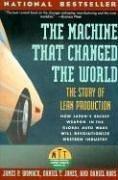
James P. Womack, Daniel T. Jones, Daniel Roos · 1990

An MIT study of car plants worldwide that showed why Japanese lean production won.
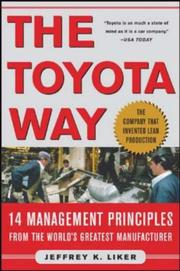
Jeffrey K. Liker · 2004

Toyota's management system as fourteen principles in four groups.
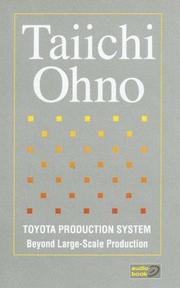
Taiichi Ohno · 1988

The founder's account of just-in-time and automation with a human touch.

Jeffrey K. Liker, Timothy N. Ogden · 2011

The recall crisis and tsunami tested against the lean model.
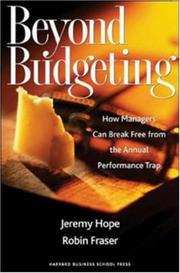
Jeremy Hope, Robin Fraser · 2003

Why the annual budget harms firms, and how some run without one.

Where it sits in the reference 3

Companies
Business themes
Business themes

Topics

Business and Management