Updates

  1. Person pages list letters, writing, profiles and links as sortable tables with filters, and show each person's companies as links; Fund letters show each letter's description in its own column.
  2. Experts show a checked job title and a short description of each person; 30 more people have photographs.
  3. Every company, fund, university and publication the experts work for has a page listing the people there.
  4. Fund letters show each letter's thesis and filter by it; 225 person pages list the essays, columns and newsletter issues the person wrote.
  5. Person pages list every essay and newsletter issue a person wrote, and their own books as a table in List view.
  6. Recommends shows the five largest kinds of book and the rest under More; browse pictures load sooner.
  7. Podcasts and talks link the original episode, filter by Audio and video or Press, and list each publisher once.
  8. Pages are wider, Recommends has List and Grid, and a filter clicked again turns off.
  9. Book cards sit in a ruled grid with Open Library and Goodreads links and each book's one-line note.
  10. Funds is now Investors; each investor's styles are buttons that filter the table.
  11. Podcasts and talks on a person's page filter by year and publisher and show as a list or a grid of pictures.
  12. Quotes show only people's own words: 472 summaries written by list sites are gone.
  13. Country pages open from Browse again, and every link on the shelf lands on a page.
  14. Subject and person pages show their sections as tabs, and each book appears once on a person's page.
  15. Book cards show the quote, who said it and the source; grids show five cards to a row.
  16. On a phone, a menu holds the sections, search, Updates, Feedback and dark mode.
  17. Feedback takes a screenshot of the page with no browser prompt, opens a screenshot full size when you click it, and clears itself once sent.
  18. Book cards are centred, search names the topic each book sits in, and any text cut short shows whole on hover.
  19. Search groups its results by kind: people, companies, geographies, subjects, topics, books, funds, fund letters and papers.
  20. The Books table lists who recommended each book by name, and the browser tab names the section you are in.
  21. Feedback can take a screenshot of the page, or one you paste or choose, and opens in the corner beside Updates.
  22. Each rail button reopens its section where you left it, and Browse, Table and People show on every book and subject page.
  23. Filters grey out choices that hold nothing instead of hiding them, and Books › People filters by authors or recommenders.
  24. Feedback takes a subject line and up to three screenshots.
  25. Biographies are grouped by the person they are about: 41 new pages, from Abraham Lincoln to Lee Kuan Yew.
  26. Sport splits into 23 sports, and Religion into one topic per faith.
  27. Book lists show as cards: the cover, one recommendation quote and every recommender by name.
  28. Seventeen subjects that had two or three pages under different names now have one page each.
  29. Every page lists its Experts as authors and recommenders, with a link to them on the Experts tab.
  30. Economics, Financial history, Financial panics and Accounting are subjects of their own, with one page per financial crisis.
  31. Book, person and subject pages open inside the app, so the tabs stay in view.
  32. 996 more book covers, and photographs or logos for 227 more people and companies.
  33. Books › Browse shows every subject as cards, and the rail holds Fund letters, Papers, Experts, Books and Funds.
  34. Every topic over 150 books splits into narrower topics, each with a page of its own.

Send feedback

What is it?
Screenshots, up to 3 (optional)
or paste one with Ctrl+V

We use your email only to reply to you.

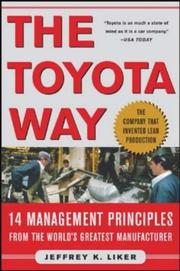
The Toyota Way

The Toyota Way

Jeffrey K. Liker
2004
T2 340 pages · about 5h 40m to read Open Librarygoodreads

The most widely used codification of Toyota's management principles.

Summary

Liker, an engineering professor who studied Toyota for two decades, sets out the company's management system as fourteen principles grouped into four categories: long-term philosophy, the right process producing the right results, developing people and partners, and continuously solving root problems to drive learning.

The process principles restate and extend the production system: create continuous flow to bring problems to the surface, use pull systems to avoid overproduction, level the workload rather than responding to demand variation directly, build a culture of stopping to fix problems, standardise tasks as the foundation for improvement, use visual control so no problem is hidden, and use only reliable thoroughly tested technology.

The distinctive material relative to Ohno's own book is the emphasis on people and on the philosophical layer. Liker argues that leaders must be grown from within because the system depends on knowledge that cannot be transferred quickly, that suppliers should be challenged and helped to improve rather than squeezed on price, that decisions should be made slowly by consensus considering all options and implemented rapidly, and that management must go and see the actual situation directly rather than working from reports.

His argument about why copying Toyota fails is the most useful part: companies adopt the visible tools without the underlying philosophy, the long-horizon commitment and the people development, and the tools then produce nothing.

The book is long and repetitive and the case examples are from the period before Toyota's 2009 and 2010 recall crisis, which complicated the account of the company's quality system.

Key takeaways 7

  1. Levelling workload so that production runs at a steady rate is a precondition for the rest of the system, because variation makes standardisation impossible.
  2. Continuous flow forces problems to the surface immediately, which is the point of it rather than a side effect.
  3. Standardised work is the foundation for improvement rather than a constraint on it, since a process that varies cannot be improved measurably.
  4. Managers must observe the actual situation directly rather than working from reports, because the information that matters does not survive summarisation.
  5. Decisions should be made slowly by consensus considering all alternatives and then implemented rapidly, which is the reverse of the usual pattern.
  6. Suppliers should be challenged and helped to improve rather than squeezed on price, since their capability determines what the manufacturer can build.
  7. Companies fail to copy Toyota because they adopt the visible tools without the long-horizon commitment and people development that make the tools function.

Who should read it

Operators attempting to implement lean or continuous improvement who need the philosophical and people components alongside the tools.

Similar books 6

Chosen by shared topics, the entries that hold them, and the people who recommended both.

Emi Osono, Norihiko Shimizu, Hirotaka Takeuchi · 2008

Argues Toyota runs on deliberate internal contradictions.
James P. Womack, Daniel T. Jones, Daniel Roos · 1990

An MIT study of car plants worldwide that showed why Japanese lean production won.
Taiichi Ohno · 1988

The founder's account of just-in-time and automation with a human touch.
Jeffrey K. Liker, Timothy N. Ogden · 2011

The recall crisis and tsunami tested against the lean model.

Taiichi Ohno · 1988

Insider account: Ohno's shorter, blunter shop-floor essays.
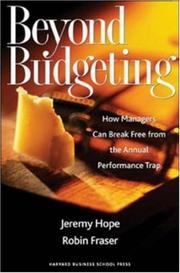
Jeremy Hope, Robin Fraser · 2003

Why the annual budget harms firms, and how some run without one.

Where it sits in the reference 3

Companies
Business themes
Business themes

Topics

Business and ManagementCompany Histories