Updates

  1. Person pages list letters, writing, profiles and links as sortable tables with filters, and show each person's companies as links; Fund letters show each letter's description in its own column.
  2. Experts show a checked job title and a short description of each person; 30 more people have photographs.
  3. Every company, fund, university and publication the experts work for has a page listing the people there.
  4. Fund letters show each letter's thesis and filter by it; 225 person pages list the essays, columns and newsletter issues the person wrote.
  5. Person pages list every essay and newsletter issue a person wrote, and their own books as a table in List view.
  6. Recommends shows the five largest kinds of book and the rest under More; browse pictures load sooner.
  7. Podcasts and talks link the original episode, filter by Audio and video or Press, and list each publisher once.
  8. Pages are wider, Recommends has List and Grid, and a filter clicked again turns off.
  9. Book cards sit in a ruled grid with Open Library and Goodreads links and each book's one-line note.
  10. Funds is now Investors; each investor's styles are buttons that filter the table.
  11. Podcasts and talks on a person's page filter by year and publisher and show as a list or a grid of pictures.
  12. Quotes show only people's own words: 472 summaries written by list sites are gone.
  13. Country pages open from Browse again, and every link on the shelf lands on a page.
  14. Subject and person pages show their sections as tabs, and each book appears once on a person's page.
  15. Book cards show the quote, who said it and the source; grids show five cards to a row.
  16. On a phone, a menu holds the sections, search, Updates, Feedback and dark mode.
  17. Feedback takes a screenshot of the page with no browser prompt, opens a screenshot full size when you click it, and clears itself once sent.
  18. Book cards are centred, search names the topic each book sits in, and any text cut short shows whole on hover.
  19. Search groups its results by kind: people, companies, geographies, subjects, topics, books, funds, fund letters and papers.
  20. The Books table lists who recommended each book by name, and the browser tab names the section you are in.
  21. Feedback can take a screenshot of the page, or one you paste or choose, and opens in the corner beside Updates.
  22. Each rail button reopens its section where you left it, and Browse, Table and People show on every book and subject page.
  23. Filters grey out choices that hold nothing instead of hiding them, and Books › People filters by authors or recommenders.
  24. Feedback takes a subject line and up to three screenshots.
  25. Biographies are grouped by the person they are about: 41 new pages, from Abraham Lincoln to Lee Kuan Yew.
  26. Sport splits into 23 sports, and Religion into one topic per faith.
  27. Book lists show as cards: the cover, one recommendation quote and every recommender by name.
  28. Seventeen subjects that had two or three pages under different names now have one page each.
  29. Every page lists its Experts as authors and recommenders, with a link to them on the Experts tab.
  30. Economics, Financial history, Financial panics and Accounting are subjects of their own, with one page per financial crisis.
  31. Book, person and subject pages open inside the app, so the tabs stay in view.
  32. 996 more book covers, and photographs or logos for 227 more people and companies.
  33. Books › Browse shows every subject as cards, and the rail holds Fund letters, Papers, Experts, Books and Funds.
  34. Every topic over 150 books splits into narrower topics, each with a page of its own.

Send feedback

What is it?
Screenshots, up to 3 (optional)
or paste one with Ctrl+V

We use your email only to reply to you.

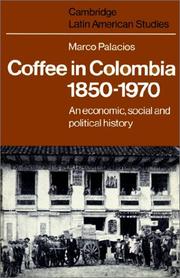
Coffee in Colombia, 1850-1970

Coffee in Colombia, 1850-1970

Marco Palacios
1980
T3 356 pages · about 5h 56m to read Open Librarygoodreads

Economic history of the crop, the growers' federation and the export institutions built around it.

Summary

The reference has not verified this book in detail; the summary states only what the title, author and subject establish.

Palacios, a Colombian historian, wrote an economic and social history of coffee in Colombia from the mid-nineteenth century to 1970. The reference has not verified the book's detailed contents.

The subject matters because Colombian coffee developed differently from other Latin American export economies. In much of the region, export agriculture concentrated land in large estates worked by dependent labour. In Colombia, coffee production came substantially from smallholders, particularly in Antioquia and Caldas, working plots they owned. The reasons for this and its consequences are the analytical questions.

The consequences examined in the literature include the effect on income distribution, which was less concentrated than in comparable export economies; the political effect, since a large class of smallholding producers has different interests and different political capacity from a landed oligarchy; the role of the National Federation of Coffee Growers, established in 1927, which represented producers, managed quality and marketing, operated a price stabilisation fund and became one of the most powerful institutions in the country; and the effect of international coffee price volatility on the Colombian economy and on public finances, given the export concentration.

Palacios also examines the relationship between coffee and the periods of political violence, including La Violencia after 1948, and the regional structure of Colombian politics.

The book is academic history and the standard reference on its subject. The international coffee agreements that governed the market when it was written collapsed in 1989, which changed the industry's structure substantially.

Key takeaways 7

  1. Colombian coffee was produced substantially by smallholders working land they owned, unlike the estate systems elsewhere in Latin America.
  2. Smallholding production produced a less concentrated income distribution than comparable export economies achieved.
  3. A large class of smallholding producers has different political interests and different organisational capacity from a landed oligarchy.
  4. The National Federation of Coffee Growers managed quality, marketing and price stabilisation and became one of the country's most powerful institutions.
  5. Export concentration in a single commodity transmitted international price volatility directly into public finances.
  6. Regional differences in how coffee was produced shaped Colombia's regional political structure.
  7. The international agreements governing coffee prices when the book was written collapsed in 1989.

Who should read it

Readers studying commodity export economies and the institutional consequences of smallholder versus estate production.

Similar books 6

Chosen by shared topics, the entries that hold them, and the people who recommended both.
R. Albert Berry · 1983

Dated but the only serious English work on Colombian manufacturing.

William Roseberry, Lowell Gudmundson, Mario Samper Kutschbach · 1995

Comparative coffee political economy; sets Colombia's growers' federation in context.

Gerardo della Paolera, Alan M. Taylor · 2003

Essays on why a rich, well-endowed Argentina stagnated for so long.

Javier Martínez, Alvaro Díaz · 1996

How the productive structure and business class were remade after 1973.

Sebastian Edwards · 1995

Latin America's reforms from the 1980s debt crisis to the mid-1990s, assessed.
Stephen Haber · 1997

Essays on why Brazil's and Mexico's economies lagged from 1800 to 1914.

Where it sits in the reference 3

Geographies
Industries
Economics

Topics

General HistoryEconomicsAsia, Africa, Latin America and the Middle East